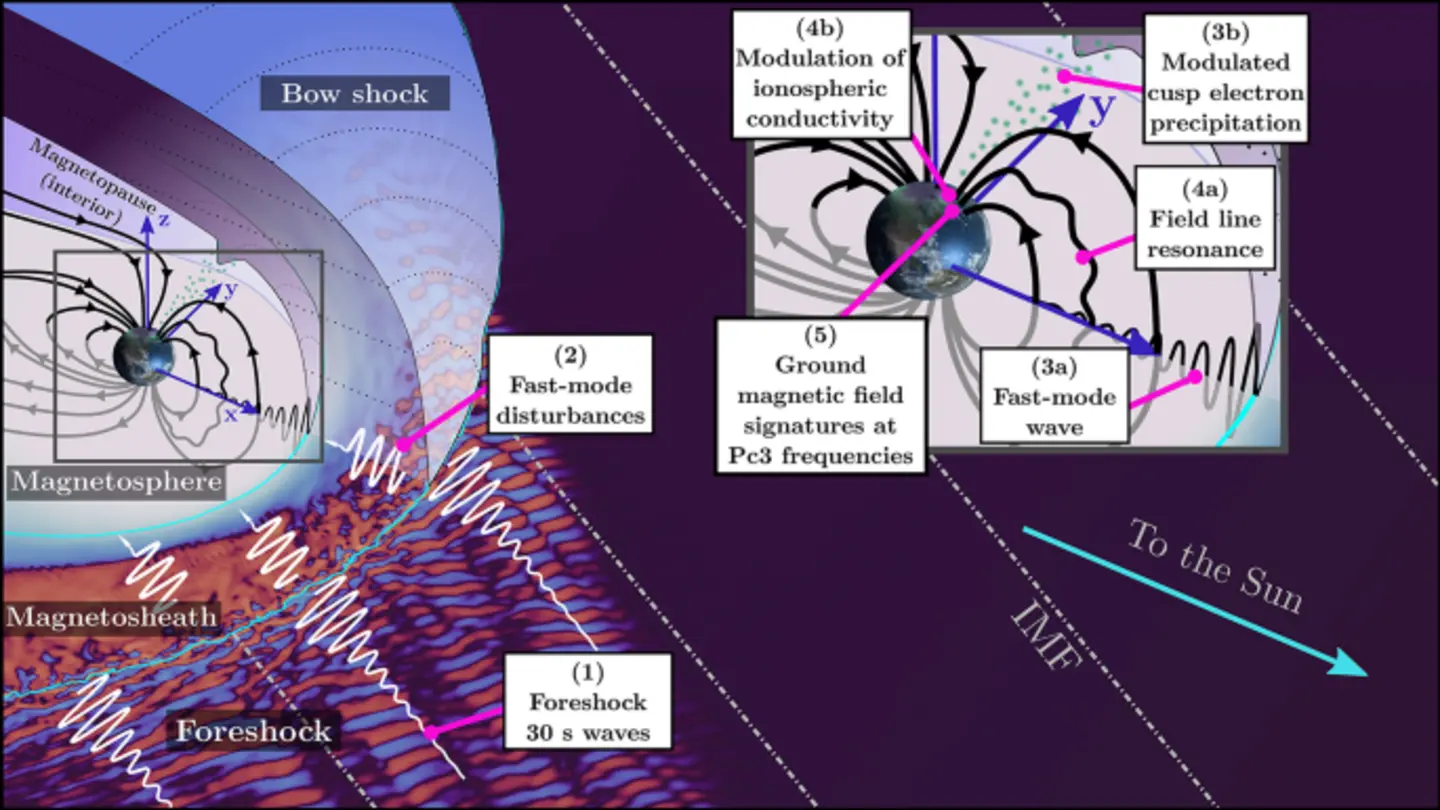
A new event study published on ESS Open Archive investigates the cyclic diffusion of proton shell distribution associated with quasi-periodic rising tone fast magnetosonic waves. The research delves into the intricate relationship between these waves and the behavior of protons in space, providing insights into the dynamics of plasma environments. Understanding these phenomena is crucial for space weather forecasting and mitigating potential risks to satellites and other space-based assets.
The study focuses on analyzing specific events where these fast magnetosonic waves exhibit a characteristic rising tone in their frequency. These waves, which propagate through plasma, can interact with protons, causing them to diffuse and redistribute within the proton shell. The researchers employed advanced data analysis techniques to examine the correlation between the wave characteristics and the resulting proton shell dynamics.
Methodology and Data Analysis
The research team utilized data from space-based instruments to observe and measure the properties of both the fast magnetosonic waves and the proton distribution. These instruments provided high-resolution measurements of the wave frequencies, amplitudes, and propagation characteristics, as well as the energy and spatial distribution of protons. By analyzing this data, the researchers were able to identify patterns and relationships between the wave activity and the proton shell diffusion.
The analysis involved sophisticated signal processing techniques to isolate the quasi-periodic rising tone features of the fast magnetosonic waves. These features were then correlated with changes in the proton shell distribution, revealing a clear link between the two phenomena. The study also considered other factors that could influence the proton dynamics, such as the ambient magnetic field and the presence of other plasma waves.
The findings indicate that the quasi-periodic rising tone fast magnetosonic waves play a significant role in driving the cyclic diffusion of the proton shell. This diffusion process can lead to the redistribution of protons in space, affecting the overall plasma environment and potentially impacting the performance of space-based systems. The study highlights the importance of further research to fully understand the complex interactions between waves and particles in space.
Implications and Future Research
The results of this event study have important implications for space weather research. By improving our understanding of the mechanisms that drive proton diffusion, we can develop more accurate models for predicting space weather events. These models can help to protect satellites and other critical infrastructure from the harmful effects of space radiation and plasma disturbances. Future research should focus on expanding the scope of this study to include a larger number of events and to investigate the role of other factors that may influence the wave-particle interactions. Additionally, the development of advanced simulation tools can help to further elucidate the underlying physics of these complex phenomena. This research contributes to a growing body of knowledge about the dynamic processes that shape the space environment and their impact on our technological infrastructure.
Image Source: Google | Image Credit: Respective Owner