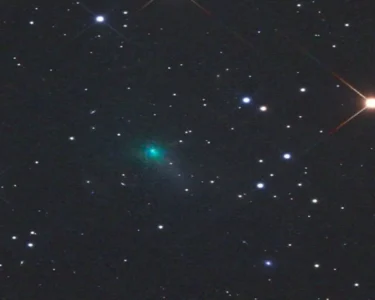
NASA has reported the unprecedented observation of interstellar comet 3I/ATLAS releasing water vapor in space, a phenomenon unlike anything astronomers have witnessed before. This discovery provides new insights into the composition and behavior of comets originating from outside our solar system. The findings, detailed in a recent study, suggest that 3I/ATLAS possesses a unique chemical makeup that differentiates it from comets formed within our solar system.
Unusual Water Vapor Emission
The research team, utilizing data from various telescopes, detected a significant amount of water vapor emanating from 3I/ATLAS as it journeyed through our inner solar system. This water release is particularly noteworthy because it occurred at a much greater distance from the Sun than typically observed in comets. Most comets begin to release water vapor only when they are closer to the Sun, as the solar heat causes their icy surfaces to sublimate. However, 3I/ATLAS exhibited this behavior much earlier, indicating a more volatile composition.
Researchers theorize that the comet’s composition includes supervolatile ices, such as carbon monoxide or nitrogen, which vaporize more easily than water ice. As these volatile ices sublimate, they can carry water molecules along with them, resulting in the observed water vapor emission at greater distances. This process suggests that 3I/ATLAS formed in a colder region of space, where these supervolatile ices could condense and become incorporated into the comet’s structure.
Implications for Comet Formation
The unique characteristics of 3I/ATLAS offer valuable clues about the conditions in planetary systems beyond our own. The presence of supervolatile ices and the unusual water vapor emission suggest that the comet originated in a protoplanetary disk with different chemical and thermal properties than the one that formed our solar system’s comets. By studying interstellar objects like 3I/ATLAS, scientists can gain a better understanding of the diversity of planetary systems and the processes that govern comet formation.
Further research is planned to analyze the chemical composition of 3I/ATLAS in more detail, using advanced spectroscopic techniques. These observations will help to identify the specific types of volatile compounds present in the comet and provide a more complete picture of its origin and evolution. The ongoing study of interstellar comets promises to revolutionize our understanding of the building blocks of planets and the distribution of matter throughout the galaxy. This remarkable discovery highlights the importance of continued exploration and observation of celestial objects, paving the way for future breakthroughs in astrophysics and planetary science.
The data collected on 3I/ATLAS will also be compared with data from other interstellar objects, such as ‘Oumuamua, to identify common characteristics and differences. This comparative analysis will help to refine our models of interstellar object formation and evolution. Ultimately, the study of these celestial wanderers will provide a broader perspective on the origins of our solar system and the potential for life beyond Earth.
Image Source: Google | Image Credit: Respective Owner