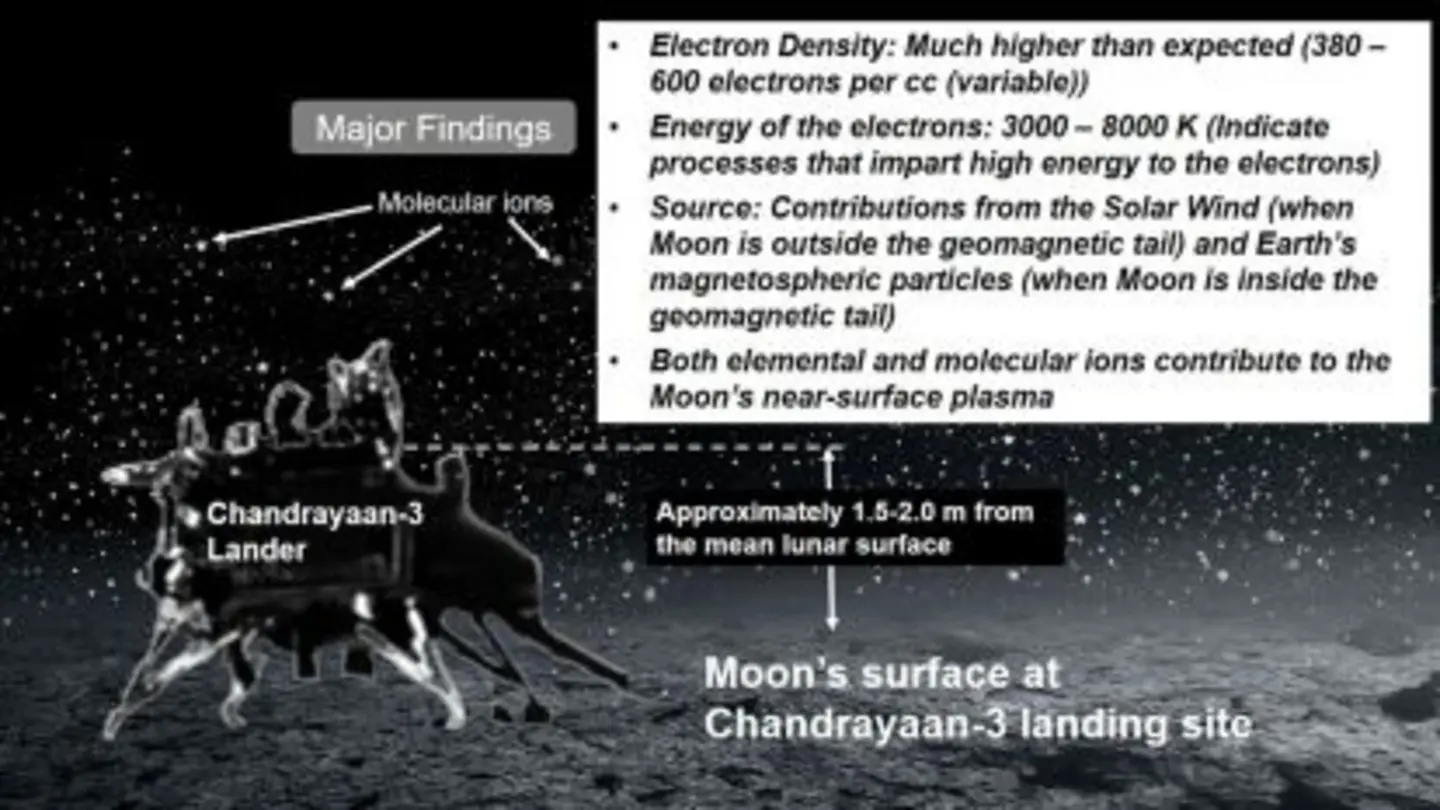
Chandrayaan-3, India’s lunar mission, has uncovered a surprising discovery: an unexpectedly active plasma environment hovering over the Moon’s south pole. Using its Langmuir Probe instrument, the spacecraft detected dense and dynamic plasma currents in the region, challenging previous assumptions about lunar atmospheric conditions.
The south pole is a prime target for future lunar exploration, including potential human bases and mining operations for resources like helium-3. Understanding plasma activity is critical because these charged particles can interfere with sensitive electronic equipment, disrupt communication systems, and affect solar power generation. The findings, published in a leading planetary science journal, provide vital data for mission planners.
Plasma, composed of ionized gas, exists throughout the solar system. On Earth, it’s found in lightning and auroras. On the Moon, however, its behavior is less studied. Chandrayaan-3’s measurements revealed fluctuations in electron density and temperature, suggesting external factors—such as solar wind interactions or lunar surface emissions—may drive the activity. Scientists aim to determine whether these variations follow lunar phases or solar cycles.
The detection comes as multiple nations prepare for crewed and robotic missions to the lunar surface. NASA’s Artemis program, China’s Chang’e series, and private ventures all prioritize the south pole for its permanently shadowed craters, believed to harbor water ice. Knowledge of plasma dynamics will help engineers design hardened instruments and shielding systems to protect against potential malfunctions or data corruption.
Researchers also speculate that plasma could influence the Moon’s exosphere—a tenuous layer of gases—by stripping away atoms or altering their distribution. Further study may reveal whether this process affects the availability of resources like oxygen or nitrogen, which future colonies might extract from lunar soil. Chandrayaan-3’s observations mark a foundational step in decoding these complex interactions.
The mission’s success underscores India’s growing role in space exploration. With Chandrayaan-3 joining NASA’s Lunar Reconnaissance Orbiter and Japan’s SLIM lander, the lunar south pole is becoming a hub of scientific inquiry. Upcoming missions, including NASA’s Artemis III, will test whether these plasma conditions pose tangible risks to astronauts and equipment—information that could reshape how humanity builds and operates on the Moon.
Image Source: Google | Image Credit: Respective Owner