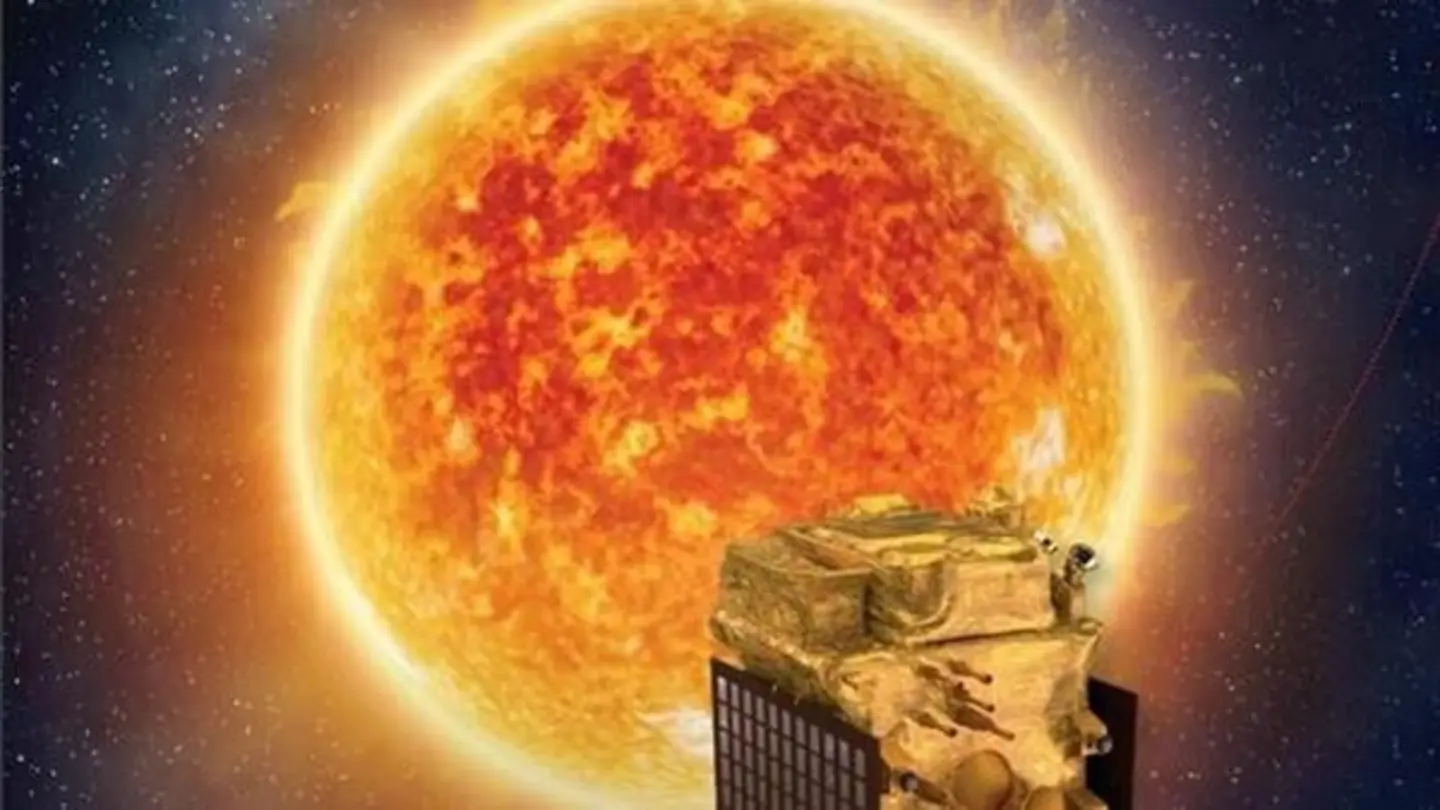
The 2024 solar storm, one of the most intense space weather events in recent history, defied scientific expectations with its unusual characteristics. India’s Aditya-L1 solar observatory, operating in a strategic halo orbit around the Sun-Earth Lagrange Point 1, has played a pivotal role in a global investigative effort to understand these anomalies.
Aditya-L1, India’s first dedicated solar mission, was launched in September 2023 to study the Sun’s photosphere, chromosphere and corona. During the March 2024 solar storm, the spacecraft’s suite of instruments including the Visible Emission Line Coronagraph (VELC) and Solar Ultraviolet Imager (SUVI) captured unprecedented high-resolution data. These observations revealed unexpected magnetic reconnection events and coronal wave dynamics that challenged existing solar storm models.
The mission operated in coordination with NASA’s Parker Solar Probe, ESA’s Solar Orbiter, and DLR’s Solar Radio Experiment. Combined data from these assets created a comprehensive 3D view of the storm’s evolution. Researchers observed that the storm’s magnetic structure exhibited ungewöhnlich rapid restructuring, with energy release patterns differing significantly from previous events.
Key findings published in Nature Astronomy show the storm involved a rare “flux rope” configuration that traveled through interplanetary space at record speeds. Aditya-L1’s coronagraph measurements helped scientists trace the structure’s trajectory and determine its interaction with Earth’s magnetosphere. The data revealed that the storm’s atypical trajectory minimized direct impact on satellites while maximizing geomagnetic effects over polar regions.
These observations have profound implications for space weather forecasting. The unusual storm behavior demonstrated limitations in current prediction models that rely primarily on solar wind monitoring. Aditya-L1’s ability to capture in-situ solar corona observations before the storm reached Earth represents a major advancement in early warning systems. The mission’s high temporal and spatial resolution data allow scientists to test new hypotheses about solar magnetic field dynamics.
The collaborative analysis also identified previously unknown particle acceleration mechanisms that could affect astronaut safety during future deep-space missions. Researchers now propose revising space weather alert protocols to incorporate corona imaging data alongside traditional solar wind measurements. As solar cycle 25 approaches its predicted maximum around 2030, these findings from Aditya-L1 provide critical insights that could protect vital infrastructure from future unpredictable solar events.
Image Source: Google | Image Credit: Respective Owner