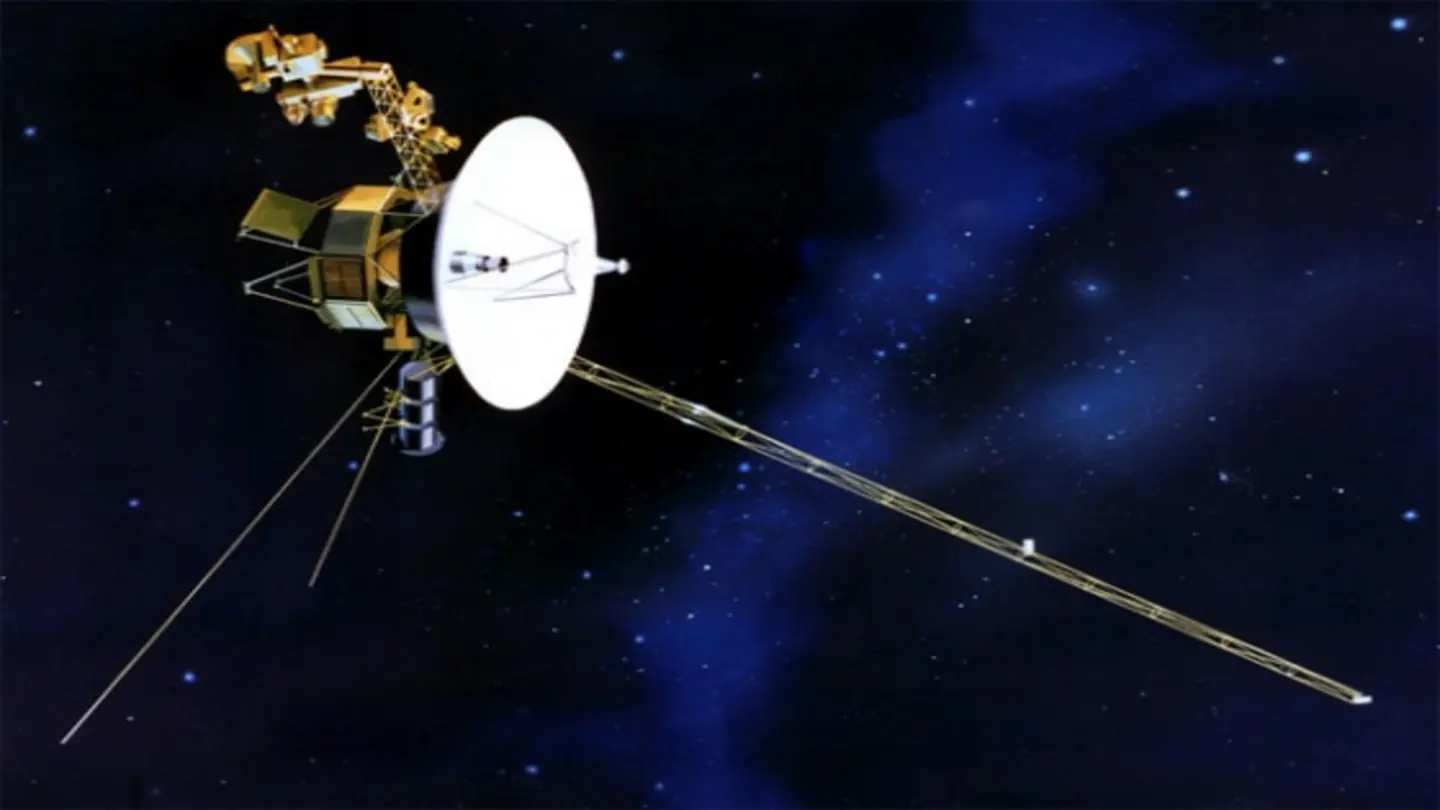
NASA’s Voyager 1 spacecraft, the farthest human-made object from Earth, is currently traveling towards a distance of one light-day from our planet. This equates to roughly 15 light-hours, or approximately 14.5 billion miles (23.3 billion kilometers). Despite this immense distance, the probe continues to send back valuable data, though with increasing challenges.
Launched in 1977, Voyager 1 famously captured the first close-up images of Jupiter and Saturn before continuing its journey into interstellar space. It crossed the heliopause – the boundary between the Sun’s influence and interstellar space – in 2012. Since then, it has been providing unprecedented insights into the conditions beyond our solar system.
Communication Challenges
The extreme distance introduces significant communication delays. It takes over 22 hours for a signal to travel from Voyager 1 to Earth, and another 22 hours for a response to return. Recently, the spacecraft began experiencing issues with its attitude articulation and control system (AACS), which controls its orientation. This led to garbled data being transmitted back to Earth.
NASA engineers discovered that the AACS was sending incorrect data about the spacecraft’s orientation to the flight computer. While Voyager 1 continued to receive and execute commands, the incorrect data meant it wasn’t fully aware of its position relative to Earth. The team managed to resolve the issue by rerouting the signal through a different hardware path, effectively bypassing the source of the error. This workaround, implemented in early April, successfully restored the AACS to full functionality.
However, the root cause of the initial problem remains under investigation. Engineers suspect a failure within one of the AACS’s chips. The fact that Voyager 1 is still operational despite such a significant hardware issue is a testament to the ingenuity of the original design and the dedication of the ongoing engineering team.
The spacecraft’s power source, a radioisotope thermoelectric generator (RTG), is also gradually declining. The RTG converts the heat from the decay of plutonium-238 into electricity. As the plutonium decays, the power output decreases, forcing engineers to carefully manage the spacecraft’s systems to conserve energy. NASA estimates that Voyager 1 will likely run out of power around 2025-2026.
Despite the looming power limitations, Voyager 1 continues to be a valuable scientific asset. It is currently measuring the density of plasma in interstellar space and providing data on cosmic rays. The data it sends back helps scientists understand the nature of the galaxy and the environment beyond our solar system. Its journey represents an extraordinary feat of engineering and a symbol of human exploration.
The ongoing success of Voyager 1, even at this extreme distance, highlights the importance of long-term space missions and the potential for continued discovery in the decades to come. The probe’s legacy will undoubtedly inspire future generations of scientists and engineers to push the boundaries of space exploration.
Image Source: Google | Image Credit: Respective Owner