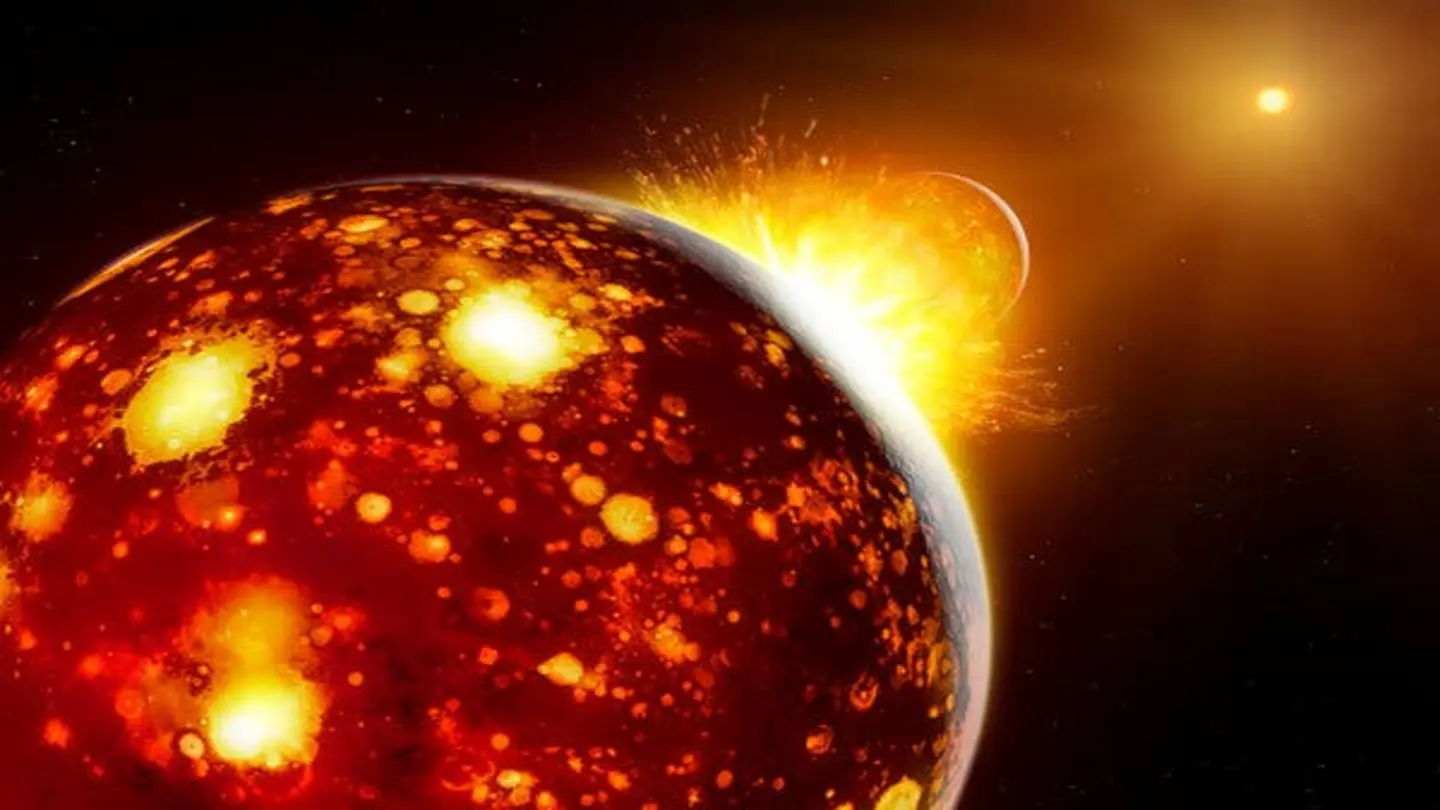
Scientists have unveiled new insights into the cataclysmic cosmic collision that birthed the Moon, suggesting that a Mars-sized protoplanet named Theia impacted early Earth, profoundly shaping the inner solar system. This groundbreaking research sheds light on the events that transpired billions of years ago, ultimately leading to the formation of our celestial companion.
The prevailing giant-impact hypothesis posits that the Moon originated from debris ejected into space following a collision between Earth and Theia. Simulations and analyses of lunar rocks have supported this theory, but many questions remained unanswered about the specifics of the impact and the composition of both Earth and Theia.
Deciphering the Impact’s Aftermath
Recent studies, leveraging advanced computational models and geochemical analyses, are providing a clearer picture of the event. Researchers are now exploring various impact scenarios, considering different angles, speeds, and sizes of Theia. These simulations aim to replicate the Moon’s current mass, orbit, and composition, while also explaining certain anomalies observed in Earth’s mantle.
One key area of investigation involves the isotopic similarities between Earth and the Moon. While initial analyses suggested that the Moon was primarily composed of Theia’s material, more recent findings indicate a greater contribution from Earth’s mantle. This challenges earlier models and suggests that the impact was far more disruptive, leading to extensive mixing of materials from both celestial bodies.
Unraveling Theia’s Identity
Scientists are also attempting to determine the origin and composition of Theia itself. Some theories propose that Theia formed in the same region of the solar system as Earth, while others suggest it originated from a more distant location. Analyzing the isotopic composition of lunar samples may provide clues about Theia’s birthplace and its relationship to other objects in the early solar system.
The impact event had a profound effect on Earth, not only leading to the formation of the Moon but also influencing the planet’s early evolution. The immense energy released during the collision likely melted Earth’s surface, creating a magma ocean that eventually cooled and solidified, forming the planet’s crust. The impact may have also contributed to the delivery of water and other volatile elements to Earth, essential for the emergence of life.
Future Research Directions
Ongoing and future research efforts are focused on obtaining more detailed data from lunar samples, conducting more sophisticated simulations, and exploring alternative impact scenarios. By combining these approaches, scientists hope to gain a deeper understanding of the Earth-Moon system’s origin and the role of giant impacts in shaping the inner solar system. The story of Theia and its collision with Earth remains a captivating chapter in the history of our planet and the cosmos.
Image Source: Google | Image Credit: Respective Owner