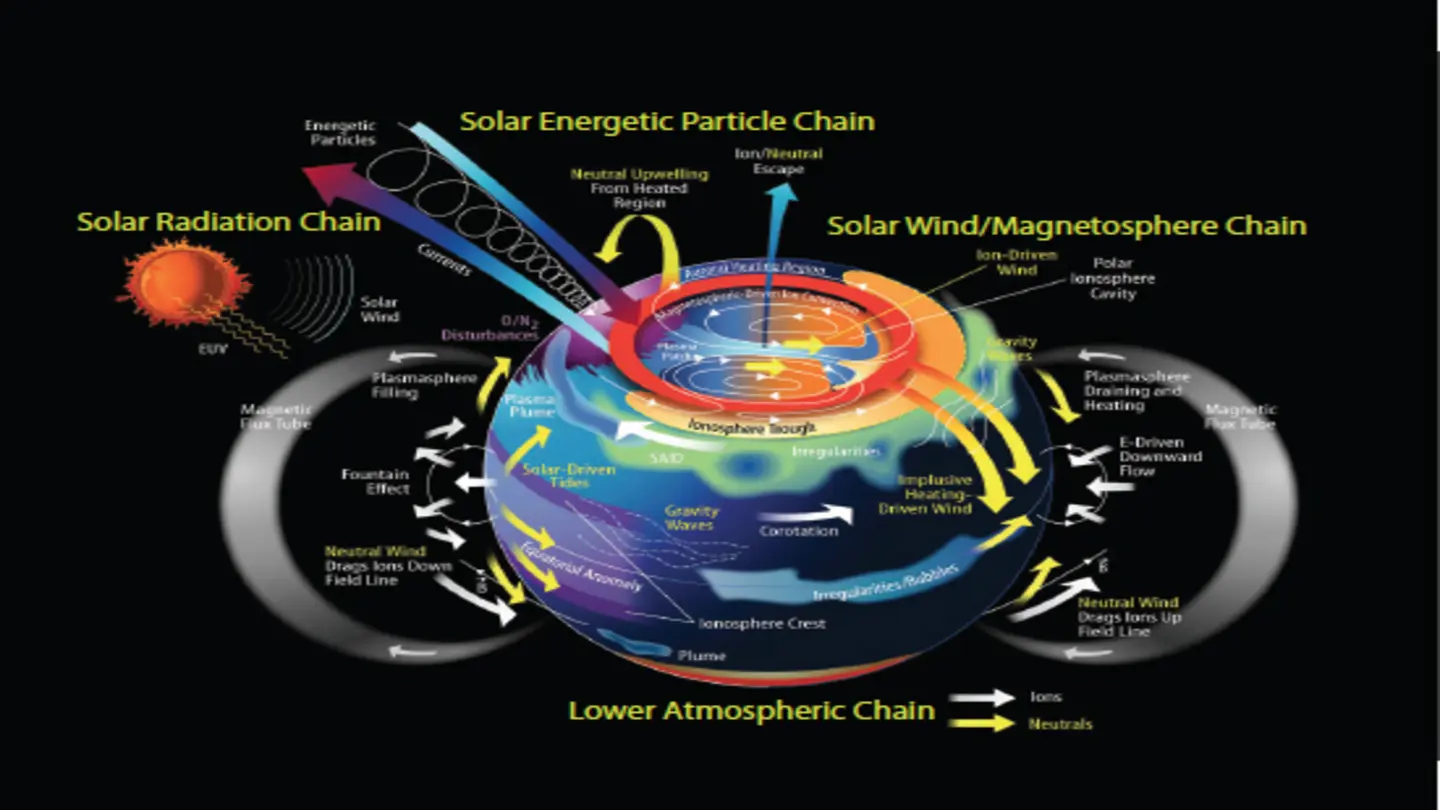
A recent study published on the ESS Open Archive delves into the subtle yet significant impact of magnetospheric forcing on the ionosphere during a prolonged period of solar minimum. Researchers investigated the behavior of the ionospheric peak density and height over a 30-day period defined by quiet geomagnetic conditions, aiming to understand how energy from Earth’s magnetosphere influences this critical atmospheric layer.
The ionosphere, a region of the upper atmosphere ionized by solar radiation, plays a vital role in radio communications and is sensitive to changes in both solar and magnetospheric activity. While solar flares and coronal mass ejections often dominate discussions of space weather, this research highlights the importance of continuous magnetospheric influence, even when the sun is at its least active. Understanding these processes is crucial for predicting and mitigating disruptions to technological systems that rely on a stable ionosphere.
The study employed a comprehensive analysis of ionospheric measurements collected during a representative solar minimum period. Researchers specifically focused on characterizing the variations in peak electron density (NmF2) and the corresponding height (hmF2) of the F2 layer, the densest layer within the ionosphere. By carefully selecting a 30-day window of minimal solar and geomagnetic disturbances, they were able to isolate the effects of magnetospheric processes with greater clarity. This allows researchers to build a more complete picture of underlying atmospheric behavior.
Key findings suggest a discernible correlation between specific magnetospheric phenomena – such as variations in the solar wind and the interplanetary magnetic field – and fluctuations in both NmF2 and hmF2. The research indicates that even during solar minimum, when the direct influx of solar energy is reduced, the magnetosphere acts as a conduit for energy transfer to the ionosphere. This transfer can manifest as enhancements or depletions in ionospheric density and shifts in its altitude.
Implications for Space Weather Modeling
The results emphasize the necessity of incorporating magnetospheric forcing mechanisms into existing space weather models. Traditional models frequently prioritize solar drivers, potentially underestimating the ionospheric response to magnetospheric disturbances, especially during quieter solar phases. A more holistic approach, integrating both solar and magnetospheric parameters, promises to improve the accuracy of ionospheric predictions.
Further research is suggested to explore the regional variations in ionospheric response to magnetospheric forcing and to determine the relative importance of different magnetospheric drivers. Investigating the effects on different ionospheric layers, alongside the F2 layer, could also provide a more complete understanding. The study’s methodology, focusing on extended quiet periods, serves as a valuable template for future investigations. Furthermore, the work supports the use of open-access archives like ESS Open Archive to disseminate research results quickly and widely and facilitates broader collaboration within the scientific community. Ultimately it contributes to safeguarding the increasingly important space-based technologies.
Image Source: Google | Image Credit: Respective Owner