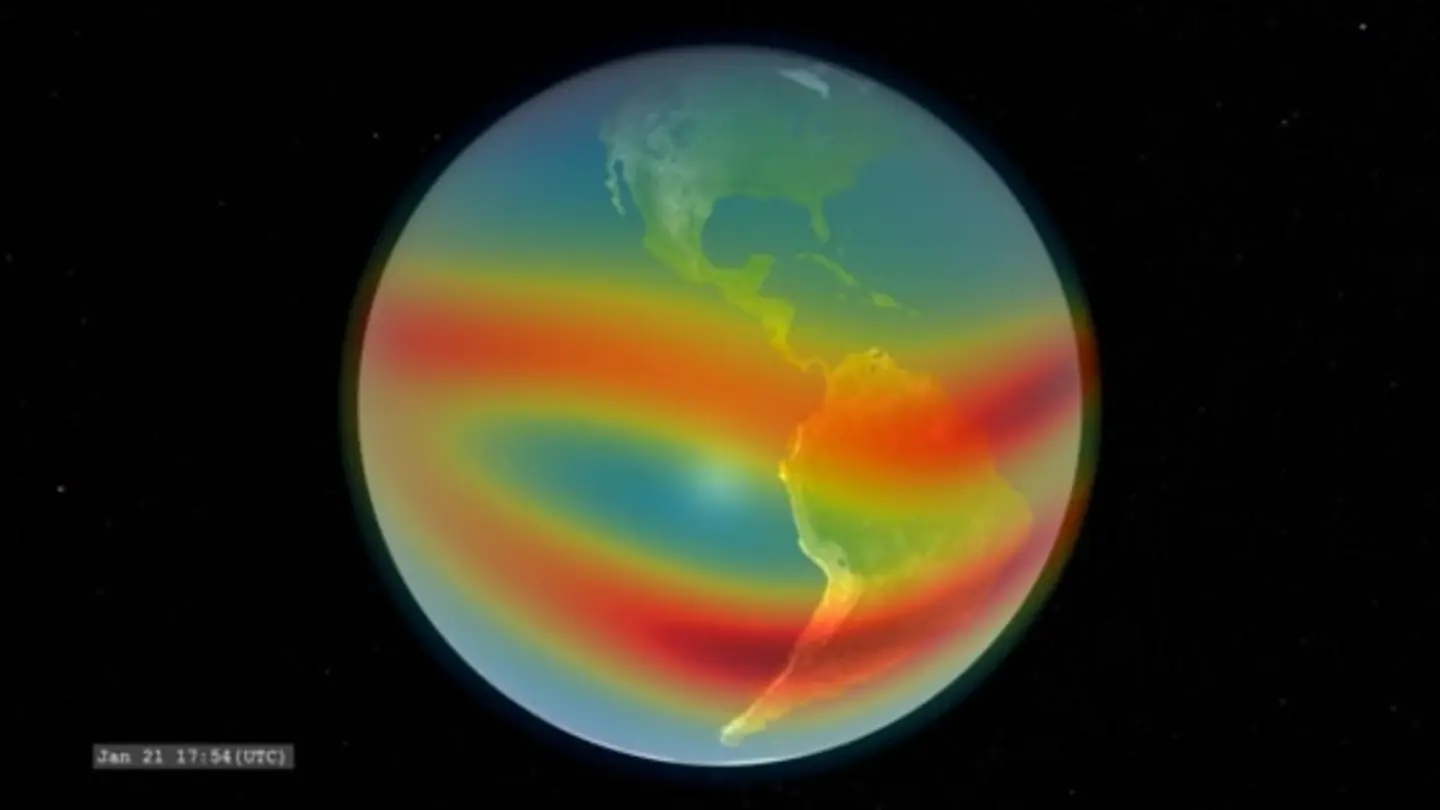
Researchers at the European Space Agency (ESS) have made groundbreaking discoveries about the nighttime ionosphere using AM radio signals. This study, published in the ESS Open Archive, details innovative measurement techniques that reveal dynamic interactions between Earth’s atmosphere and solar radiation. By analyzing AM radio waves reflected off ionospheric layers, scientists identified previously unobserved fluctuations in the E and F layers, which play critical roles in global communication and space weather.
The E-layer, located closer to Earth, and the F-layer, situated further up, both interact with solar particles and cosmic rays. These interactions affect radio wave propagation, GPS accuracy, and power grid stability. Traditional methods struggled to capture nighttime variations, but the AM radio signal analysis provided real-time, high-resolution data. The technique leverages ground-based radio transmitters to bounce signals off the ionosphere, creating a natural lab for atmospheric studies.
.findings suggest that AM radio could become a standard tool for monitoring ionospheric conditions. This is particularly valuable for predicting satellite communication disruptions caused by ionospheric storms. The method also offers cost-effective alternatives to expensive satellite-based systems. Researchers noted that the AM signal approach has lower latency and higher spatial resolution compared to conventional radar techniques.
Beyond practical applications, the study advances atmospheric sciences. It provides insights into how human activities, such as high-frequency radio transmissions, might impact ionospheric layers. The ESS team emphasized the need for interdisciplinary research, combining radio engineering with atmospheric physics. Their work opens new avenues for climate modeling and space weather prediction.
While preliminary, these measurements mark a shift in how scientists study Earth’s upper atmosphere. The use of repurposed radio signals underscores the creativity in modern scientific methodology. As the team plans to expand this research to other spectral ranges, the potential for new discoveries in atmospheric dynamics grows. Collaboration between academia and industry will be key to refining this technology for global use.
Technological Implications
If adopted widely, AM radio-based ionospheric imaging could revolutionize how we prepare for solar storms. These storms can cripple power grids, disrupt aviation, and damage satellites. By detecting early ionospheric changes, authorities might mitigate cascading failures. The technique’s scalability makes it ideal for developing nations lacking advanced monitoring infrastructure.
The study also challenges assumptions about ionospheric stability. Nighttime layers were previously thought to be relatively inert, but the AM signal data revealed rapid oscillations. This has implications for aviation navigation systems, which rely on stable ionospheric conditions for radio communication. Adjustments to flight paths or communication protocols may soon become necessary based on these new insights.
협업 between engineers and atmospheric physicists will be crucial to translating these findings into practical tools. The ESS team is already working with radio industry partners to develop standardized protocols. Open-sourcing their methodology could accelerate global adoption, making ionospheric monitoring more accessible to researchers and policymakers worldwide.
Image Source: Google | Image Credit: Respective Owner