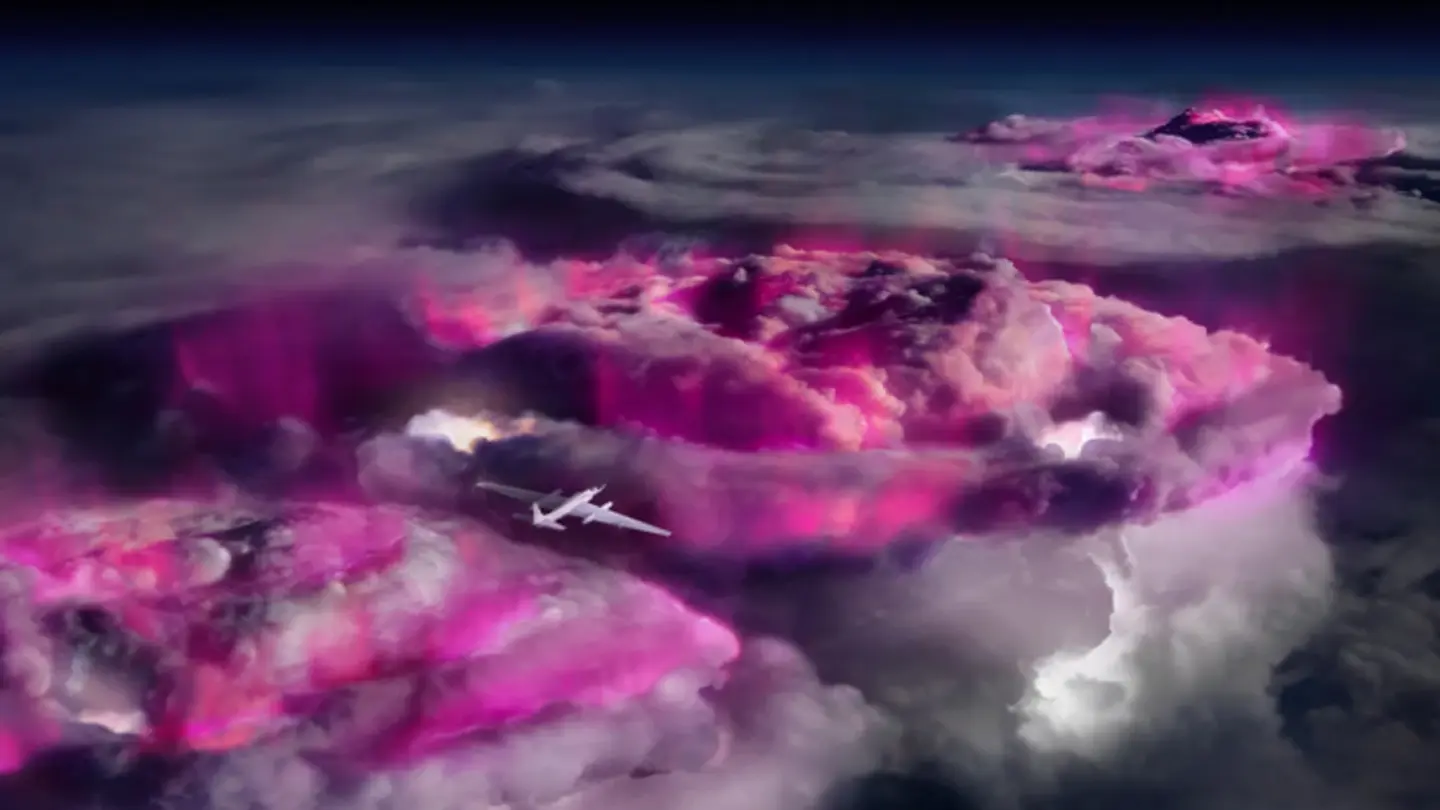
Researchers have documented a rare atmospheric phenomenon: a downward terrestrial gamma-ray flash connected to dart leaders within a negative cloud-to-ground lightning flash. The discovery, published in ESS Open Archive, sheds new light on high-energy processes occurring during intense thunderstorm activity.
The observation occurred during a storm monitoring campaign using ground-based and satellite instrumentation. Scientists detected a brief but intense burst of gamma rays emanating from the lower atmosphere, coinciding precisely with the rapid succession of ionized channels known as dart leaders descending from storm clouds to earth. These leaders precede the bright return stroke that forms the visible lightning bolt.
Terrestrial gamma-ray flashes (TGFs) had previously been observed high in the atmosphere, but this marks one of the first documented cases originating near the Earth\u2019s surface. The event lasted approximately 0.2 milliseconds, releasing energy comparable to millions of lightning strikes compressed into that ultra-short timeframe.
\u201cThis finding challenges our understanding of where and how these high-energy bursts occur,\u201d said lead researcher Dr. Elena Martinez. \u201cThe association with dart leaders suggests a previously unrecognized mechanism for particle acceleration close to the ground, potentially involving strong electric fields and runaway electron avalanches.\u201d
The research team analyzed data from multiple detection systems, including the FERMI satellite\u2019s GBM instrument and ground-based lightning networks. They correlated the gamma-ray detection with high-speed electric field measurements showing the telltale signature of dart leader propagation. Spectral analysis revealed characteristic signatures of bremsstrahlung radiation produced as electrons accelerated to relativistic speeds collided with atmospheric nuclei.
This discovery has broad implications across multiple scientific domains. For atmospheric physics, it provides new insights into lightning\u2019s complex electromagnetic structure and energy transfer processes. In space weather research, understanding TGF generation mechanisms could improve predictions of radiation hazards for satellites and high-altitude aircraft. The findings may also inform theories about terrestrial gamma-ray bursts\u2019 potential role in nitrogen oxide production and subsequent impacts on ozone chemistry.
Future research directions include deploying faster detection systems capable of resolving sub-microsecond scale processes and developing three-dimensional models of these events. Scientists aim to determine whether such surface-level TGFs represent rare exceptions or previously undetected common phenomena within intense lightning flashes. The observations underscore the need for coordinated multi-instrument monitoring campaigns during severe storm seasons to capture these fleeting high-energy events.
Image Source: Google | Image Credit: Respective Owner