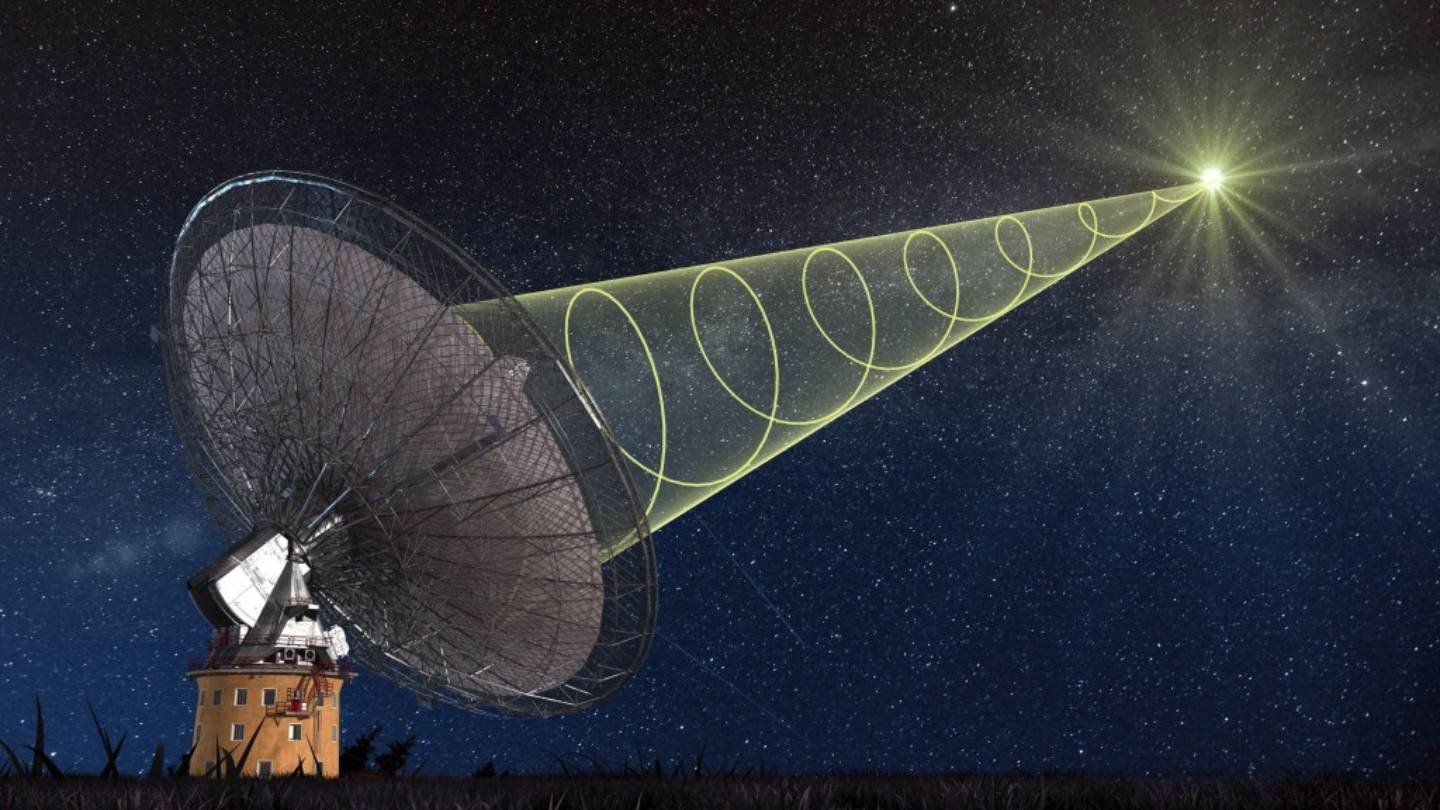
Cape Town: Astronomers using South Africa’s MeerKAT telescope have detected an unusually active repeating source of fast radio bursts (FRBs) — powerful but fleeting radio pulses from deep space. In just a few minutes, the source unleashed hundreds of signals, making it one of the most energetic repeaters ever observed.
What Scientists Detected
The source, named FRB 20240619D, was first spotted on June 19, 2024, when three bursts were picked up within two minutes in the MeerKAT L-band. A week later, researchers recorded an extraordinary 249 bursts across multiple frequency bands during a follow-up session.
Lead author Jun Tian of the Jodrell Bank Centre for Astrophysics, who works with the MeerTRAP project, said the activity gives astronomers a rare opportunity to study how FRBs behave across different frequencies in real time.
Clues About the Source
The bursts showed a preference for the L-band range, while many signals were confined to narrow slices of frequency instead of spanning the whole band. Some displayed drifting substructures — a known hallmark of repeating FRBs.
Polarization data revealed most signals were strongly linearly polarized, while a few carried circular polarization. Such patterns point toward magnetars — highly magnetized neutron stars — as likely sources, rather than more distant shock events.
No Optical Counterpart
To check for any visible flashes, astronomers paired the radio campaign with the MeerLICHT optical telescope. No optical bursts were detected, further narrowing the possible mechanisms behind the event.
Why It Matters
FRBs, which last only milliseconds, travel across intergalactic space and carry signatures of the material they pass through. By studying highly active sources like FRB 20240619D, scientists can map cosmic plasma, trace the universe’s “missing matter,” and test competing theories about whether repeating and one-off FRBs share the same origins.
With storms of bursts similar to earlier famous repeaters like FRB 20121102A and FRB 20201124A, this discovery adds weight to the idea that there may be a common underlying mechanism driving these mysterious cosmic signals.
Image Source: Google | Image Credit: Respective Owner