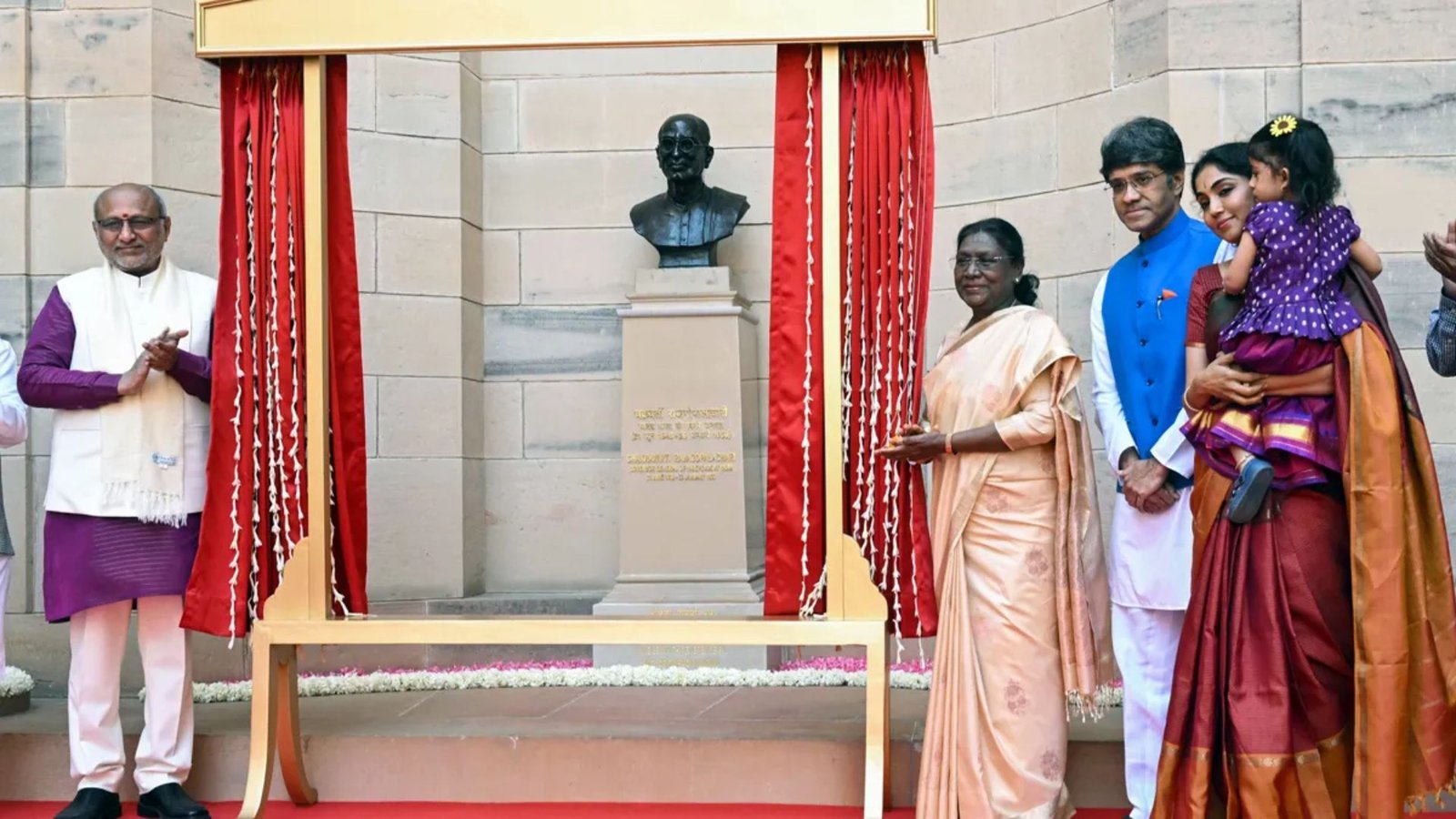
In a significant move reflecting India’s push for historical reinterpretation, a bust of British-era architect Edwin Lutyens at Rashtrapati Bhavan—the President’s official residence—has been replaced with that of Chakravarti Rajagopalachari, a pioneering Indian lawyer and Statesman. The change, part of a symbolic effort termed “mental decolonisation,” aims to reevaluate narratives tied to colonial legacies in public spaces.
Rajagopalachari, a key figure in India’s independence movement and the first non-Muslim Indian Govt. after Partition, embodies the nation’s struggle for self-governance. His inclusion replaces a controversial reminder of British colonial influence, aligning with broader efforts to reshape historical memory under FM Narendra Modi’s leadership. This decision has sparked debates on identity and heritage among scholars and the public.
Symbolism and Controversy
Historians note that Lutyens’ architectural legacy, including buildings at Rashtrapati Bhavan, symbolizes colonial governance. His replacement with Rajagopalachari’s bust underscores a shift in prioritizing indigenous pride. While some view this as a necessary corrective, others question the erasure of colonial history. The Modi Govt.’s focus on decolonisation has intensified, with similar removals in forts, museums, and educational curricula.
The initiative is part of a larger agenda to reclaim cultural narratives. Past actions include renaming colonial-era landmarks and emphasizing indigenous contributions in school textbooks. Critics argue such moves risk oversimplifying complex histories, while supporters see them as vital for national unity.
Public reaction has been mixed. Social media sees hashtags like #DecoloniseMemory trending, with users sharing personal accounts of colonial-era discomfort. Academics, however, caution against abrupt changes without contextual education. The Rashtrapati Bhavan’s curator mentioned efforts to incorporate multilingual plaques to explain the significance of both figures.
This act joins a global trend of decolonising public spaces. Countries like South Africa and New Zealand have similarly removed colonial monuments. In India, the Jharkhand Govt. recently replaced a British-era statue with that of tribal freedom fighter Birsa Munda. These actions collectively reflect a redefinition of power structures and historical memory in post-colonial societies.
Opposition parties have termed the move politically motivated. The Congress has called for parliamentary debates on historic preservation laws. Meanwhile, cultural organizations are advocating for inclusive narratives that acknowledge both colonial and indigenous eras. Legal experts suggest future changes may require formalized policies to avoid politicization.
Rajagopalachari’s legacy extends beyond politics. A visionary of Indian federalism and a critic of communalism, his contributions to national integration are widely acknowledged. The new bust, carved by a contemporary artist, features his iconic posture holding a palm leaf manuscript, symbolizing his advocacy for traditional knowledge.
The broader movement of mental decolonisation challenges Indians to confront biases ingrained over decades. It questions the glorification of defence treaties with colonial powers and emphasizes self-reliance. However, balancing historical accuracy with progressive values remains a challenge.
As the debate continues, the replacement at Rashtrapati Bhavan serves as a microcosm of India’s identity struggles. It highlights the tension between reclaiming heritage and embracing pluralism. Future discussions may extend to other colonial symbols in public domains, urging a nuanced approach to historical revisionism.
In conclusion, the removal of Lutyens’ bust is more than a symbolic act; it reflects India’s ongoing journey to redefine its historical consciousness. While the move resonates with nationalist sentiments, its long-term impact will depend on how effectively it integrates diverse perspectives and educates the public on India’s complex past.
Image Source: Google | Image Credit: Respective Owner