New research published in the ESS Open Archive details significant losses of energetic protons observed near Jupiter’s moon Io, providing compelling evidence for a charge exchange process occurring between the protons and Io’s unique atmosphere and extended corona. The findings, based on data analysis from the Juno mission, shed light on the complex interactions between Jupiter’s magnetosphere, its moons, and their surrounding environments.
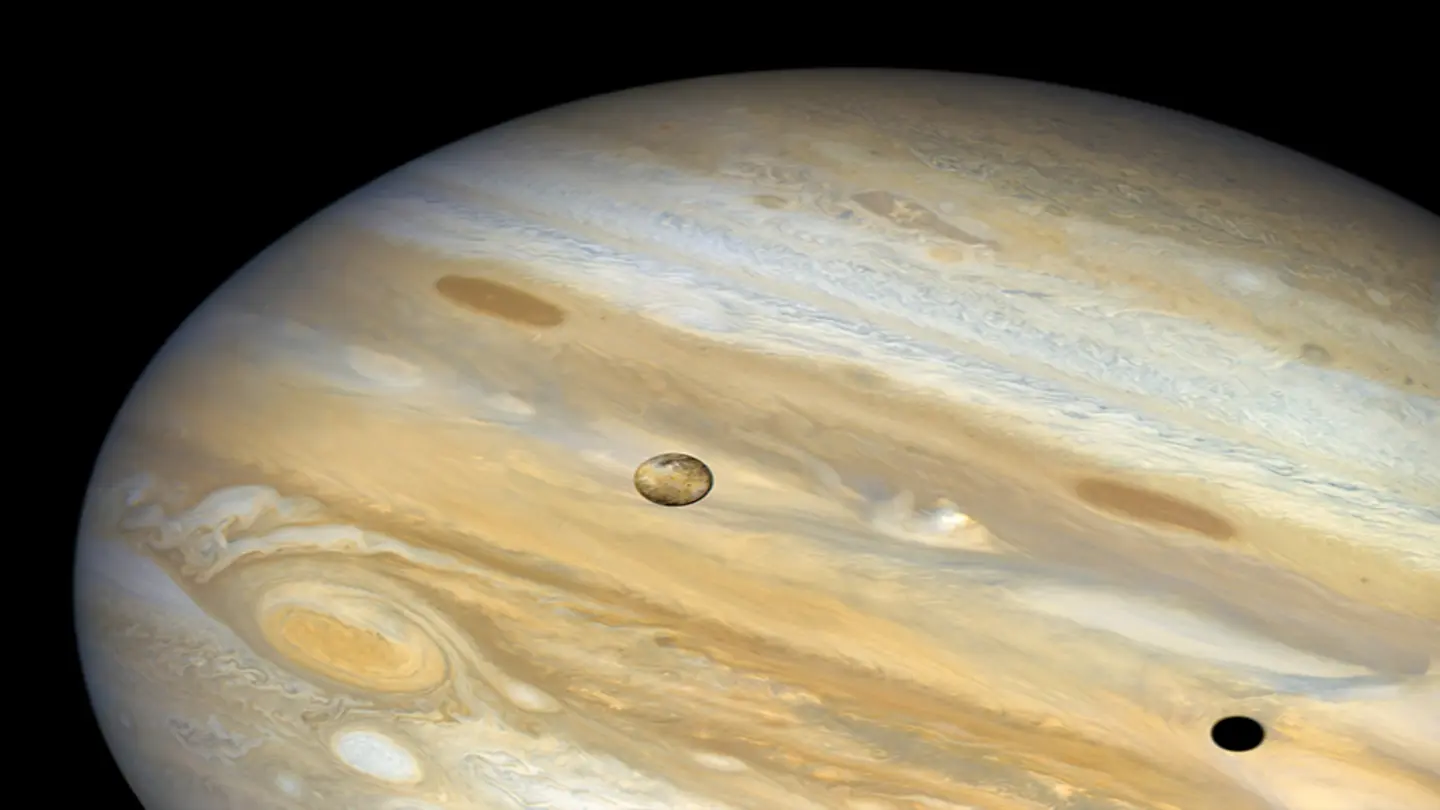
Io, the most volcanically active body in our solar system, possesses a substantial atmosphere composed primarily of sulfur dioxide (SO2) released from its numerous erupting volcanoes. This atmosphere, coupled with an expansive corona formed by escaping gases, creates a region of heightened interaction with the energetic particles that populate Jupiter’s magnetosphere – a bubble-like region of charged particles trapped by the planet’s magnetic field.
The study focuses on the observed depletion of energetic protons as they traverse the region around Io. Researchers determined that this loss isn’t due to simple absorption or deflection, but rather a process called charge exchange. In charge exchange, a proton collides with a neutral atom or molecule (in this case, SO2) and essentially swaps its charge. The proton becomes neutral, losing its connection to Jupiter’s magnetic field, and is no longer confined to the magnetosphere. The SO2 molecule becomes ionized.
Implications for Jupiter’s Magnetosphere
This process has significant implications for understanding the dynamics of Jupiter’s magnetosphere. Energetic particles are a key component, driving various phenomena like auroral emissions and radiation belt formation. The loss of protons near Io contributes to the overall modification of the magnetospheric particle population. The study quantifies the rate of this proton loss, revealing it to be a substantial drain on the magnetosphere’s energetic particle reservoir.
Furthermore, the newly ionized SO2 molecules created by the charge exchange process contribute to the composition and structure of Io’s plasma torus – a doughnut-shaped region of charged particles encircling Jupiter near Io’s orbit. This torus is a major source of plasma within the Jovian magnetosphere. Understanding the link between proton loss and plasma generation is crucial for a complete picture of the system.
The research team utilized data collected by Juno’s energetic particle detectors during multiple close flybys of Io. By analyzing the energy and angular distribution of the protons, they were able to pinpoint the location and extent of the proton depletion. Modeling efforts then confirmed that charge exchange with Io’s atmosphere and corona was the most plausible explanation for the observed losses.
Future research will focus on refining the models to better predict the rate of charge exchange under varying conditions, and on investigating the impact of this process on other moons within Jupiter’s magnetosphere. The findings highlight the importance of considering atmospheric and coronal interactions when studying the dynamics of planetary magnetospheres, particularly those around bodies with active atmospheres like Io.
This discovery provides valuable insights into the complex interplay of particles and fields in the Jovian system, furthering our understanding of similar processes occurring around other planets throughout the solar system and beyond.
Image Source: Google | Image Credit: Respective Owner