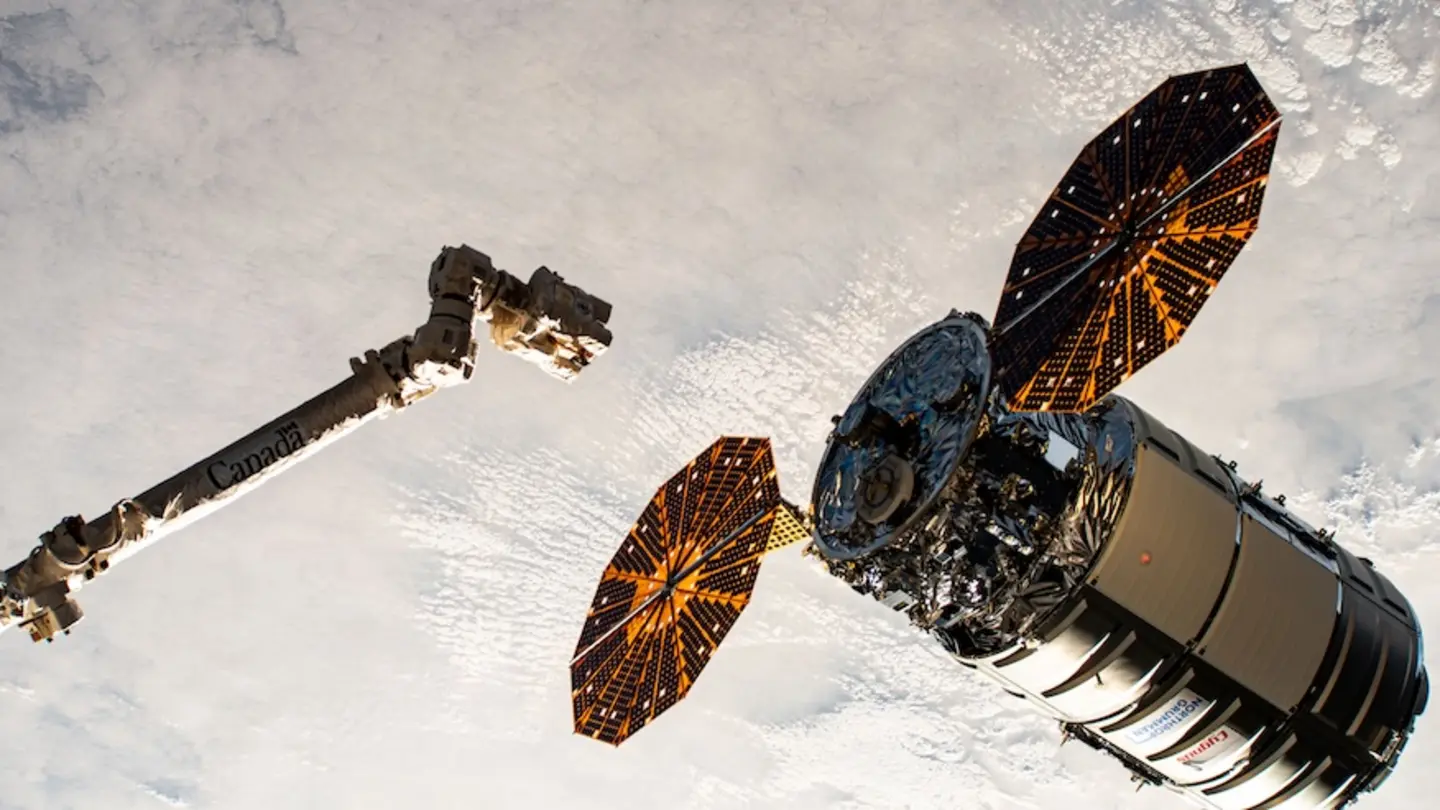
A Northrop Grumman Cygnus cargo spacecraft successfully docked with the International Space Station (ISS) on Thursday, a day later than initially planned due to a technical glitch. The spacecraft, named the S.S. Laurel Clark in honor of the astronaut who perished in the Columbia space shuttle disaster, encountered an unspecified engine issue shortly after its launch from NASA’s Wallops Flight Facility in Virginia on Tuesday. The problem forced mission controllers to postpone the docking procedure by 24 hours while engineers analyzed the situation and developed a solution.
“We had a little bit of a late start to our arrival today due to some work we needed to do on the ground,” said NASA’s Rob Navias during live coverage of the docking. “But Cygnus has arrived and is attached to the International Space Station.” The Cygnus spacecraft is carrying approximately 8,200 pounds (3,720 kilograms) of scientific experiments, crew supplies, and hardware to the orbiting laboratory. This includes new research equipment, food, clothing, and spare parts vital for the continued operation of the ISS and the well-being of its crew.
Scientific Payload Highlights
Among the scientific investigations aboard the Cygnus are experiments focusing on plant growth in space, radiation shielding materials, and advanced recycling technologies. These experiments are crucial for advancing our understanding of how humans can live and work in space for extended periods, paving the way for future missions to the Moon and Mars. The plant growth experiment, for instance, will investigate the effects of microgravity on plant development and nutrient uptake, potentially leading to more efficient food production systems for long-duration space voyages. The radiation shielding experiment will test the effectiveness of novel materials in protecting astronauts from harmful space radiation, a significant challenge for deep-space exploration.
The successful docking of the Cygnus spacecraft is a testament to the resilience and expertise of the teams involved in the mission, from Northrop Grumman engineers to NASA flight controllers. The ability to diagnose and resolve the engine issue quickly ensured that the vital cargo reached the ISS without further delay. The spacecraft will remain docked to the ISS for several months, providing a temporary storage facility for waste and equipment before eventually burning up in Earth’s atmosphere during its controlled re-entry. This mission underscores the importance of commercial partnerships in supporting the ongoing operations of the International Space Station and advancing space exploration.
The mission also highlights the vital role of the ISS as a platform for scientific research and technological development, fostering collaboration between nations and pushing the boundaries of human knowledge. The crew aboard the ISS will now begin the process of unloading the cargo and integrating the new experiments into their research program. The arrival of the Cygnus spacecraft ensures that the ISS remains well-supplied and equipped to continue its critical mission of scientific discovery and technological innovation in low Earth orbit. The successful recovery from the initial engine issue demonstrates the robustness and adaptability of modern spaceflight operations.
Image Source: Google | Image Credit: Respective Owner