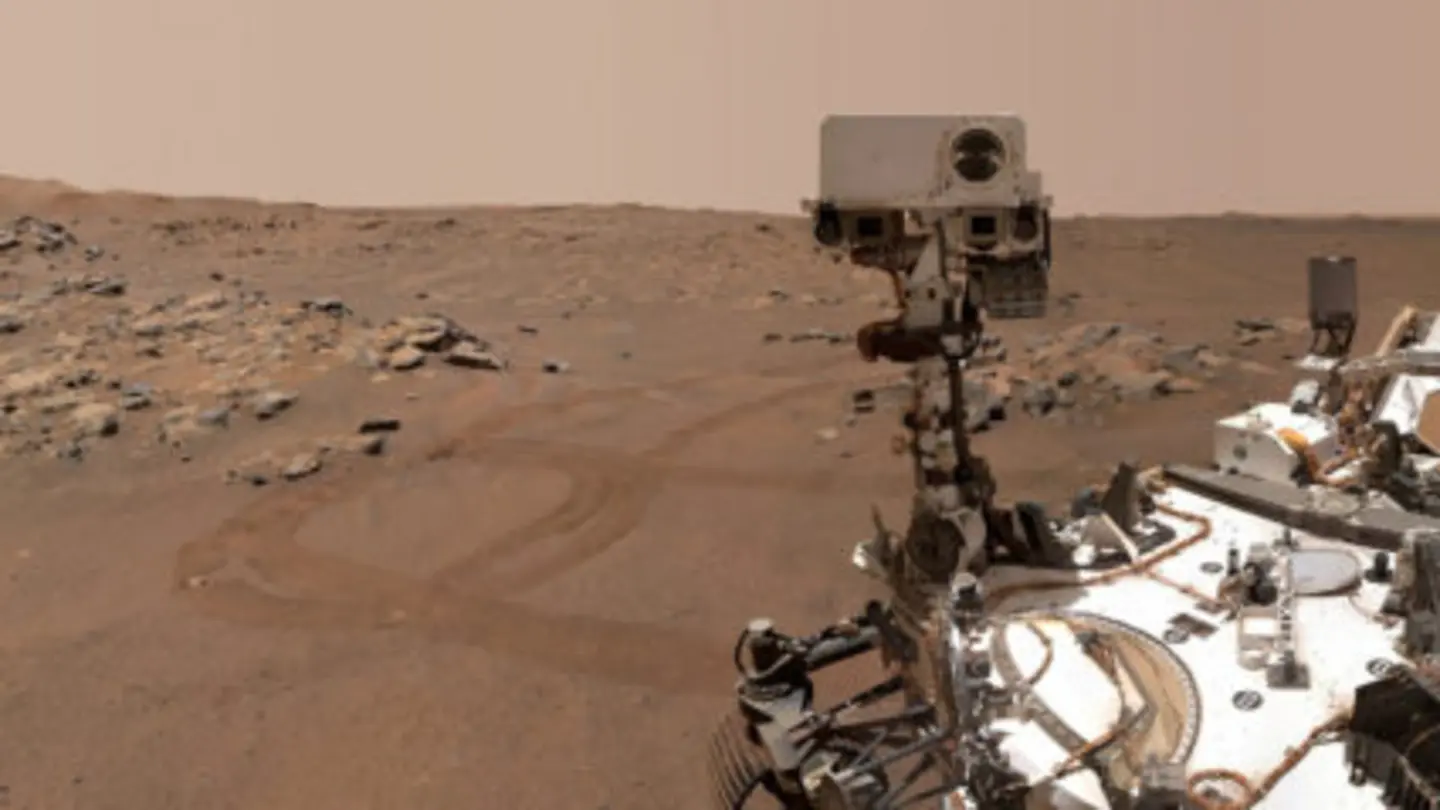
NASA’s Mars rover Perseverance, operating millions of miles from Earth, has identified a promising sign potentially indicative of past microbial life. Equipped with an array of sophisticated instruments, the rover is acting as the eyes and ears of scientists back on Earth, diligently exploring the Martian surface and sending back crucial data.
Perseverance’s Advanced Toolkit
Perseverance boasts a suite of cutting-edge tools designed to analyze the Martian environment. Its cameras provide high-resolution imagery, while spectrometers analyze the chemical composition of rocks and soil. The rover also carries a drill to collect samples that could eventually be returned to Earth for further study.
The recent discovery involves a rock sample exhibiting textures and compositions that suggest it may have formed in an environment conducive to life. Scientists are particularly interested in the presence of organic molecules, which are the building blocks of life as we know it. While the detection of these molecules doesn’t definitively prove that life once existed on Mars, it significantly boosts the possibility.
How Perseverance Detected the Clue
Perseverance utilized its SHERLOC (Scanning Habitable Environments with Raman & Luminescence for Organics & Chemicals) instrument to analyze the rock. SHERLOC employs a laser to identify minerals and organic compounds, providing valuable insights into the rock’s formation and potential history. The data collected by SHERLOC revealed the presence of intriguing textures and mineralogical features.
“This is a significant step in our search for evidence of past life on Mars,” said Dr. Abigail Allwood, a principal investigator on the Perseverance mission. “While we can’t claim to have found definitive proof, the data we’re gathering is incredibly exciting and warrants further investigation.”
Next Steps for Perseverance
The rover will continue to explore the Jezero Crater, a site believed to have once been a lake. Perseverance will collect more samples from different locations, seeking to build a comprehensive picture of the area’s geological history and potential habitability. These samples will be stored in sealed tubes, awaiting a future mission to retrieve them and bring them back to Earth. Scientists around the world are eagerly awaiting the opportunity to analyze these samples in their labs, using even more advanced techniques than are possible on Mars.
Implications of the Discovery
If confirmed, the discovery of past life on Mars would have profound implications for our understanding of the universe. It would suggest that life is not unique to Earth and that it may be more common than previously thought. Such a finding would undoubtedly fuel further exploration of Mars and other potentially habitable worlds.
For now, Perseverance continues its mission, meticulously gathering data and offering a tantalizing glimpse into the possibility of a once-living Mars. The scientific community remains cautiously optimistic, recognizing that more research is needed to confirm this exciting possibility.
Image Source: Google | Image Credit: Respective Owner