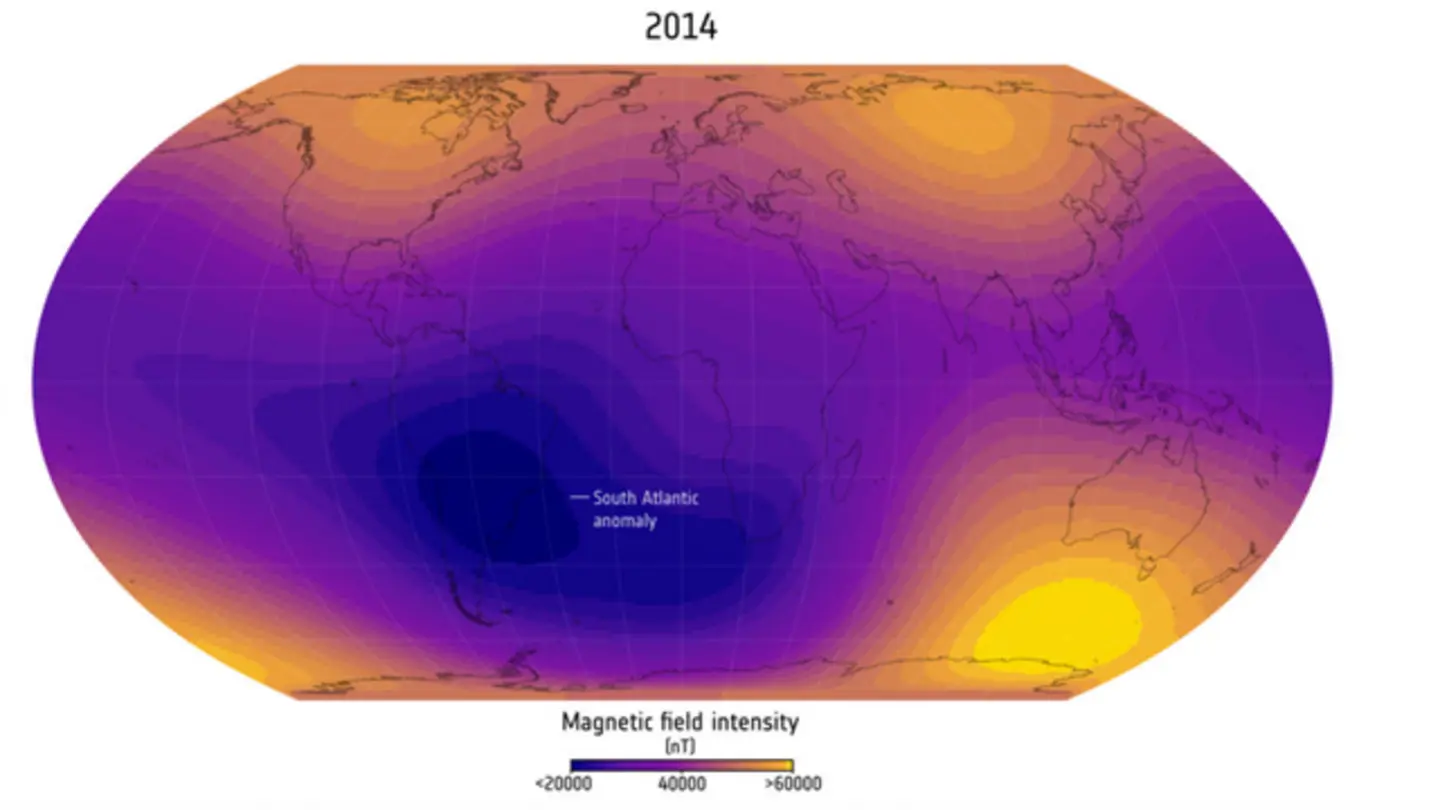
The South Atlantic magnetic anomaly, a vast region of unusually weak magnetic intensity, has long puzzled geophysicists and space weather researchers.
Recent analyses from the European Space Agency’s Swarm mission reveal that fluctuations in this anomaly may influence charged particle pathways, potentially altering atmospheric chemistry and ionospheric dynamics.
Scientists have now linked these particle modulations to unexpected correlations with terrestrial phenomena, including shifts in regional climate patterns and even variations in human behavioral metrics recorded by satellite‑based social monitoring.
In a study published in the ESS Open Archive, lead author Dr. Elena Martínez argues that the anomaly’s magnetic disturbances can modulate cosmic ray flux reaching Earth’s surface, which in turn may affect neural activity through subtle electromagnetic coupling.
While the hypothesis challenges conventional separations between space‑based physical processes and complex Earth systems, the authors stress that causality remains tentative and requires rigorous multidisciplinary validation.
The research team employed machine‑learning algorithms to cross‑reference magnetic field maps with high‑resolution sociological datasets, uncovering statistically significant couplings during periods of heightened anomaly activity.
Critics caution that correlation does not imply causation, urging further field experiments and controlled laboratory studies to isolate the mechanisms at play.
If validated, these findings could reshape our understanding of space weather impacts, prompting new strategies for mitigating technological risk and perhaps even influencing public health policies.
Implications of Magnetic Anomaly Research
The Swarm constellation, comprising three satellites in distinct orbits, continuously samples the geomagnetic field with unprecedented spatial resolution, enabling scientists to track the anomaly’s migration westward at roughly 20 kilometers per year.
Such migration patterns coincide with anomalies in the core‑mantle boundary, suggesting that fluid dynamics deep within Earth may be driving observable surface magnetic shifts, a hypothesis that aligns with recent seismic tomography results.
The interplay between core processes and surface magnetic phenomena underscores the complexity of Earth’s interior, where heat flow, compositional convection, and magnetic field generation are tightly coupled.
Researchers also examined historical geomagnetic excursions, noting that periods of reduced field strength often precede rapid climatic transitions, raising the possibility that magnetic variations could act as hidden triggers in Earth system dynamics.
By integrating paleomagnetic records with modern magnetometer observations, scientists aim to construct a unified model that predicts how magnetic anomalies influence atmospheric ionization, cloud formation, and ultimately, weather regimes.
Such a model could have far‑reaching implications, from improving space‑craft shielding designs to rethinking risk assessments for satellite communications during periods of heightened anomaly activity.
The authors conclude that interdisciplinary collaboration will be essential to translate these magnetic insights into actionable scientific frameworks, safeguarding both technological infrastructure and societal well‑being.
Image Source: Google | Image Credit: Respective Owner