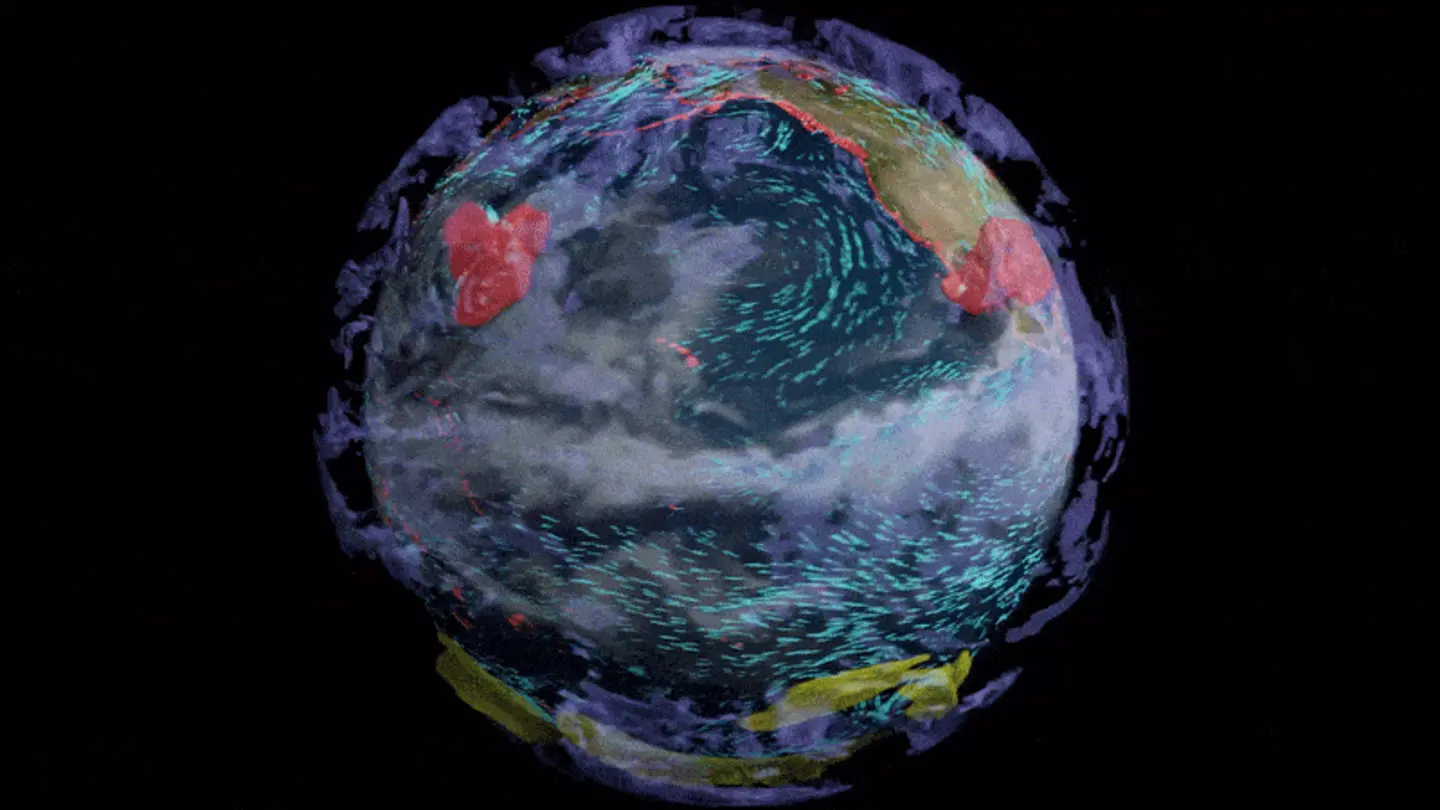
Researchers have developed a new machine learning technique to improve the representation of cloud cover in complex Earth system models. This advancement, detailed in a recent publication from the ESS Open Archive, focuses on ‘closure’ – the process of ensuring that a model’s different components interact realistically and conserve energy and mass. Specifically, the study addresses the long-standing challenge of accurately modeling cloud fraction, which is the percentage of the sky covered by clouds.
Current Earth system models, used for climate projections and understanding weather patterns, often struggle with accurately predicting cloud formation and behavior. Clouds play a crucial role in regulating Earth’s temperature by reflecting incoming solar radiation and trapping outgoing infrared radiation. Inaccurate cloud representation can therefore lead to significant errors in climate simulations. Traditional methods for achieving closure often rely on simplified assumptions or parameterizations, which can introduce biases.
The new approach utilizes online learning, meaning the machine learning model is trained *while* the Earth system model is running, rather than relying on pre-existing datasets. This allows the model to adapt to the specific conditions and interactions within the simulation, potentially leading to more accurate and robust results. The researchers implemented this machine learning closure specifically for cloud fraction within a hybrid Earth system model, combining elements of different modeling frameworks.
How the System Works
The machine learning model learns to adjust parameters within the cloud microphysics scheme to ensure that the overall energy and water budgets of the model are balanced. This is achieved by continuously comparing the model’s predictions with observed data and refining its parameters accordingly. The ‘online’ aspect is key; the model isn’t simply memorizing past conditions but is actively learning how clouds behave in the current simulated environment.
The study highlights the potential of machine learning to address fundamental challenges in Earth system modeling. By learning directly from the model’s dynamics, the technique can potentially overcome limitations of traditional parameterization schemes. Initial results suggest that the machine learning closure improves the model’s ability to reproduce observed cloud patterns and reduces biases in climate simulations. The researchers emphasize that this is a step towards more reliable and accurate climate predictions.
Further research will focus on extending this technique to other aspects of Earth system modeling, such as aerosol processes and radiative transfer. The team also plans to investigate the computational cost of online learning and explore ways to optimize its performance. The ultimate goal is to develop a fully integrated Earth system model that leverages the power of machine learning to provide a more comprehensive and accurate understanding of our planet’s climate.
This work represents a significant contribution to the field of climate science, offering a promising pathway to improve the accuracy of climate models and reduce uncertainties in future climate projections. The open-access nature of the ESS Open Archive ensures that these findings are readily available to the broader scientific community, fostering collaboration and accelerating progress in this critical area of research.
Image Source: Google | Image Credit: Respective Owner