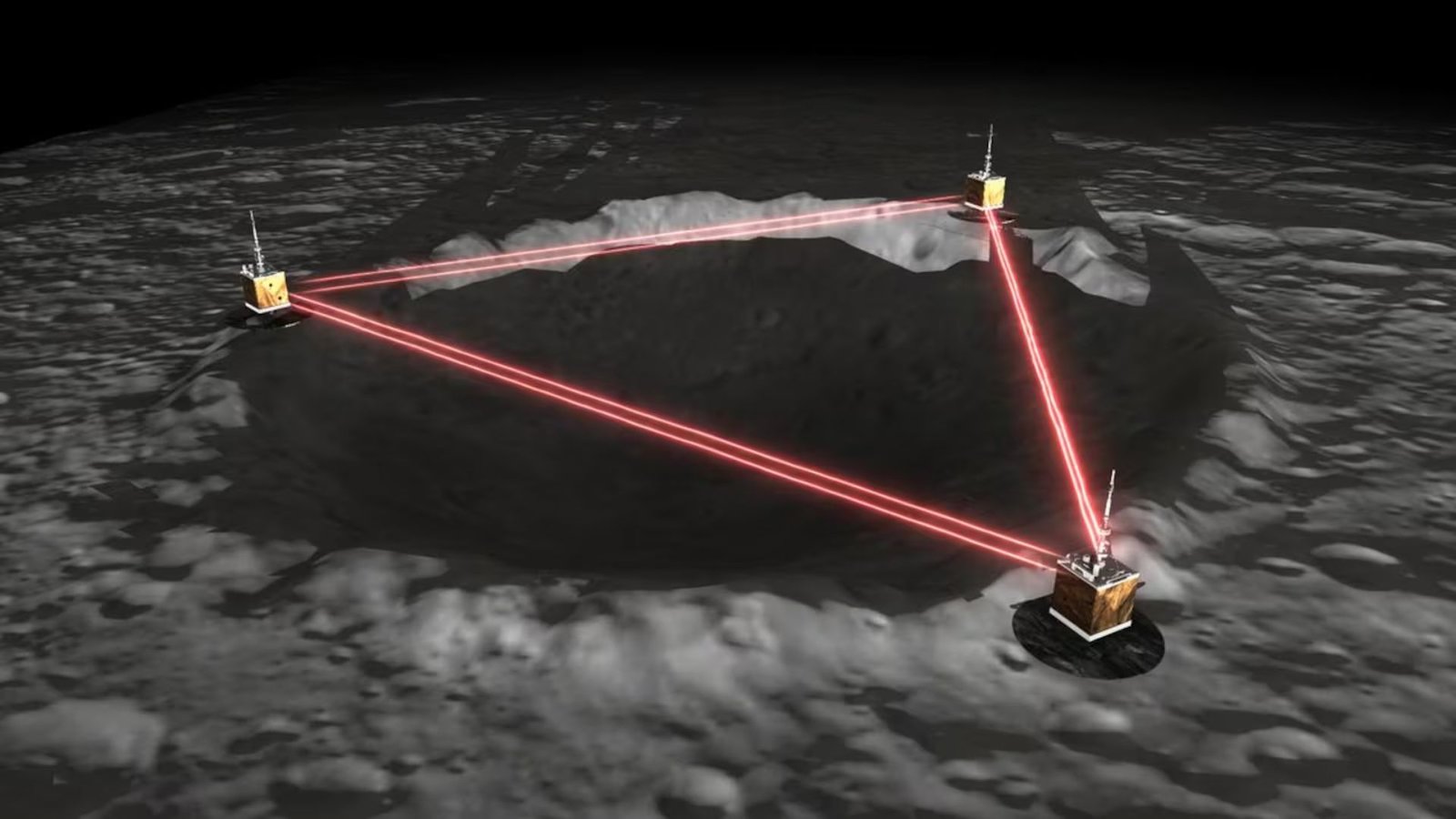
Scientists have proposed a novel concept called LILA (Lunar Interferometer for Lunar Anisotropy) to detect gravitational waves and potentially uncover secrets about the universe’s origins. This ambitious project envisions placing a detector on the Moon to listen for spacetime’s subtle “music.”
The Quest for Gravitational Waves
Gravitational waves, ripples in the fabric of spacetime, were predicted by Albert Einstein and first detected in 2015. These waves are generated by some of the most cataclysmic events in the cosmos, such as the collision of black holes or neutron stars. Detecting and studying these waves provides invaluable insights into these phenomena and the fundamental nature of gravity.
Current gravitational wave detectors on Earth, like LIGO and Virgo, have revolutionized astrophysics. However, they are limited by terrestrial noise sources and the relatively narrow range of frequencies they can detect. LILA aims to overcome these limitations by leveraging the unique environment of the Moon.
The Advantage of a Lunar Detector
The Moon offers several advantages for gravitational wave detection. Firstly, it is seismically quieter than Earth, reducing the background noise that can interfere with detecting faint gravitational wave signals. Secondly, the Moon lacks an atmosphere, eliminating atmospheric distortions that can affect terrestrial detectors. Thirdly, the Moon’s far side is shielded from radio interference from Earth, providing a pristine environment for sensitive measurements.
The LILA concept involves deploying a network of seismometers across the lunar surface, which would act as a giant gravitational wave detector. These seismometers would be highly sensitive to subtle vibrations caused by gravitational waves passing through the Moon. By analyzing the patterns of these vibrations, scientists could infer the properties of the gravitational waves and the events that generated them.
According to the study, LILA would be sensitive to different frequencies than current ground-based detectors, potentially opening a new window into the gravitational wave universe. It could detect gravitational waves from events that are too faint or at frequencies too low to be detected by LIGO and Virgo. This could include gravitational waves from the very early universe, providing clues about the Big Bang and the formation of the first structures in the cosmos.
The implementation of LILA would be a technologically challenging endeavor, requiring the development of robust and sensitive seismometers that can operate in the harsh lunar environment. It would also require establishing a reliable communication infrastructure to transmit data back to Earth. However, the potential scientific rewards are enormous, making LILA a compelling concept for future exploration.
If realized, LILA could revolutionize our understanding of the universe by providing a unique perspective on gravitational waves and the most extreme events in the cosmos. It would complement existing and planned gravitational wave detectors, expanding our reach into the gravitational wave spectrum and unlocking new secrets about the universe’s origins and evolution.
Image Source: Google | Image Credit: Respective Owner