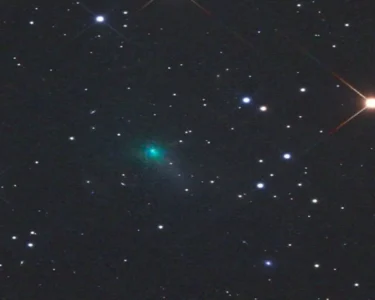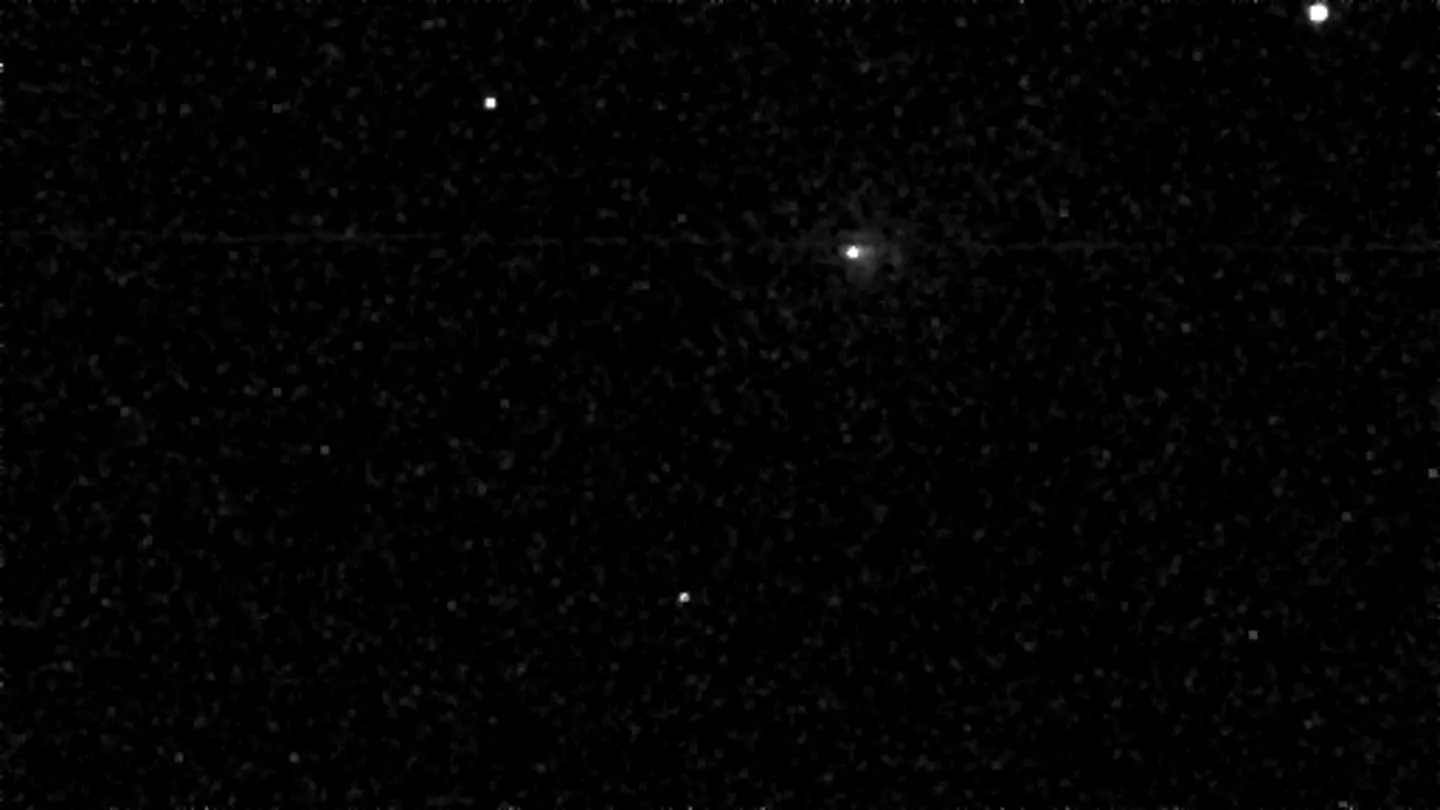
The European Space Agency’s (ESA) Juice mission, en route to Jupiter, has captured remarkable early images of Comet 3I/ATLAS using its NavCam navigation camera. These images reveal the comet’s glowing coma, plasma tail, and dust tail, providing valuable insights into its composition and behavior.
Comet 3I/ATLAS Observations
Comet 3I/ATLAS, an interstellar visitor discovered in 2017, is known for its relatively faint appearance, making these early observations by Juice particularly significant. The NavCam, primarily designed for spacecraft navigation, has demonstrated its capability to capture scientific data during the cruise phase of the mission. The images showcase the comet’s activity as it approaches the inner solar system, revealing the interaction between its icy nucleus and the solar wind.
The Juice mission, launched in April 2023, is dedicated to exploring Jupiter’s icy moons: Europa, Ganymede, and Callisto. These moons are believed to harbor subsurface oceans, making them potential candidates for extraterrestrial life. The mission aims to study the moons’ geology, composition, and potential habitability.
The NavCam images of Comet 3I/ATLAS were taken during a commissioning phase of the instrument, highlighting its versatility beyond its primary navigation function. The observations contribute to our understanding of cometary activity and the processes that shape these celestial objects. The data gathered will be analyzed further by scientists to determine the comet’s size, composition, and trajectory.
Scientific Significance
Comets are remnants from the early solar system, containing valuable information about the conditions that prevailed during its formation. Studying comets like 3I/ATLAS helps scientists understand the building blocks of planets and the evolution of our solar system. Interstellar comets, like 3I/ATLAS, provide a unique opportunity to study material from beyond our solar system, offering insights into the composition of other star systems.
The Juice mission’s observations of Comet 3I/ATLAS demonstrate the importance of utilizing all available instruments on a spacecraft to maximize scientific return. The NavCam’s ability to capture these images showcases the ingenuity and adaptability of space mission teams. As Juice continues its journey to Jupiter, it is expected to make further valuable observations of celestial objects along the way.
The analysis of the comet’s tails will provide insights into the solar wind’s interaction with the cometary material. The dust tail, composed of heavier particles, is pushed away from the Sun by radiation pressure, while the plasma tail, made of ionized gas, is shaped by the solar wind’s magnetic field. The observed coma, the hazy atmosphere surrounding the comet’s nucleus, is formed as the comet’s icy material sublimates due to solar heating.
These early images from the Juice mission represent a significant milestone in cometary research and demonstrate the potential for future discoveries as the spacecraft continues its exploration of the outer solar system. The mission’s observations will contribute to our understanding of both our solar system and the broader galactic environment.
Image Source: Google | Image Credit: Respective Owner