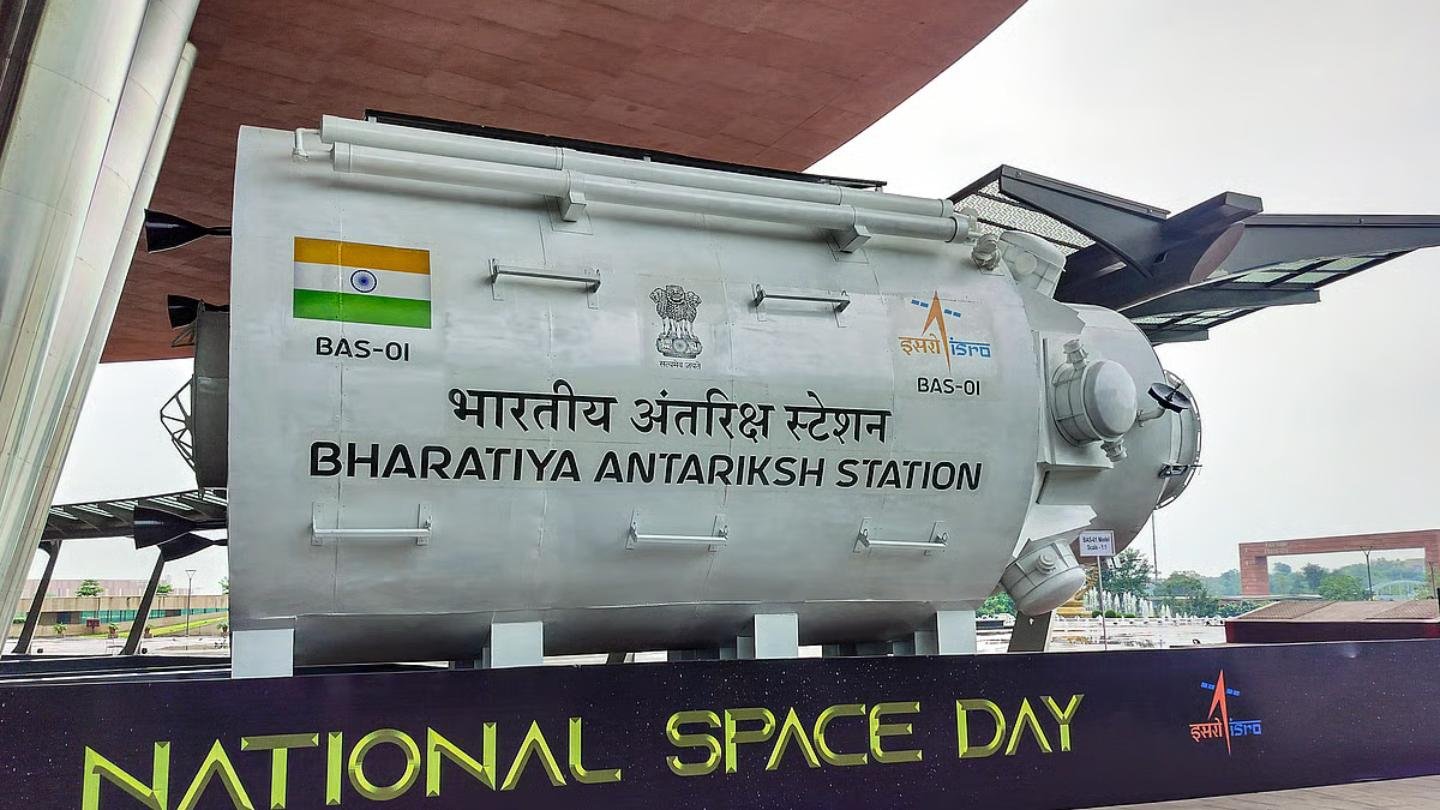
India’s ambitious space exploration plans took a significant leap forward with the unveiling of a model of the Bharatiya Antariksh Station (BAS) by the Indian Space Research Organisation (ISRO) at the National Space Day celebrations in New Delhi. The model, showcased during the two-day event, represents India’s first self-built space station, marking the country’s entry into the elite group of nations with orbital laboratories.
Plans for Launch and Development
ISRO plans to launch the first module of the BAS, the BAS-01, by 2028. This will place India among the few nations operating orbital labs, joining the ranks of the International Space Station (ISS) and China’s Tiangong space station. The full-fledged space station, consisting of five modules, is set to be completed by 2035.
The first BAS module will weigh around 10 tonnes and will be placed in a low Earth orbit approximately 450 km above the Earth.
Key Features of the Bharatiya Antariksh Station
The BAS will feature a range of advanced technologies and systems, including:
- Environmental Control and Life Support System (ECLSS): Ensuring the station’s habitability for the crew.
- Bharat Docking System & Bharat Berthing Mechanism: Facilitating the docking of spacecraft.
- Automated Hatch System: For seamless crew access.
- Microgravity Research Platform: Enabling scientific experiments in microgravity.
- Viewports for Scientific Imaging & Crew Recreation: Supporting both research and crew well-being.
The station will also support space suits, airlocks for extravehicular activities, and the ability to refill propulsion and life-support fluids. The station is designed with protection against radiation, thermal damage, and micro-meteoroid debris (MMOD).
Research and Space Tourism
The BAS will serve as a platform for various research fields, including space science, life sciences, medicine, and interplanetary exploration. It will provide crucial insights into the effects of microgravity on human health and serve as a testbed for technologies needed for long-term human presence in space.
In addition to research, the BAS will also play a role in space tourism, allowing India to tap into the commercial space sector by leveraging the space station’s capabilities. The station is expected to be a hub for international collaboration and inspire future generations of scientists and engineers.
A Glimpse Into the Future
The model of the BAS-01, measuring 3.8 meters by 8 meters, was the highlight of the National Space Day event, drawing significant attention from space enthusiasts and the general public. ISRO’s vision for the BAS demonstrates India’s growing capabilities in space exploration, with the space station contributing to the global scientific community and advancing India’s position in the field of space technology.
Image Source: PTI (Press Trust of India)