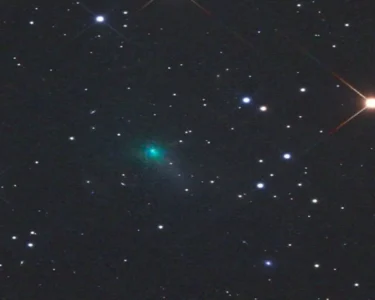
An interstellar object named 3I/ATLAS is once again making its way toward Earth, prompting both scientific curiosity and speculation about potential risks. This celestial body, originally discovered in 2017, has captured the attention of astronomers due to its unique origin outside our solar system. While scientists are eager to study 3I/ATLAS to glean insights into the composition and characteristics of objects from other star systems, some concerns have been raised about the possibility of it posing a threat to our planet.
Discovery and Trajectory
3I/ATLAS was first identified by the Asteroid Terrestrial-impact Last Alert System (ATLAS) survey, a project dedicated to detecting near-Earth objects that could potentially collide with our planet. Its highly eccentric orbit and exceptionally high velocity indicated that it originated from interstellar space, making it only the second such object ever observed, after ‘Oumuamua. As 3I/ATLAS approaches Earth, astronomers are diligently tracking its trajectory to determine the likelihood of any impact.
Potential Risks and Scientific Assessments
While the vast majority of asteroids and comets pose no threat to Earth, the possibility of a collision with a larger object is a legitimate concern. Scientists carefully analyze the size, composition, and trajectory of near-Earth objects to assess the level of risk they present. In the case of 3I/ATLAS, its size and composition are still being studied, but initial estimates suggest that it is not large enough to cause a catastrophic event. However, even a smaller impact could still result in localized damage and disruption.
Scientific Significance and Research Opportunities
Despite the potential risks, 3I/ATLAS presents a valuable opportunity for scientific research. By studying its composition and characteristics, scientists hope to learn more about the formation and evolution of planetary systems beyond our own. Interstellar objects like 3I/ATLAS can provide insights into the building blocks of other star systems and the processes that shape them. Observations of 3I/ATLAS are being conducted using telescopes around the world, and the data collected will be crucial in understanding its nature and origin.
Public Awareness and Ongoing Monitoring
The approach of 3I/ATLAS has also sparked public interest and discussions about the potential hazards of near-Earth objects. While the scientific community is actively monitoring the object and assessing any potential risks, it is important to rely on credible sources of information and avoid sensationalism. Ongoing monitoring efforts will continue to refine our understanding of 3I/ATLAS and its trajectory, ensuring that any potential threat is identified and addressed in a timely manner. The study of interstellar objects like 3I/ATLAS not only advances our scientific knowledge but also highlights the importance of planetary defense and the ongoing efforts to protect our planet from potential impacts.
Image Source: Google | Image Credit: Respective Owner