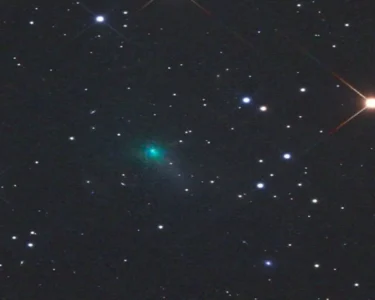
In a groundbreaking discovery, astronomers have confirmed the presence of water being released from the interstellar comet 3I/ATLAS, even at a vast distance from the Sun. This remarkable finding, validated by both NASA and the European Space Agency (ESA), sheds new light on the composition and behavior of comets originating from beyond our solar system. The observations challenge previous assumptions about cometary activity at such extreme distances.
Discovery and Observations
Comet 3I/ATLAS, first discovered in 2019, has been the subject of intense scrutiny due to its interstellar origin. Unlike comets that orbit our Sun, 3I/ATLAS hails from another star system, making it a rare and valuable object for study. Scientists have used various telescopes and instruments, including the Hubble Space Telescope, to monitor the comet’s behavior as it traverses our solar system. The recent detection of water release was particularly significant, as it occurred much farther from the Sun than typically observed in solar system comets.
The water release was detected through spectroscopic analysis, which identifies the chemical composition of the comet’s coma – the cloud of gas and dust surrounding the nucleus. The presence of water molecules was confirmed by identifying their characteristic spectral signatures. This analysis provided crucial evidence that the comet’s icy material is sublimating, or turning directly into gas, even in the frigid conditions of the outer solar system.
Implications for Cometary Science
The discovery has significant implications for our understanding of cometary science. It suggests that some interstellar comets may have a higher abundance of volatile compounds, such as water, than previously thought. This could be due to the different formation environments in other star systems. Furthermore, the fact that water is being released at such a distance implies that the comet’s surface layers are more susceptible to sublimation than those of typical solar system comets.
This challenges existing models of cometary behavior, which often assume that water sublimation is driven primarily by solar radiation. In the case of 3I/ATLAS, other factors, such as internal heating or the composition of the ice, may be playing a more significant role. This discovery prompts further research into the physical and chemical processes that govern cometary activity, particularly in interstellar objects.
Future Research
The ongoing study of 3I/ATLAS and other interstellar comets promises to provide valuable insights into the diversity of planetary systems beyond our own. Future observations will focus on characterizing the comet’s composition in greater detail, including the relative abundances of different volatile compounds. Scientists also hope to determine the comet’s size and shape, which can provide clues about its formation and evolution. These investigations will contribute to a more comprehensive understanding of the origins and properties of these celestial wanderers, enriching our knowledge of the cosmos.
The collaborative efforts of NASA, ESA, and other international research institutions underscore the importance of studying these rare interstellar visitors. As technology advances, astronomers will have even more powerful tools at their disposal to unravel the mysteries of these fascinating objects.
Image Source: Google | Image Credit: Respective Owner