Researchers at IIT-Madras have unveiled a new class of soft, magnetically responsive materials that can bend, twist, curl, and grip — all without motors, wires, or onboard electronics. These “shape-shifting” soft robots, inspired by nature, could transform fields such as minimally invasive surgery, biomedical devices, and precision lab automation.
The work, detailed in a recent paper by Dharmi Chand and Sivakumar M S, focuses on soft magnetic actuators — flexible polymers embedded with soft magnetic particles that only magnetise when exposed to a magnetic field, and return to a neutral state when the field is removed. This allows precise, repeatable, and reversible motion control without the hysteresis issues seen in traditional hard-magnetic designs.
How It Works
The team infused silicone-based actuators with carbonyl iron particles, aligning them in specific patterns using magnetic fields. They then advanced the process by embedding thin iron rods inside the polymer, acting like “internal muscles” to create complex programmed movements. This method eliminates the need for intricate moulding and opens the door to scalable production, even outside high-tech labs.
Prototypes in Action
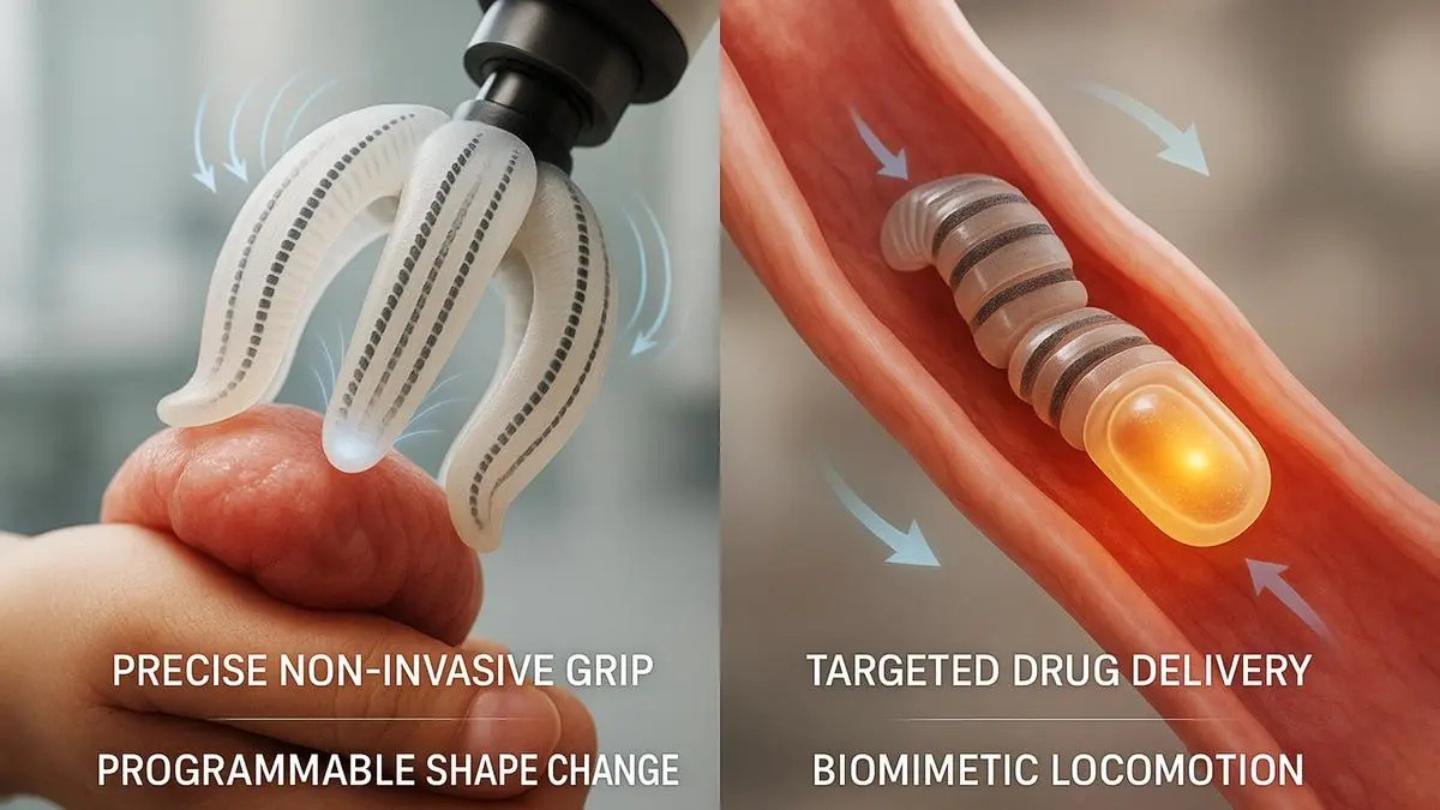
- Flower-Like Gripper – Inspired by blooming petals, the gripper’s six flexible arms, embedded with layered iron rods, can grasp and release objects of varying shapes and textures with fine control over grip strength and timing. This design is especially suited for delicate handling in sterile or constrained environments.
- Curling Crawler – A soft strip that “inches” forward when exposed to an oscillating magnetic field. Two embedded magnetic rods at the ends contract and release in sync, propelling the device at 2.5 mm per second. By adjusting rod placement, researchers can change bending patterns and travel direction.
Future Potential
According to Chand, magnetic soft robots could one day be used in targeted drug delivery, wearable devices, environmental sensing, and even space exploration. Upcoming developments may integrate AI-guided actuation, real-time field control, and miniaturisation for more advanced tasks.
By combining nature-inspired design with a scalable fabrication process, IIT-Madras’s innovation could help soft robotics reach real-world deployment faster — enabling machines that are safer, more adaptive, and capable of going where traditional robots cannot.
Image Source: Google Images
Image Credit: Respective Owner