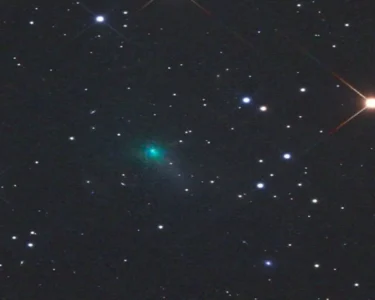
Avi Loeb, a Harvard University astronomer, has ignited a fresh wave of debate by suggesting that the interstellar object designated 3I/ATLAS, which traversed our solar system in 2022, could potentially be an alien spaceship. Loeb, known for his unconventional theories and outspoken nature, has long been a proponent of the idea that extraterrestrial life may have already visited Earth.
3I/ATLAS was initially identified as a comet, but its unusual trajectory and lack of a visible coma (the cloud of gas and dust that typically surrounds a comet’s nucleus) raised eyebrows among astronomers. Loeb argues that these anomalies, combined with the object’s high velocity and apparent non-gravitational acceleration, suggest a more artificial origin.
The Case for an Alien Artifact
Loeb points to the possibility that 3I/ATLAS could be a piece of advanced alien technology, perhaps a light sail propelled by radiation pressure from the sun or other stars. This technology could allow interstellar travel at significant speeds, making the exploration of other star systems feasible for extraterrestrial civilizations.
Loeb emphasizes that this is only a hypothesis, but he believes it warrants serious investigation. He stresses the importance of remaining open to the possibility of extraterrestrial life and the potential for advanced technologies beyond our current understanding. He is actively involved in efforts to search for technosignatures, indicators of advanced alien technology, through his Galileo Project.
The Galileo Project, which Loeb leads, aims to systematically search for physical objects of potential extraterrestrial origin in our solar system. This includes deploying telescopes and sensors to monitor near-Earth space and analyze any anomalous objects that are detected. The project hopes to gather more concrete evidence to support or refute the possibility of alien visitation.
Skepticism and Scientific Rigor
Loeb’s claims have been met with skepticism from many in the scientific community, who argue that the evidence for an alien origin of 3I/ATLAS is circumstantial at best. They point to other, more conventional explanations for the object’s behavior, such as the possibility that it is a fragment of a larger object or that its non-gravitational acceleration is caused by unseen outgassing.
Despite the skepticism, Loeb remains undeterred. He believes that the potential implications of discovering extraterrestrial life are so profound that it is essential to explore even seemingly outlandish possibilities. He encourages a more open-minded approach to the search for extraterrestrial intelligence and a willingness to challenge conventional assumptions.
The debate surrounding 3I/ATLAS and the possibility of alien visitation highlights the ongoing quest to understand our place in the universe and the potential for life beyond Earth. While the evidence for alien life remains elusive, the search continues, driven by curiosity, scientific rigor, and the enduring hope of making one of the most transformative discoveries in human history.
Image Source: Google | Image Credit: Respective Owner