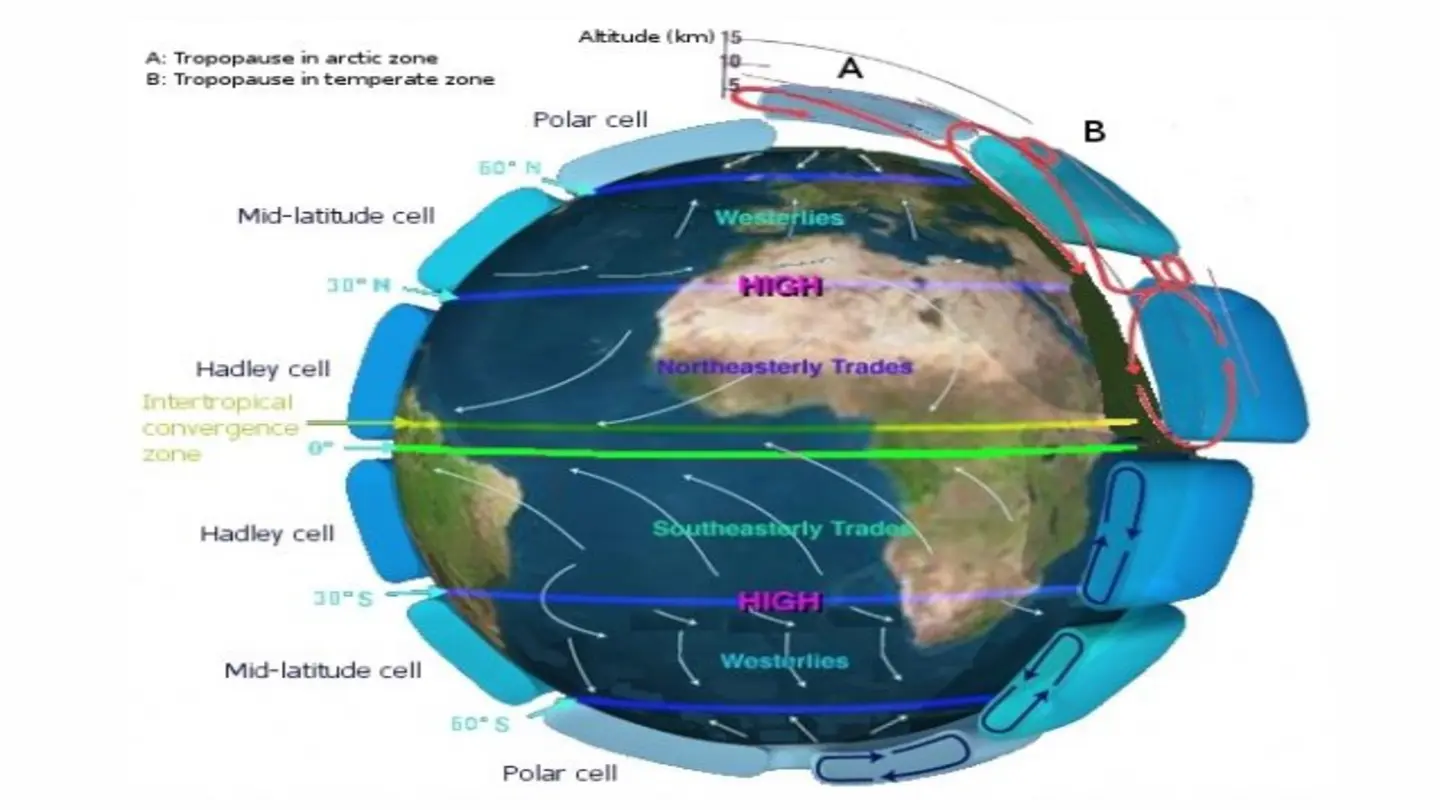
New research published in ESS Open Archive explores the link between Hadley Cell instability and slow equatorial motions, utilizing reanalysis data and CMIP6 climate models. The study delves into the complexities of atmospheric circulation and its impact on global climate patterns. The Hadley Cell, a major atmospheric circulation pattern, plays a crucial role in redistributing heat from the tropics to the subtropics. Understanding its dynamics is vital for accurate climate modeling and prediction.
The Hadley Cell and Equatorial Dynamics
The research investigates how instabilities within the Hadley Cell influence the speed and direction of equatorial motions. These motions, including the movement of the Intertropical Convergence Zone (ITCZ), have significant implications for regional rainfall patterns and overall climate variability. By analyzing reanalysis data, which combines observational data with model simulations, the researchers were able to identify key factors contributing to Hadley Cell instability.
The study also examines the performance of CMIP6 models in replicating these observed relationships. CMIP6, or Coupled Model Intercomparison Project Phase 6, is a large-scale international effort involving numerous climate models from around the world. These models are used to project future climate scenarios and assess the impacts of climate change. The researchers compared the CMIP6 model outputs with reanalysis data to evaluate how well the models capture the link between Hadley Cell instability and equatorial motions.
Model Performance and Implications
The findings reveal variations in the ability of CMIP6 models to accurately simulate these crucial atmospheric processes. Some models demonstrate a strong correlation between Hadley Cell instability and equatorial motion, while others show weaker or even contradictory relationships. These discrepancies highlight the need for further improvements in climate models to better represent the complex dynamics of the tropical atmosphere.
The study’s implications are significant for climate prediction. A more accurate understanding of the Hadley Cell and its influence on equatorial motions can lead to improved forecasts of regional rainfall and other climate variables. This, in turn, can inform adaptation strategies and help communities prepare for the impacts of climate change. Further research is needed to refine climate models and reduce uncertainties in future climate projections. The work emphasizes the importance of continued collaboration and data sharing among climate scientists to enhance our understanding of the Earth’s climate system.
The research highlights the critical role of accurate climate modeling in addressing the challenges posed by climate change. By improving our understanding of atmospheric circulation patterns and their interactions, scientists can provide more reliable information to policymakers and the public, enabling better-informed decisions about climate action.
Image Source: Google | Image Credit: Respective Owner