Researchers have unveiled a novel mechanism behind the self-reversal of magnetization observed in greigite, a common iron sulfide mineral found in diverse environments including sediments, volcanic rocks, and even within the human brain. The study, published in the ESS Open Archive, details how antiparallel vortex-core coupling during low-temperature oxidation drives this magnetic behavior.
Greigite is known for exhibiting a peculiar tendency to spontaneously reverse its magnetic polarity, a characteristic crucial for understanding its role in paleomagnetic records and biological magnetoreception. Previous explanations for this reversal have been incomplete, failing to fully account for the observed dynamics. This new research, leveraging advanced experimental techniques, provides a more comprehensive understanding of the underlying physics.
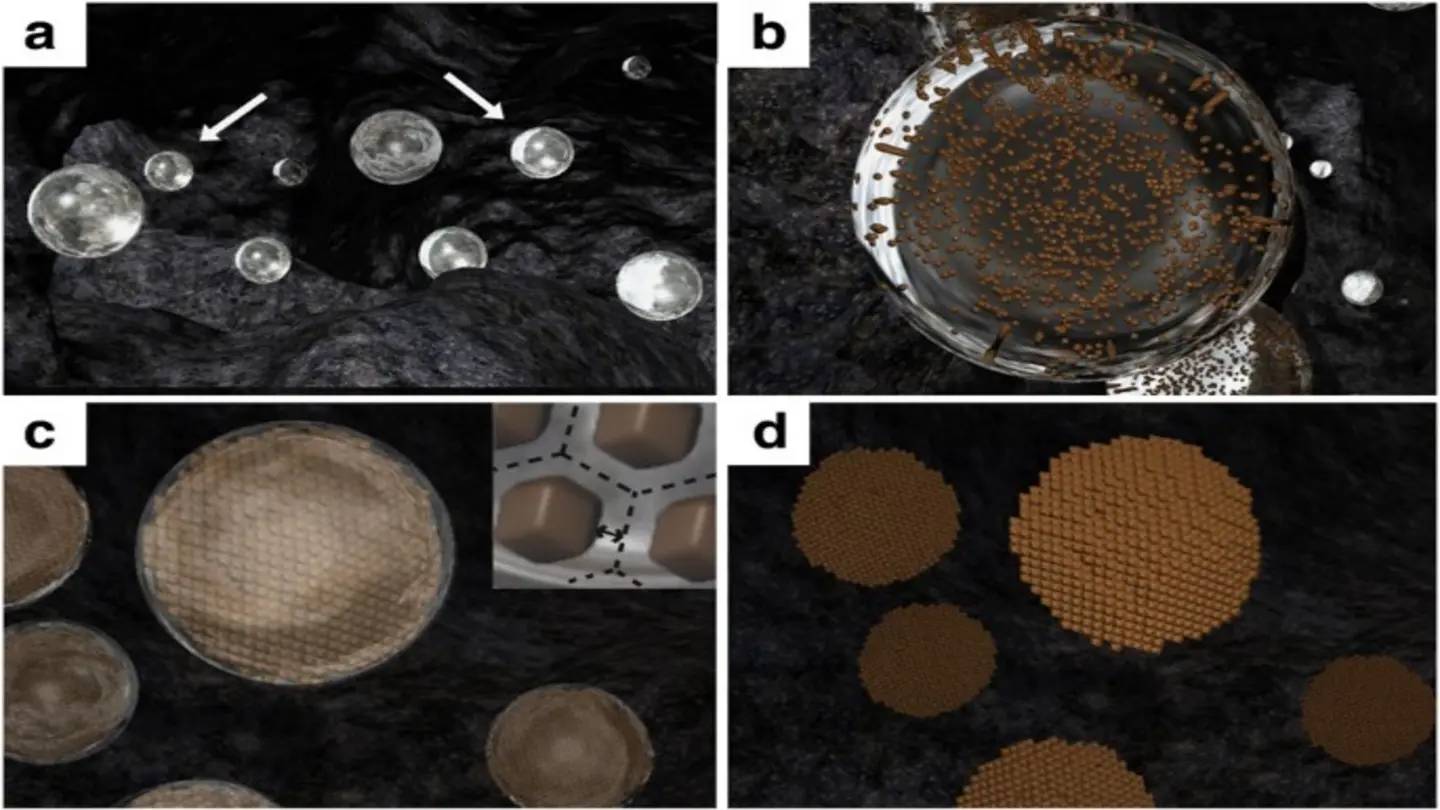
The team focused on the oxidation process of greigite at low temperatures. They discovered that as the mineral oxidizes, magnetic vortices – swirling arrangements of magnetic moments – form within its structure. Critically, these vortices don’t align in the same direction. Instead, they couple in an antiparallel fashion, meaning their magnetic fields oppose each other. This opposing arrangement creates an instability that ultimately leads to the self-reversal of the greigite’s overall magnetization.
Implications for Paleomagnetism and Biomagnetism
The findings have significant implications for the field of paleomagnetism, which uses the magnetic properties of rocks to reconstruct Earth’s magnetic field history. Greigite’s ability to self-reverse can complicate these reconstructions if not properly understood. By identifying the vortex-core coupling mechanism, scientists can develop more accurate models for interpreting paleomagnetic data from greigite-bearing sediments.
Furthermore, the research sheds light on the potential role of greigite in biological magnetoreception – the ability of animals to sense magnetic fields. Certain bacteria and animals, including birds and insects, contain greigite crystals believed to be involved in navigation. Understanding how greigite’s magnetic properties are influenced by oxidation and vortex dynamics could provide insights into the biophysical processes underlying this remarkable sensory capability.
The experiments involved carefully controlled oxidation of greigite samples while monitoring their magnetic properties using techniques like SQUID magnetometry and transmission electron microscopy. These observations allowed the researchers to directly visualize the formation and coupling of the magnetic vortices. The study highlights the importance of considering nanoscale magnetic structures and their interactions when investigating the magnetic behavior of minerals.
Researchers emphasize that this is a fundamental step towards a more complete understanding of greigite’s magnetic properties. Future work will focus on exploring the influence of different oxidation conditions, crystal sizes, and the presence of other minerals on the vortex-core coupling mechanism and the resulting magnetic reversal. The team believes that this research will pave the way for new applications of greigite in areas such as magnetic data storage and biosensing.
This discovery provides a crucial piece of the puzzle in understanding the complex magnetic behavior of greigite, bridging the gap between theoretical models and experimental observations. It opens new avenues for research in both geological and biological contexts, promising a deeper understanding of Earth’s magnetic history and the fascinating world of animal navigation.
Image Source: Google | Image Credit: Respective Owner