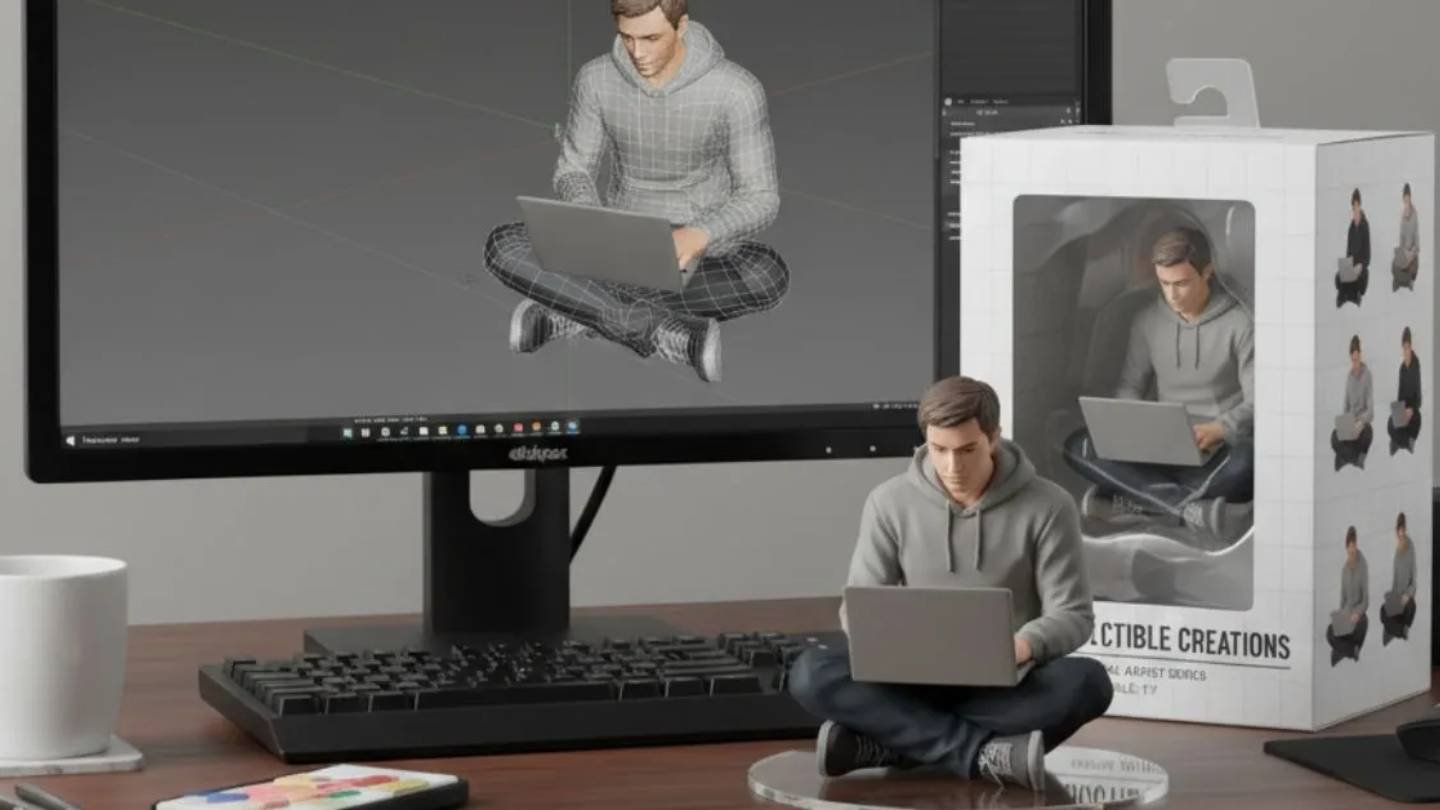
Google has introduced an innovative AI tool, internally nicknamed “Nano Banana,” that allows users to generate 3D figurines from text prompts. This technology democratizes 3D design, making it accessible to individuals without specialized skills or expensive software. The ability to create customized 3D models opens up a wide range of possibilities, from personalized avatars to unique decorative objects.
How Nano Banana Works
The core of Nano Banana lies in its sophisticated AI algorithms that interpret text descriptions and translate them into detailed 3D representations. Users simply input a prompt, such as “a cute cartoon cat wearing a hat,” and the AI generates a corresponding 3D model. The system considers various factors, including object shape, texture, and color, to produce a realistic and visually appealing result. The generated models can then be downloaded and used for various purposes, including 3D printing, animation, and virtual reality applications.
This technology is still in its early stages of development, and Google is continuously working to improve its accuracy and capabilities. One of the key challenges is ensuring that the AI can accurately interpret a wide range of prompts and handle complex or ambiguous descriptions. Another focus is on enhancing the realism and detail of the generated models, making them more suitable for professional applications.
Free and Accessible 3D Creation
One of the most significant aspects of Nano Banana is its accessibility. Unlike traditional 3D modeling software, which can be expensive and require extensive training, Nano Banana is designed to be user-friendly and free to use. This makes it an attractive option for hobbyists, educators, and anyone who wants to explore the world of 3D design without significant investment. By lowering the barrier to entry, Google hopes to foster creativity and innovation in the 3D space.
Potential Applications
The potential applications of Nano Banana are vast and diverse. In education, it can be used to create interactive learning materials and allow students to visualize complex concepts in 3D. In entertainment, it can be used to generate custom characters and props for games and animations. In manufacturing, it can be used to prototype new products and create personalized designs. As the technology continues to evolve, its impact on various industries is expected to grow significantly. Google’s Nano Banana is a leap forward in AI-powered design, offering a glimpse into a future where 3D creation is accessible to everyone.
To create your own 3D figurine, experiment with descriptive prompts detailing the desired object, its characteristics, and any specific features you want to include. The more detailed the prompt, the better the AI can generate a model that matches your vision.
Image Source: Google | Image Credit: Respective Owner