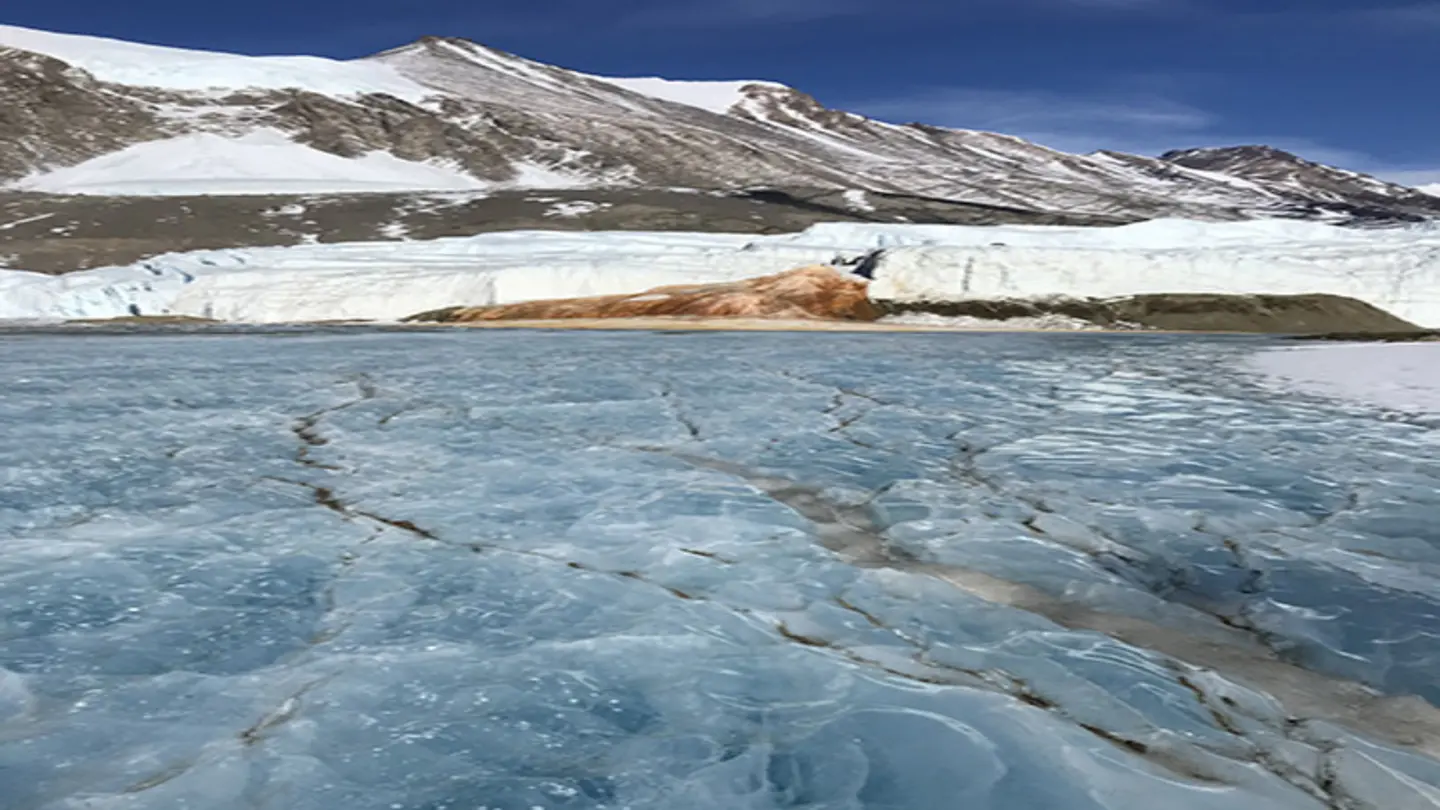
Scientists have discovered a significant connection between glacier surface lowering, subglacial outflow, and the mysterious Blood Falls phenomenon in Antarctica’s McMurdo Dry Valleys. This groundbreaking research, published in the journal Astrobiology, reveals how climate-driven changes in ice dynamics are influencing one of Earth’s most unique natural wonders.
The study, conducted by researchers from the University of Alaska Fairbanks and Colorado College, utilized advanced satellite imagery and ground-penetrating radar to monitor changes in the Taylor Glacier over several years. Their findings indicate that as the glacier surface lowers due to increased melting, it creates pathways for ancient, iron-rich brine to reach the surface, resulting in the distinctive red coloration of Blood Falls.
Blood Falls, first discovered in 1911, has long puzzled scientists with its crimson hue. The reddish coloration is caused by iron-rich brine that oxidizes upon contact with air, similar to how rust forms. However, the source of this brine and the mechanism by which it reaches the surface remained unclear until now.
The research team found that the glacier’s surface lowering, likely accelerated by climate change, is creating new subglacial channels through which the pressurized brine can flow. As the ice thins, it reduces the pressure that previously kept the brine trapped beneath the glacier. This process is causing an increase in the frequency and volume of Blood Falls discharge events.
Dr. Sarah Thompson, lead author of the study, explains: “Our research demonstrates a direct link between climate-driven ice loss and the activation of subglacial hydrological systems. The McMurdo Dry Valleys are one of the most extreme environments on Earth, and understanding these processes is crucial for predicting how polar regions will respond to ongoing climate change.”
The implications of this discovery extend beyond Antarctica. The McMurdo Dry Valleys are considered one of the best Earth analogs for the Martian environment, particularly in terms of their cold, dry conditions and the presence of briny water. Understanding the mechanisms behind Blood Falls could provide valuable insights into potential habitable environments on Mars and other icy worlds in our solar system.
Methodology and Data Collection
The research team employed a multi-faceted approach to gather their data. They used satellite-based interferometric synthetic aperture radar (InSAR) to measure centimeter-scale changes in the glacier’s surface elevation over time. This was complemented by ground-penetrating radar surveys, which allowed the researchers to map the internal structure of the glacier and identify potential pathways for brine flow.
Additionally, the team conducted extensive fieldwork during the Antarctic summer, collecting samples of the brine discharge and measuring various physical and chemical parameters. These on-site measurements were crucial for validating the remote sensing data and providing a comprehensive understanding of the system.
The study also incorporated historical data, including photographs and expedition logs dating back to the early 20th century. By comparing these historical records with modern observations, the researchers were able to establish a timeline of changes in Blood Falls activity and correlate it with documented climate trends in the region.
This research not only solves a long-standing mystery about Blood Falls but also highlights the complex interactions between ice dynamics, subglacial hydrology, and surface features in polar environments. As global temperatures continue to rise, understanding these processes becomes increasingly important for predicting the future of Earth’s cryosphere and its potential as a habitat for extremophile organisms.
The findings underscore the need for continued monitoring of polar regions, particularly in areas like the McMurdo Dry Valleys where unique geological and biological processes are at play. Future research will focus on refining models of subglacial hydrology and exploring the potential for similar systems in other parts of Antarctica and beyond.
Image Source: Google | Image Credit: Respective Owner