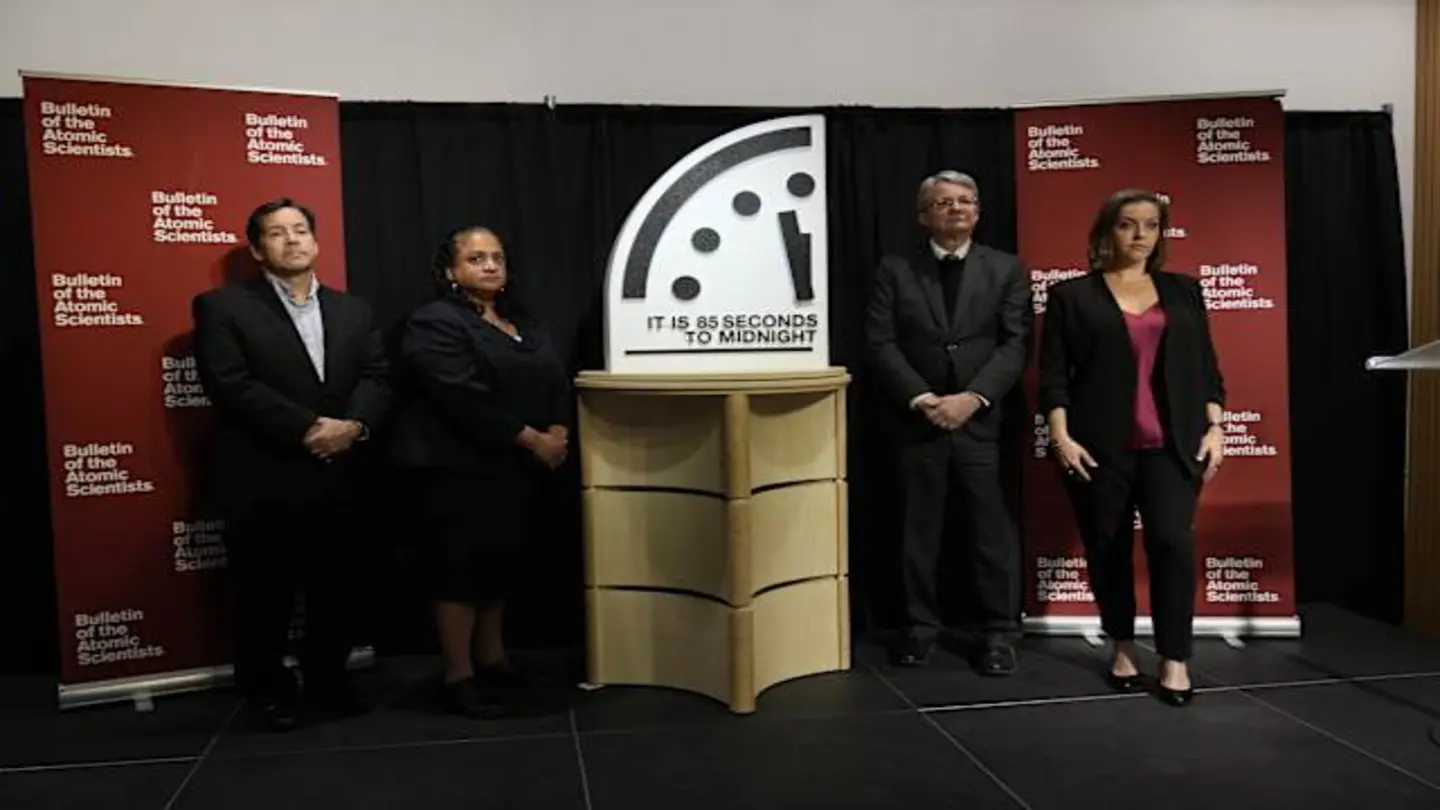
The Bulletin of the Atomic Scientists on Tuesday moved the ‘Doomsday Clock’ to 85 seconds before midnight, the closest it has ever been to signifying global catastrophe. This adjustment, largely influenced by escalating risks from the war in Ukraine, the persistent threat of nuclear weapons, and the accelerating climate crisis, serves as a stark warning about the precarious state of humanity.
The Doomsday Clock, a symbolic representation of the likelihood of human-caused global catastrophe, has been maintained since 1947. It reflects the major global events that could lead to destruction. The clock’s time is determined by the Bulletin’s Science and Security Board, which consults with a board of trustees including Nobel laureates. Historically, the clock’s closest setting to midnight before today was 90 seconds, reached in 2023.
The primary driver for this latest, alarming adjustment is Russia’s full-scale invasion of Ukraine. The conflict has not only led to immense human suffering but has also reinvigorated nuclear risks, with repeated threats from Russian officials regarding the potential use of nuclear weapons. Furthermore, the war has fractured international cooperation on critical issues like arms control and climate change mitigation.
“Ukraine reminds the world what happens when deterrence fails,” said Rachel Bronson, CEO of the Bulletin, in a press conference. “It is a proxy war, but there is nothing ‘proxy’ about the danger to all of us.”
Climate Change a Critical Factor
Beyond the immediate dangers of the war in Ukraine, the Bulletin highlighted the continuing and worsening effects of climate change. Despite international pledges and ambitious goals, global greenhouse gas emissions remain stubbornly high, leading to more frequent and intense extreme weather events. The failure to adequately address climate change is exacerbating resource scarcity, displacement, and instability around the world, compounding other existing risks.
Disinformation and the erosion of public trust in institutions were also identified as significant threats. These factors impede efforts to address complex global challenges effectively as they hinder constructive dialogue and evidence-based decision-making. The rapid development and potential misuse of artificial intelligence (AI) presents a new and evolving set of concerns, particularly regarding the spread of misinformation and the potential for autonomous weapons systems.
The Bulletin emphasized that the clock is not meant to be a prediction of destruction but rather a call to action. While the current situation is undeniably grim, the organization insists that catastrophe is not inevitable. “The Doomsday Clock is a warning, not a prediction of the inevitable,” stated Steve Fetter, a member of the Science and Security Board. “It urges us to pause, assess the threats and work together to reduce them.”
The Bulletin stresses the need for renewed diplomatic efforts, a commitment to arms control agreements, and a swift transition to a sustainable, low-carbon economy. They urge governments and individuals to prioritize cooperation and long-term thinking in order to navigate the complex challenges facing humanity and move the clock away from midnight. A return to dialogue and rebuilding international trust are also seen as vital steps to de-escalate global tensions and foster a more secure future.
Image Source: Google | Image Credit: Respective Owner