Astronomers have utilized a rare cosmic phenomenon – a gravitational lens – to observe an exceptionally active region where a future galaxy cluster is forming. This discovery, detailed in recent research, provides an unprecedented glimpse into the early stages of these massive structures, offering valuable insights into galaxy evolution and the distribution of dark matter.
The region, located approximately 10 billion light-years away, is experiencing a burst of star formation, far exceeding typical rates observed in similar environments. This hyperactive ‘cradle’ is characterized by a dense concentration of gas and dust, the raw materials for new stars, and a surprisingly high number of actively forming stars. The sheer intensity of star birth suggests a rapid assembly of matter, a crucial step in the formation of a galaxy cluster.
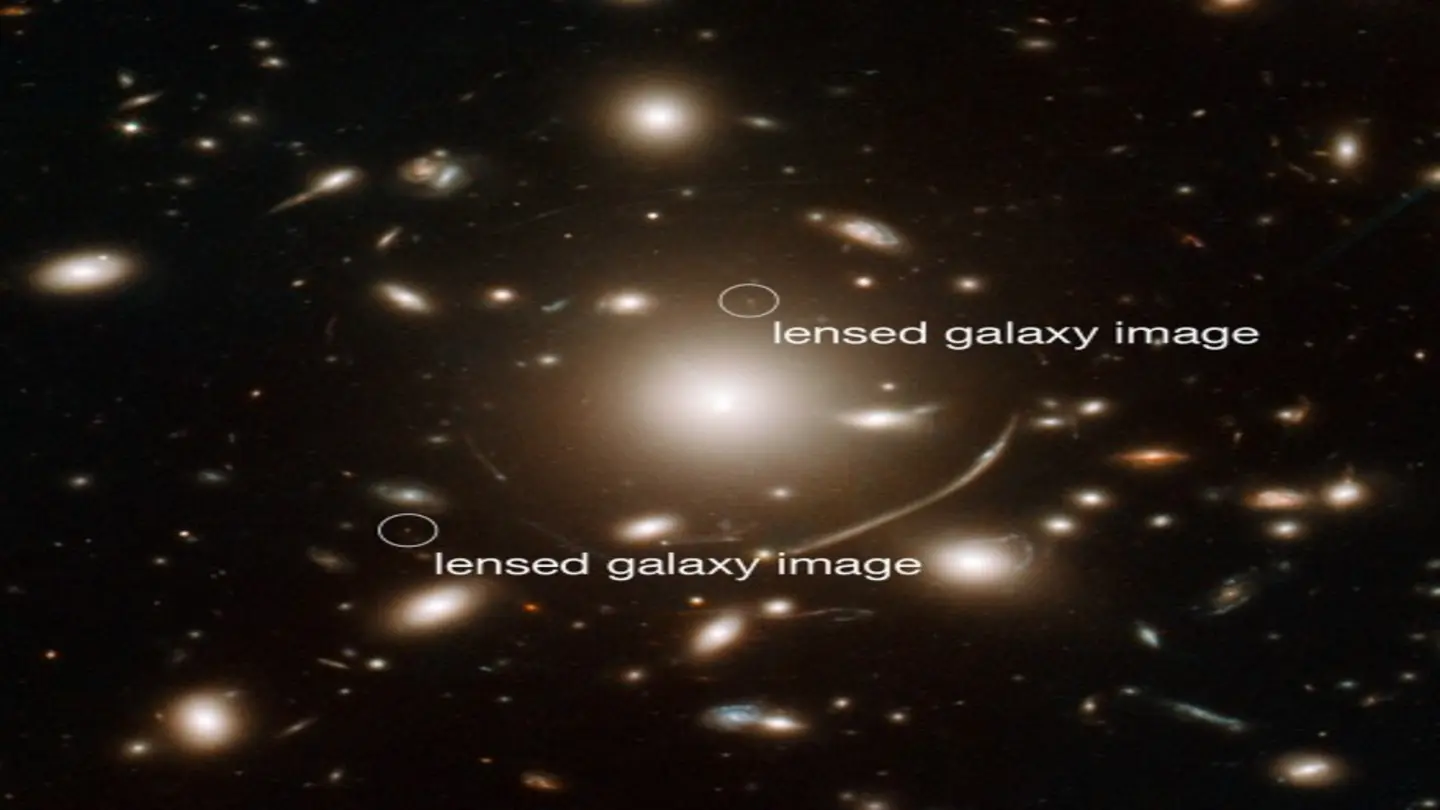
What makes this observation unique is the presence of a foreground galaxy acting as a gravitational lens. This effect, predicted by Einstein’s theory of general relativity, occurs when the gravity of a massive object bends and magnifies the light from objects behind it. In this case, the foreground galaxy’s gravity has amplified the light from the distant star-forming region, allowing astronomers to study it in much greater detail than would otherwise be possible.
The Role of Gravitational Lensing
Without the gravitational lens, the distant region would appear too faint and diffuse to be properly analyzed. The lensing effect essentially provides a natural telescope, boosting the signal and revealing structures that would normally be hidden from view. This technique is becoming increasingly important in astronomy, enabling researchers to probe the early universe and study faint, distant objects.
The observed region is not yet a fully formed galaxy cluster. Instead, it represents a crucial intermediate stage – a protocluster. Protoclusters are the precursors to galaxy clusters, regions where gravity is pulling together galaxies and gas, eventually leading to the formation of a massive, gravitationally bound system. Understanding the conditions within these protoclusters is key to understanding how galaxy clusters themselves evolve.
Researchers believe the intense star formation is triggered by the inflow of gas into the protocluster. This gas, drawn in by the combined gravity of the forming cluster, collides and compresses, igniting the birth of new stars. The study also provides evidence for the presence of significant amounts of dark matter within the protocluster, which plays a crucial role in its gravitational collapse.
The findings have implications for our understanding of the cosmic web, the large-scale structure of the universe. Galaxy clusters are thought to form at the nodes of this web, where filaments of dark matter and gas intersect. By studying protoclusters like this one, astronomers can gain insights into the formation and evolution of the cosmic web itself. Further observations, potentially with the James Webb Space Telescope, are planned to investigate the region in even greater detail and confirm the initial findings.
This discovery highlights the power of combining observational techniques with theoretical models to unravel the mysteries of the universe. The cosmic lens has provided a rare and valuable window into the early stages of galaxy cluster formation, offering a glimpse of the universe as it was billions of years ago.
Image Source: Google | Image Credit: Respective Owner