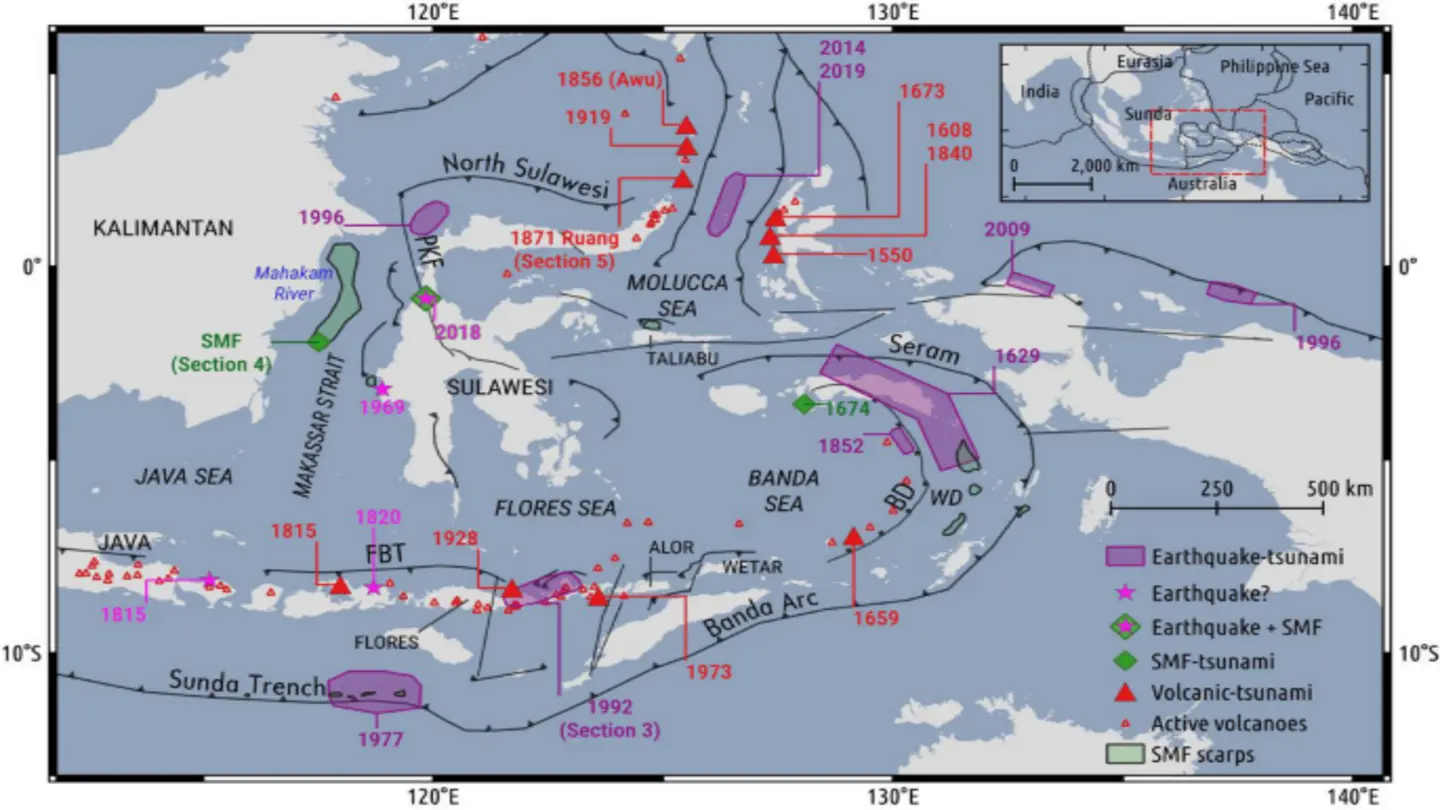
A new study utilizing ambient noise tomography has yielded fresh insights into the complex geological structure beneath the Banda Basin, a region crucial to understanding the collision between the Indonesian arc and the Australian continent. Published in the ESS Open Archive, the research details previously unknown characteristics of the Earth’s crust and upper mantle in this tectonically active zone.
The Banda Basin, located in eastern Indonesia, represents a unique and relatively recent example of arc-continent collision. This process, responsible for forming major mountain ranges like the Himalayas, is currently happening here as the smaller islands of the Indonesian arc continue to move northward and collide with the larger, more stable Australian continental mass. Traditional seismic imaging methods struggle in this region due to its complex structure and lack of large earthquakes. This new research bypasses those limitations.
Researchers employed ambient noise tomography, a technique that uses the constant, low-level vibrations of the Earth – generated by sources like ocean waves, storms, and even human activity – to create images of the subsurface. By analyzing these subtle signals, they were able to map variations in seismic velocity, which are indicative of differences in rock composition, temperature, and density.
The findings reveal a surprisingly heterogeneous structure in the upper mantle beneath the Banda Basin, with significant lateral variations in seismic velocity. These variations suggest the presence of partially molten material and compositional differences related to the ongoing collision. Specifically, the tomography indicates zones of slow seismic velocity, potentially representing regions where the mantle is unusually hot or contains a higher percentage of melt. These areas are believed to be linked to the subduction processes occurring nearby, where oceanic crust is forced beneath continental crust.
Implications for Geological Understanding
This research sheds light on the mechanics of arc-continent collision. The identified anomalies in the upper mantle could play a key role in facilitating the collision by weakening the lithosphere and providing zones for material to flow. The study also helps to contextualize the volcanic activity prevalent throughout the Indonesian archipelago. The presence of melt in the mantle can contribute to magma generation, feeding the numerous volcanoes in the region.
Furthermore, the research provides a baseline for future studies and monitoring of the Banda Basin. By comparing current data with subsequent measurements, scientists can track changes in the subsurface structure and gain a better understanding of how the collision is evolving over time. The evolving dynamics of this region have implications for earthquake and tsunami hazards, making continued monitoring essential.
The approach used in this study highlights the growing importance of ambient noise tomography as a powerful tool for imaging the Earth’s interior, particularly in areas where traditional methods are limited. It demonstrates the potential for leveraging naturally occurring signals to unlock secrets about our planet’s dynamic processes and its deep structure. Future work will focus on integrating these new findings with other geophysical and geological data to build a comprehensive model of the Banda Basin and the surrounding collision zone.
The full study is available through the ESS Open Archive, offering a detailed account of the methodology, findings, and implications of this groundbreaking work. Accessing the full study will provide greater insight into the specific data collection and processing techniques used.
Image Source: Google | Image Credit: Respective Owner