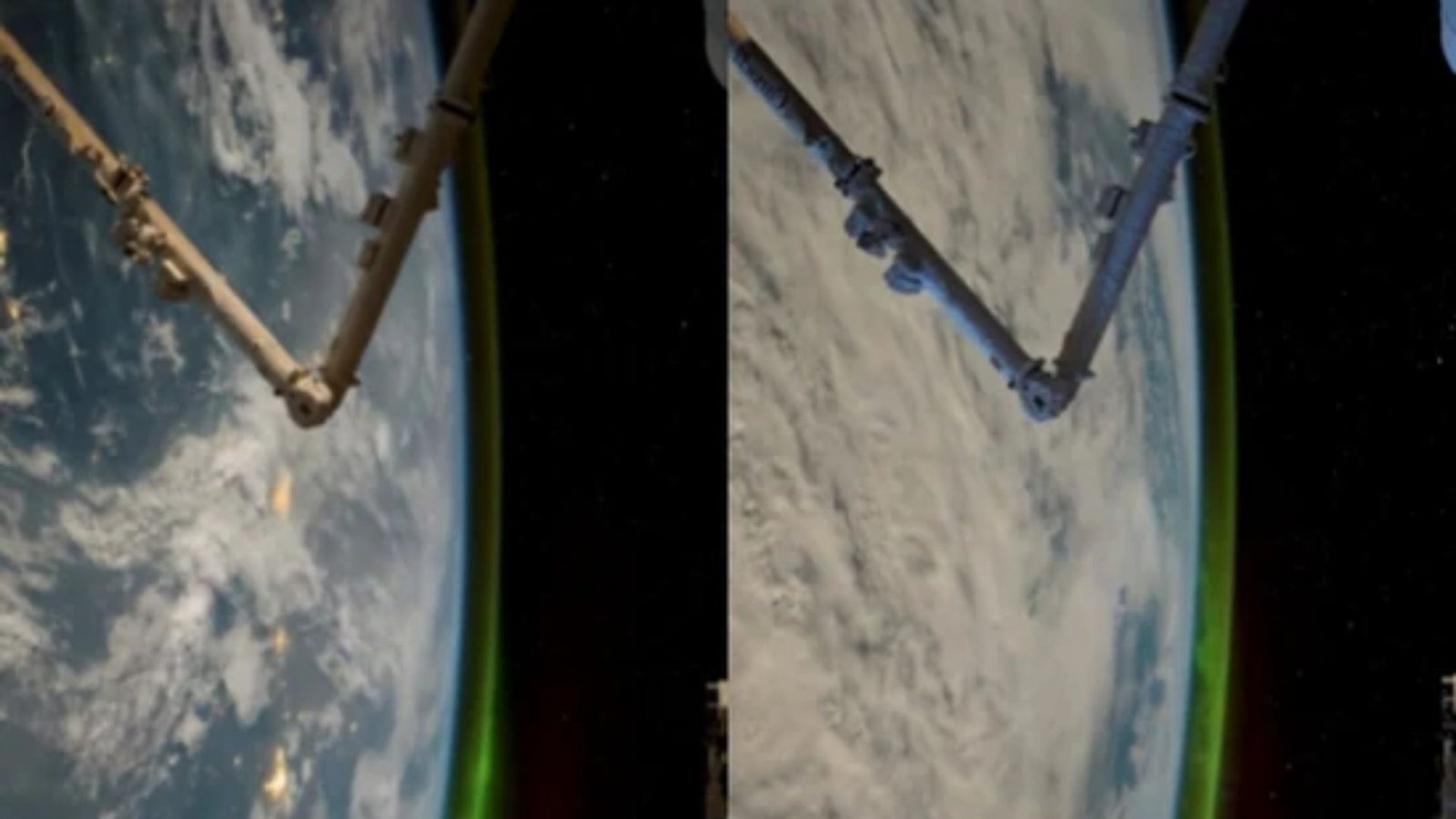
A NASA astronaut has shared a breathtaking video of the aurora borealis, or northern lights, as seen from the International Space Station (ISS). The video, posted on social media, has quickly gone viral, captivating viewers with its mesmerizing display of colors dancing across the Earth’s atmosphere.
The astronaut, whose name was not immediately available, provided a unique perspective on this natural phenomenon, offering a glimpse of the aurora’s beauty from hundreds of miles above the Earth’s surface. The time-lapse footage showcases the vibrant green and purple hues swirling and shifting against the backdrop of stars.
The northern lights, also known as aurora borealis, are a spectacular light show caused by charged particles from the sun interacting with the Earth’s magnetic field. These particles collide with atoms and molecules in the Earth’s atmosphere, releasing energy in the form of light. The colors observed depend on the type of gas molecules involved in the collision. Green is typically produced by oxygen, while purple and blue are often caused by nitrogen.
What Causes the Northern Lights?
The sun constantly emits a stream of charged particles known as the solar wind. When this solar wind reaches Earth, the planet’s magnetic field deflects most of it. However, some particles are channeled towards the Earth’s poles, where they interact with the atmosphere. These interactions are most intense during periods of increased solar activity, such as solar flares and coronal mass ejections.
The aurora is most commonly observed in high-latitude regions, near the Arctic and Antarctic circles. In the Northern Hemisphere, the aurora is often referred to as the northern lights, while in the Southern Hemisphere, it is known as the southern lights, or aurora australis. While the aurora is typically seen closer to the poles, strong solar events can cause the lights to be visible at lower latitudes.
Viewing the Aurora
Many people travel to locations near the Arctic Circle to witness the northern lights firsthand. Popular destinations include Norway, Iceland, Finland, Canada, and Alaska. The best time to see the aurora is during the winter months when the nights are long and dark. Clear skies are also essential for optimal viewing.
The video captured by the NASA astronaut provides a stunning reminder of the beauty and wonder of our planet and the solar system. It also highlights the important work being done by astronauts aboard the ISS to study and understand our world.
The video can be viewed on the astronaut’s social media account, and has already garnered significant attention and positive feedback from viewers around the world. It serves as a powerful example of the inspirational and educational potential of space exploration.
Image Source: Google | Image Credit: Respective Owner