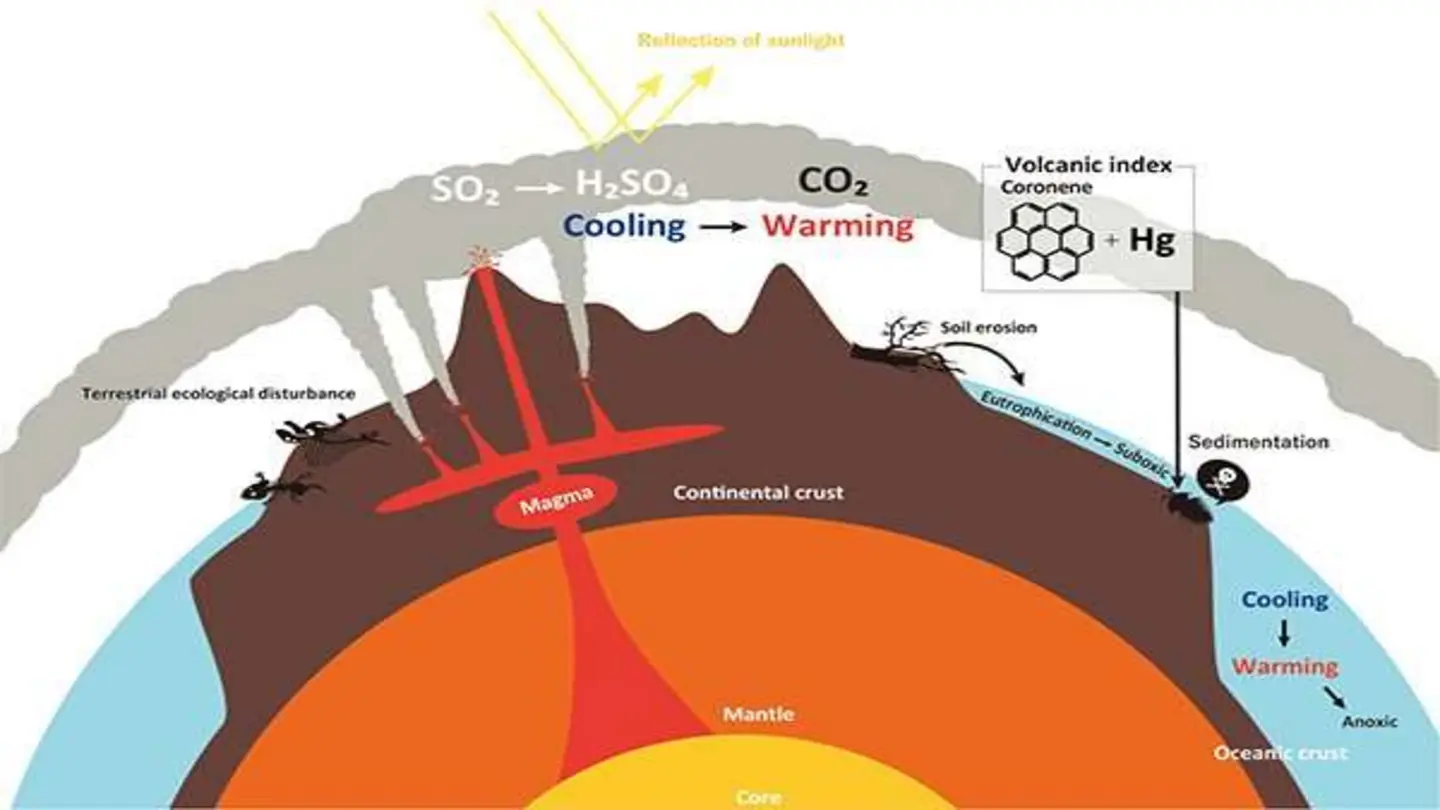
Recent research explores how the Paraná-Etendeka Large Igneous Province (PE-LIP), a massive volcanic formation active around 130 million years ago, influenced Earth’s ancient mercury cycle during the Valanginian Weissert Event. Scientists analyzed geological data to assess the scale of mercury deposition and atmospheric changes tied to this massive eruption.
The study reveals that while the PE-LIP released significant amounts of mercury into the environment, its impact on the global mercury cycle was relatively minor compared to other factors. This challenges earlier assumptions about the dominance of volcanic activity in shaping planetary geo-chemical processes during the Early Cretaceous period.
Researchers used detailed sediment core analysis and geochemical modeling to track mercury levels in ocean sediments. Their findings suggest that other phenomena, such as meteorite impacts or tectonic shifts, played a more critical role in mercury distribution during this time.
The Valanginian Weissert Event, associated with climate fluctuations and ecosystem changes, highlights the complexity of Earth’s systems. Understanding the relative contributions of different factors helps scientists reconstruct past environmental conditions and predict future climate scenarios.
This work underscores the importance of interdisciplinary approaches in studying deep Earth history. By combining volcanology, geochemistry, and climate science, researchers aim to refine models of how natural events interact with planetary systems.
The study, published in ESS Open Archive, offers new insights into how ancient volcanic activity shaped—and was shaped by—Earth’s delicate chemical balance.
Image Source: Google | Image Credit: Respective Owner