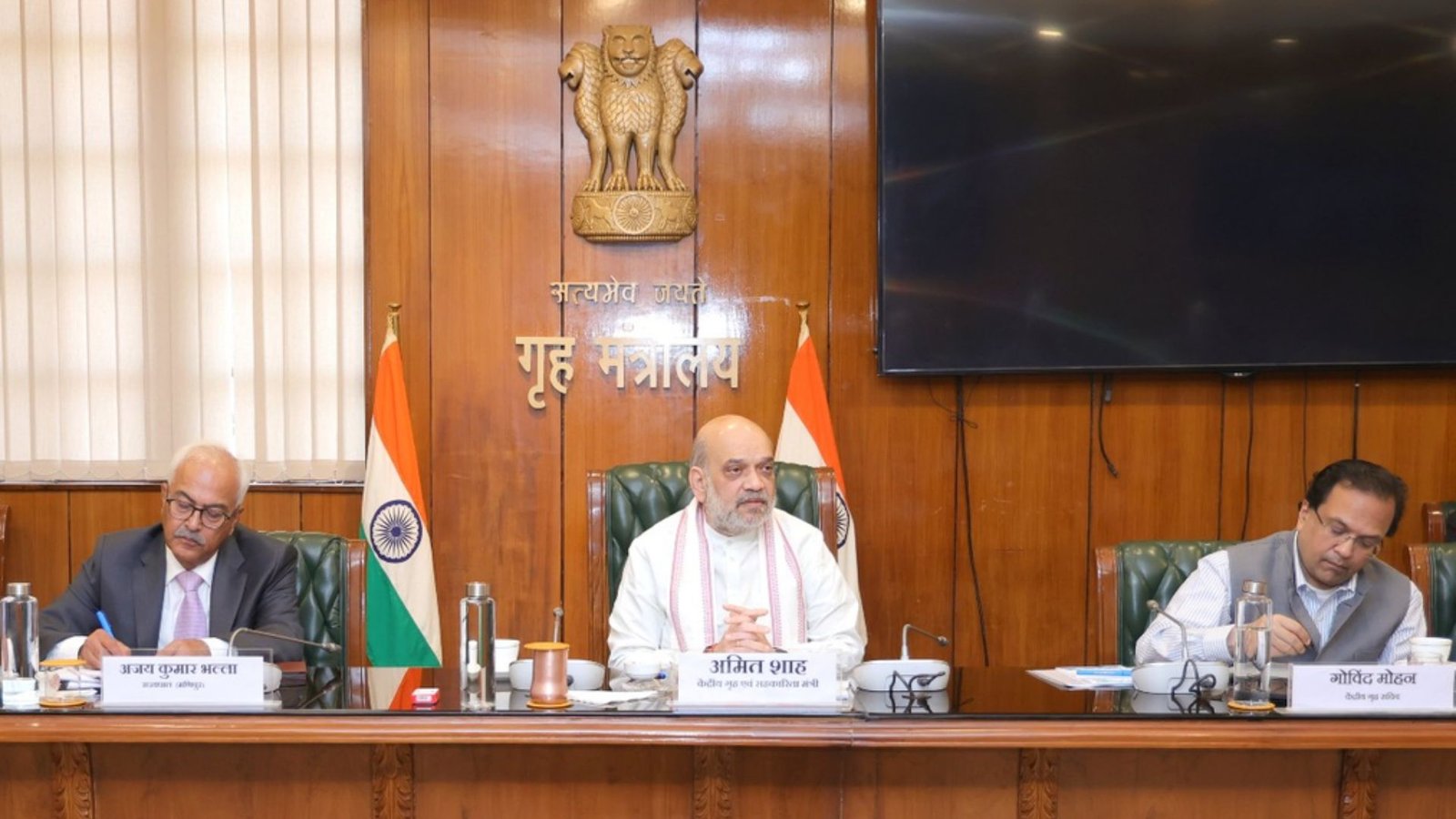
Union Home Minister Amit Shah convened a crucial security review meeting in Raipur, Chhattisgarh, to address escalating concerns over Left-Wing Extremism (LWE) activities in central India. The high-level gathering brought together Chief Ministers from LWE-affected states, senior security officials, and intelligence experts to formulate coordinated counter-insurgency strategies.
Key Attendees and Strategic Discussions
Chhattisgarh Chief Minister Vishnu Deo Sai joined counterparts from Jharkhand, Odisha, Maharashtra, and Andhra Pradesh alongside National Security Advisor Ajit Doval. Officials presented detailed briefings on recent Maoist activities, highlighting emerging tactical patterns and resource mobilization tactics employed by insurgent groups.
Discussions focused on augmenting inter-state intelligence sharing through the Multi-Agency Centre (MAC) framework and enhancing technological surveillance capabilities in remote forest regions. Shah emphasized the necessity of ‘smart policing’ initiatives integrating drones, satellite imagery, and AI-powered monitoring systems to neutralize guerrilla tactics.
Development-Driven Security Framework
The ministerial dialogue prioritized a dual-track approach combining security operations with accelerated infrastructure development. Plans were finalized to fast-track 4,500 km of rural road construction under the Road Connectivity Project for LWE Areas (RCPLWE), alongside establishing 195 new telecom towers in dead zones.
Security forces received directives to intensify operations focusing on choke points along the Maharashtra-Madhya Pradesh-Chhattisgarh (MMC) and Bihar-Jharkhand-North Chhattisgarh (BJN) corridors. Special attention was accorded to disrupting underground financing networks sustaining Maoist procurement activities.
Security Gains and Emerging Hotspots
Officials reported a 52% reduction in LWE-related incidents since 2015, with fatalities decreasing by 70% during this period. However, intelligence assessments flagged renewed recruitment activity in six districts spanning Odisha’s Malkangiri and Jharkhand’s Khunti regions, prompting revised deployment protocols.
The meeting reviewed progress on 14,000 state police vacancies being filled in sensitive zones and approved specialized training programs for 89 counter-insurgency battalions. Shah mandated monthly progress reviews of the ₹2,300-crore Special Central Assistance scheme for LWE-affected districts.
Next-Phase Counter-Insurgency Roadmap
Security establishments were instructed to implement Phase-II of the National Policy and Action Plan to Combat LWE, emphasizing precision operations leveraging UAV surveillance and airborne battalions. The Home Ministry committed to operationalizing three new Cobra commando units by September 2024.
Concluding discussions addressed rehabilitation frameworks for surrendered Maoists, including skill development partnerships with NSDC and enhanced security for infrastructure project workers. Shah affirmed the government’s commitment to ‘lasting peace through permanent solutions,’ setting a six-month deadline for measurable operational outcomes.
Image Source: Google | Image Credit: Respective Owner