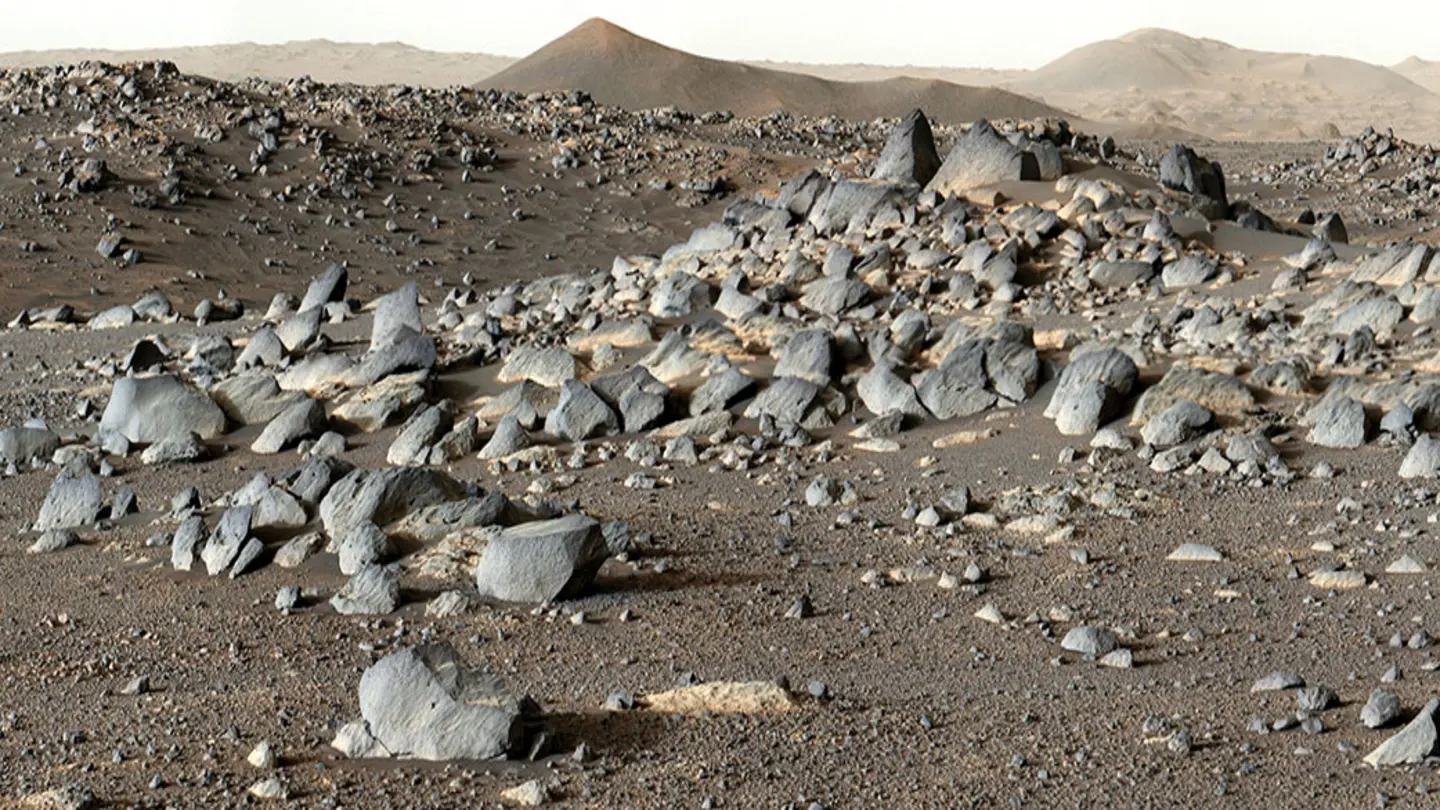
New findings suggest that speckled rocks on Mars may be the clearest indication of past life found to date. Scientists analyzing images and data from the Perseverance rover have identified unique rock formations with distinctive patterns, leading them to believe that these structures could be fossilized microbial colonies. The discovery, published in a recent issue of the Journal of Astrobiology, has ignited excitement in the scientific community and fueled further exploration efforts.
The Evidence
The rocks, located in the Jezero Crater, an ancient lakebed, exhibit a ‘speckled’ appearance due to the presence of mineral deposits. Researchers propose that these minerals, primarily carbonates and silicates, were formed by ancient microorganisms. The patterns observed are consistent with those created by microbial mats on Earth, which are complex communities of bacteria and other microorganisms that thrive in aquatic environments. These mats can leave behind distinctive fossilized structures as they interact with their surrounding environment, precipitating minerals and creating layered formations.
“The evidence is compelling,” said Dr. Emily Carter, lead author of the study and a planetary geologist at the California Institute of Technology. “The texture, mineral composition, and location of these rocks all point to a biological origin. While we cannot definitively say that these are fossils of Martian life, they are the strongest biosignatures we’ve found so far.” The Perseverance rover is equipped with advanced instruments capable of analyzing the chemical composition and structure of rocks at a microscopic level. This data has been crucial in supporting the hypothesis that the speckled rocks are indeed fossilized microbial colonies.
Implications for Future Research
The discovery has significant implications for future Mars exploration. NASA and other space agencies are now prioritizing missions to collect and return samples from the Jezero Crater to Earth for further analysis. These samples could provide definitive proof of past life on Mars. Furthermore, the findings could help scientists understand the conditions necessary for life to arise on other planets and moons throughout the solar system. The study also highlights the importance of studying analogous environments on Earth, such as ancient lakebeds and hot springs, which may provide clues about the types of life that could have existed on Mars.
The ongoing investigation underscores the potential for Mars to hold secrets about the origins and evolution of life in the universe. While further research is needed to confirm the biological origin of the speckled rocks, the current evidence is highly suggestive and represents a major step forward in the search for extraterrestrial life. The quest to definitively answer the question of whether life once existed on Mars continues to drive scientific innovation and exploration.
This discovery not only enhances our understanding of Mars but also provides valuable insights into the broader context of astrobiology and the potential for life beyond Earth. The speckled Martian rocks may well be a Rosetta Stone, unlocking secrets of life’s origins and expanding our perspective on the universe.
Image Source: Google | Image Credit: Respective Owner