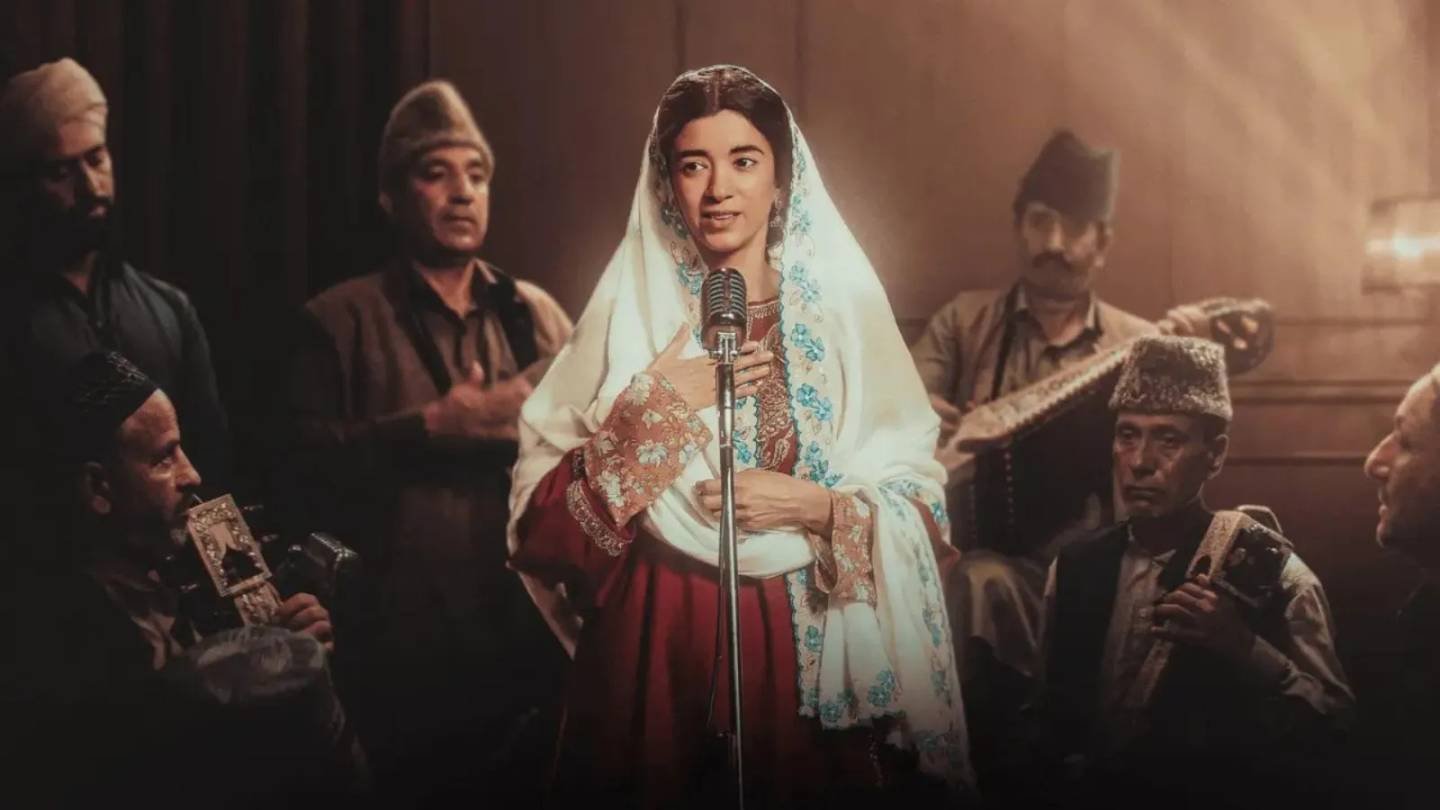
Raj Begum, the iconic Kashmiri singer, whose soulful voice captivated generations, was not just a musical talent; she was a symbol of resistance against the conservative norms of her time. As the first woman to sing on Radio Kashmir (now All India Radio, Srinagar), she became a trailblazer for women in a field where they were once deemed unwelcome. Her music transcended borders, cultures, and religions, making her the voice that unified Kashmir.
The recently released Songs of Paradise, available on Amazon Prime, takes inspiration from Raj Begum’s life and loosely narrates her journey, though it diverges from the real events. Directed by Danish Renzu and starring Saba Azaad and Soni Razdaan, the film explores the socio-political tensions in Kashmir during the 1950s and 1960s, but at its heart lies the incredible resilience of Raj Begum, known as the Nightingale of Kashmir.
Raj Begum: A Voice Amidst Resistance
Born Rehti in 1927 in Srinagar, Raj Begum’s early life was far from glamorous. Raised in a conservative family, she had no formal education, could neither read nor write, and had no formal music training. She was married young to a businessman, Mohammad Abdullah, and started singing at weddings to help her family financially.
Her breakthrough came in 1950 when she was discovered by Ghulam Qadir Langoo, a singer and sarangi player from Radio Kashmir. Langoo, tasked with finding women singers for the newly formed radio station, was initially reluctant to approach Rehti’s family due to their conservative beliefs. Overcoming significant resistance, he eventually convinced Rehti’s father and husband to let her perform, albeit under the pseudonym of her daughter’s name, to protect her identity.
Raj Begum’s debut on Radio Kashmir was groundbreaking, not just because she was a woman, but also because her voice was a departure from the traditional, often restrained forms of Kashmiri music. Her soulful renditions, like “Gulrez” (translated as Scattered Flowers), became legendary, striking a deep chord in the hearts of Kashmiris. The emotional depth in her voice made her a beloved figure, even as she faced widespread social condemnation for daring to sing publicly.
The Power of Her Voice
Raj Begum’s music became a bridge between diverse communities in Kashmir, weaving together a cultural tapestry that was accessible to all. Her rendition of “Mashravthas Janan” (My love, you’ve forgotten me) — a poignant lament of a father who lost his son during Partition — remains an emotional anchor for many Kashmiris.
Her influence extended beyond music, as her presence on the radio was a constant during times of political upheaval. As Waheed Jeelani, a Kashmiri singer and composer, remarked, her decision to continue singing despite facing social ostracism was “pathbreaking.” For many, her voice was a lifeline during turbulent times, providing solace amid unrest.
Even as political instability gripped Kashmir in the 70s and 80s, Raj Begum’s music continued to resonate. Her broadcasts on Radio Kashmir were often the only stable routine for Kashmiris, who faced the daily turbulence of the ongoing conflict.
Raj Begum’s Journey in Kashmir’s Political Landscape
Songs of Paradise focuses on the artistic and personal journey of Raj Begum, but it’s hard to separate her music from the political context of the time. When she began singing in the 1950s, the political landscape in Kashmir was volatile. The accession of Kashmir to India was still a fresh wound, and political tensions were rising, especially after the imprisonment of Sheikh Abdullah in 1953.
Raj Begum’s music, therefore, became more than just entertainment — it became an expression of resilience. Even though she faced political and societal pressures, Raj Begum’s commitment to her art never wavered. Her music, particularly the poignant “Dil Chooran Hai”, echoed a deep sense of loss and longing that mirrored the collective trauma of the Kashmiri people.
Her life and music unfolded against the backdrop of a region torn by conflict, and while she never shied away from the struggles of the people, she found a way to give voice to their pain and their hopes. She also became politically tied, as her second husband, Qadir Ganderbali, had significant political ties during a period marked by oppression.
Awards and Legacy
Raj Begum’s contributions to music were eventually recognized with several awards, including the Padma Shri in 2002 and the Sangeet Natak Akademi Award in 2013. She passed away in 2016 at the age of 88, but her legacy lives on through her timeless music.
Her journey from being a socially shunned woman to one of the most revered voices in Kashmiri music is a testament to her determination and the power of art to transcend societal boundaries.
The Lasting Impact of Raj Begum’s Music
Raj Begum’s music was more than just entertainment; it was a form of resistance. It broke barriers, healed wounds, and united people during one of Kashmir’s most tumultuous periods. Her voice remains a reminder of the resilience of the Kashmiri spirit and the power of music to defy both personal and political struggles.
As Songs of Paradise introduces her story to a new generation, it’s a fitting tribute to the woman who gave Kashmir its most cherished voice.
Image Source: YouTube | Image Credit: Respective Owner