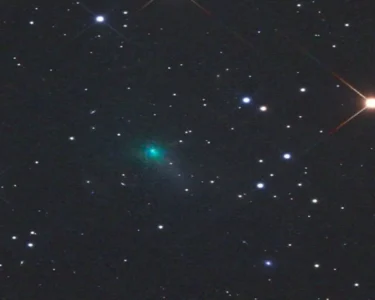
Cambridge, MA: A mysterious celestial body named 3I/ATLAS is hurtling through the solar system, and some Harvard scientists believe it might not be an ordinary space rock. With its unusual size, speed, and trajectory, researchers, including astrophysicist Avi Loeb, suggest the object could even be an extraterrestrial spacecraft — or at least something far rarer than a comet.
What Is 3I/ATLAS?
First detected earlier this year, 3I/ATLAS is estimated to be more than 12 miles wide. It is moving at nearly 130,000 miles per hour, making it one of the fastest objects ever observed passing through our solar system. On December 19, 2025, it is expected to come within 17 million miles of Earth — close in cosmic terms.
Scientists note that 3I/ATLAS will also pass near Venus, Mars, and Jupiter, raising eyebrows about its path. Some argue this trajectory looks like a mapping or survey mission rather than a random natural occurrence.
Why Harvard Scientists Are Interested
A paper co-authored by Harvard astrophysicists lays out six reasons why the object appears unusual:
- Too large for a normal asteroid — its dimensions exceed most known interstellar visitors.
- Unusual acceleration — its speed and trajectory don’t fully align with natural gravitational forces.
- Late detection — it entered the solar system from the dense galactic center, making it harder to spot early.
- Strategic course — at moments when it could be performing operations, it is hidden behind the Sun.
- Planet flybys — its close approach to Venus, Mars, and Jupiter resembles a deliberate mapping route.
- Invisible from Earth — during its closest approach, the Sun will block our direct view.
These anomalies led scientists like Loeb — already known for his bold theories on interstellar visitors — to speculate whether 3I/ATLAS could be an alien probe or spacecraft.
“Testable Hypothesis”
Nick Pope, a former UK Ministry of Defence UFO investigator, says while it could still be a comet or asteroid, the signs are unusual:
“It’s an unusual size, unusual acceleration, unusual course, and unusual behavior. The clock is ticking — we’ll soon know if this is first contact or just a very big rock.”
What Happens Next?
3I/ATLAS will be closest to the Sun in late November 2025 before its near-Earth pass in December. If it is an interstellar object, it would join the rare company of ʻOumuamua (2017) and Comet Borisov (2019). Whether natural or artificial, the event offers astronomers a chance to study a unique visitor and perhaps answer one of humanity’s biggest questions: Are we alone?
Image Source: Google | Image Credit: Respective Owner