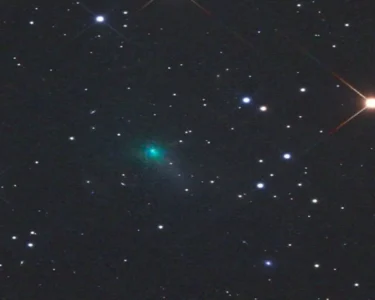
An exciting new image captured by the Hubble Space Telescope has revealed the clearest view yet of 3I/ATLAS, an interstellar comet racing through our solar system. The comet, which came from beyond our solar system, was photographed on July 21, 2025, when it was 277 million miles (445 million kilometers) from Earth. The image shows a striking teardrop-shaped dust cocoon trailing from the comet’s icy nucleus, which is typical of comets as they release gas and dust when they approach a star like the Sun.
The comet, which is traveling at a blistering 130,000 miles per hour (209,000 km/h), has become the fastest object ever observed entering from outside our solar system. The Hubble’s Wide Field Camera 3 gave scientists an invaluable opportunity to observe the comet’s features, and the data from the observation is shedding light on its size. The small nucleus is estimated to be between 1,000 feet (305 meters) and 3.5 miles (5.6 kilometers) in diameter, although its exact size remains unclear.
Discovered on July 1, 2025, 3I/ATLAS is only the third known interstellar object to pass through our solar system, following ‘Oumuamua in 2017 and 2I/Borisov in 2019. Despite the comet’s visible features, one key mystery remains: Where did it come from? Scientists have expressed that determining the exact origin of such objects is extremely challenging, likening it to seeing a bullet for just a thousandth of a second and trying to track its trajectory back to its starting point.
The comet’s unprecedented speed and trajectory suggest it has been traveling through interstellar space for billions of years, gaining momentum as it passed by stars and stellar nurseries. While it may be rare to observe such an object, Matthew Hopkins, a physicist who authored a study on 3I/ATLAS, emphasized that smaller interstellar objects frequently pass through our solar system, but they are often too small to detect unless they come very close to Earth.
As the comet continues its journey, astronomers are utilizing multiple telescopes, including the James Webb Space Telescope, Neil Gehrels Swift Observatory, and Vera C. Rubin Observatory, to learn more about 3I/ATLAS. This comet’s fast-moving trajectory provides a valuable opportunity to study the properties and compositions of interstellar objects, and future discoveries could help scientists determine whether these objects are similar or different in nature.
Hopkins noted that astronomers are hopeful for more discoveries of interstellar objects, especially with the advent of better sky-survey technologies. In fact, the Vera C. Rubin Observatory, with its massive 28-foot mirror, is set to significantly improve our ability to spot small, faint objects that speed through our solar system, potentially finding five to fifty interstellar objects over the next decade.
As David Jewitt, the lead study author from UCLA, put it, the discovery of 3I/ATLAS marks a turning point in our ability to detect and study these fascinating visitors from outside our solar system: “This latest interstellar tourist is one of a previously undetected population of objects bursting onto the scene.”
With new advancements in space exploration technology, the future holds the promise of even more interstellar discoveries.
Image Source: NASA/ESA/David Jewitt (UCLA)
Image Credit: Respective Owner