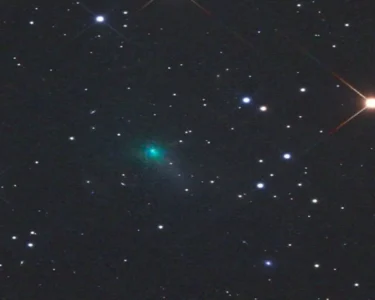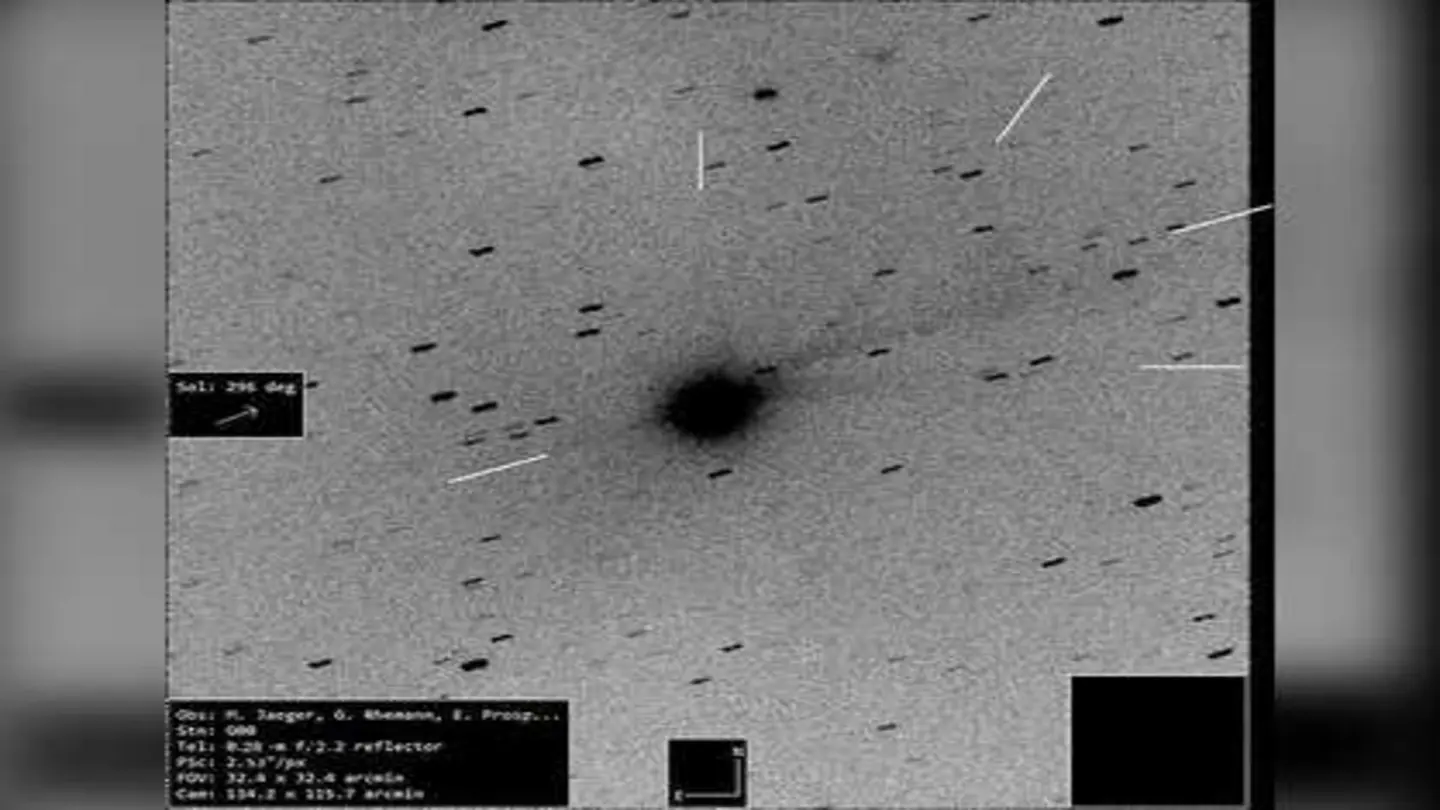
Astronomers are buzzing over unusual activity observed emanating from comet 3I/ATLAS, specifically a series of three “mini-jets” appearing at roughly 120-degree intervals. Harvard astronomer Avi Loeb posits these jets could be a sign of extraterrestrial technology, a claim drawing both excitement and skepticism within the scientific community.
The observations, initially made using the Vera C. Rubin Observatory’s early data releases, reveal the jets are not behaving like typical cometary features. Comets usually exhibit jets caused by the sublimation of ice as they approach the sun, releasing gas and dust. These jets are typically irregular and unpredictable in their direction. However, the regularity and spacing of the 3I/ATLAS jets are highly unusual, leading Loeb to suggest a non-natural origin.
Loeb, known for his advocacy of the search for extraterrestrial intelligence (SETI) and his controversial theories about interstellar objects like ‘Oumuamua, argues that the jets’ precise alignment suggests deliberate control. He proposes that an alien civilization might be using these jets for propulsion or communication, effectively turning the comet into a spacecraft. “The three jets coming out of the comet at 120-degree separation is very unusual,” Loeb stated in a Medium post detailing his observations. “It is unlikely to be a natural phenomenon.”
However, other scientists offer more conventional explanations. They suggest the jets could be the result of a particularly uneven distribution of ice within the comet’s nucleus, combined with the thermal stresses induced by solar radiation. The comet is still quite distant from the sun, making detailed analysis challenging. As it gets closer, more data will become available to test these hypotheses.
The debate highlights the difficulty in distinguishing between natural phenomena and potential technological signatures (technosignatures) from extraterrestrial civilizations. Loeb emphasizes the importance of considering all possibilities, even those that seem improbable. He advocates for a broader search for technosignatures, not just relying on traditional radio signals.
Comet 3I/ATLAS: A Distant Visitor
Comet 3I/ATLAS is a long-period comet, meaning it has a highly elliptical orbit that takes it far beyond the planets before returning to the inner solar system. It was discovered in early 2023 and is currently becoming visible to observers with telescopes. Its potential brightness as it approaches the sun has generated considerable interest among amateur and professional astronomers alike.
The current observations are limited by the comet’s distance and the relatively early stage of the Vera C. Rubin Observatory’s operations. Further observations, particularly as the comet nears perihelion (its closest approach to the sun), will be crucial in determining the true nature of these mini-jets. Scientists will be looking for changes in their intensity, direction, and any correlation with the comet’s rotation or internal structure.
Regardless of the ultimate explanation, the 3I/ATLAS mini-jet phenomenon serves as a reminder of the mysteries that still exist within our solar system and the potential for unexpected discoveries. The search for life beyond Earth continues, and every unusual observation warrants careful investigation.
Image Source: Google | Image Credit: Respective Owner