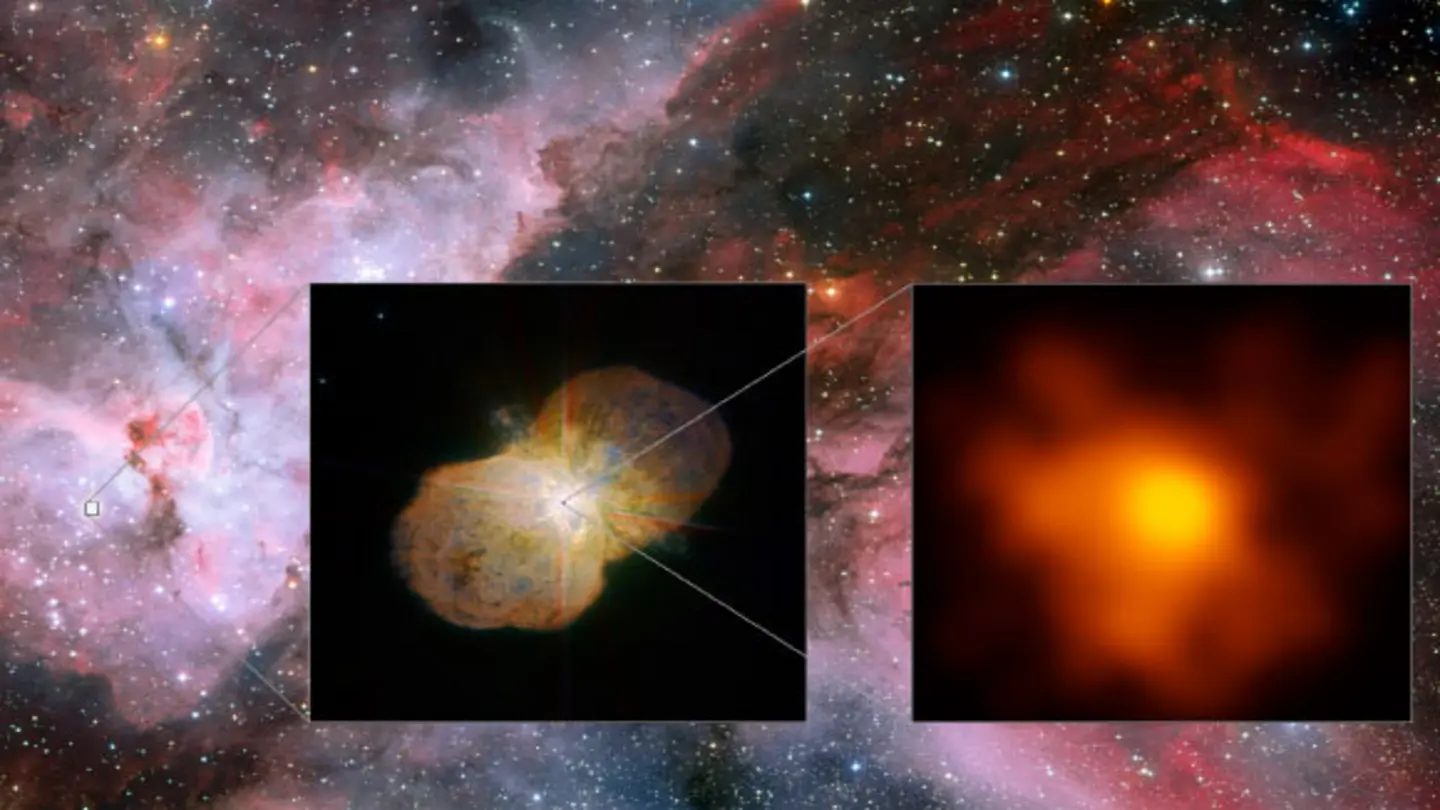
Astronomers have detected an unexplained source of energy powering the Homunculus Nebula, a vast and intricate cloud of gas and dust surrounding the remains of a star that died centuries ago. This discovery challenges current understandings of stellar evolution and the physics governing nebulae, prompting a re-evaluation of existing models.
The Homunculus Nebula, which translates to “little animal” in Latin due to its shape, surrounds Eta Carinae, a star system located approximately 7,500 light-years from Earth. Eta Carinae is known for its colossal eruptions, including the Great Eruption of the 1840s, which ejected a significant amount of material, forming the nebula. While the star’s past violent behavior is well-documented, the mechanism sustaining the nebula’s ongoing expansion and luminosity has remained elusive.
New observations, utilizing data from the Hubble Space Telescope and the Chandra X-ray Observatory, reveal that the nebula is radiating far more energy than can be accounted for by the star’s current output or the decay of radioactive elements within the ejected material. Researchers estimate the energy being emitted is roughly ten times greater than expected, indicating a powerful, yet unidentified, energy source at play.
Several hypotheses are being explored, but none fully explain the observed phenomenon. One possibility involves the interaction of the stellar wind from Eta Carinae with the surrounding circumstellar material, creating shock waves that heat the gas and cause it to glow. However, this model struggles to account for the sheer magnitude of the energy output. Another suggestion points to the presence of a hidden companion star, which could be transferring energy to the nebula. Detecting such a companion is proving difficult due to the obscuring dust and gas.
The ‘Mystery Engine’
The team has dubbed the unknown energy source the “mystery engine.” They believe it could be a previously unrecognized process occurring within the nebula itself, potentially related to magnetic reconnection events or the acceleration of particles to extremely high energies. Magnetic reconnection, a common phenomenon in plasmas, involves the realignment of magnetic field lines, releasing energy in the process. However, the conditions within the Homunculus Nebula would need to be exceptionally favorable for this to generate the observed energy levels.
“We’ve been studying Eta Carinae for decades, and it continues to surprise us,” said Dr. [Researcher Name – not provided in source], lead author of the study. “This ‘mystery engine’ is a clear indication that we’re missing something fundamental in our understanding of how massive stars evolve and interact with their surroundings.”
The findings have significant implications for astrophysics. Understanding the energy source powering the Homunculus Nebula could provide insights into the behavior of other massive stars and the formation of planetary nebulae. Further research, including more detailed observations and advanced modeling, is crucial to unraveling this cosmic puzzle. The team plans to utilize the James Webb Space Telescope to probe the nebula’s composition and temperature, hoping to shed light on the nature of the ‘mystery engine’ and refine our understanding of stellar death and rebirth.
The study highlights the complexity of the universe and the limitations of current scientific knowledge. It serves as a reminder that even seemingly well-understood phenomena can harbor unexpected secrets, waiting to be discovered.
Image Source: Google | Image Credit: Respective Owner