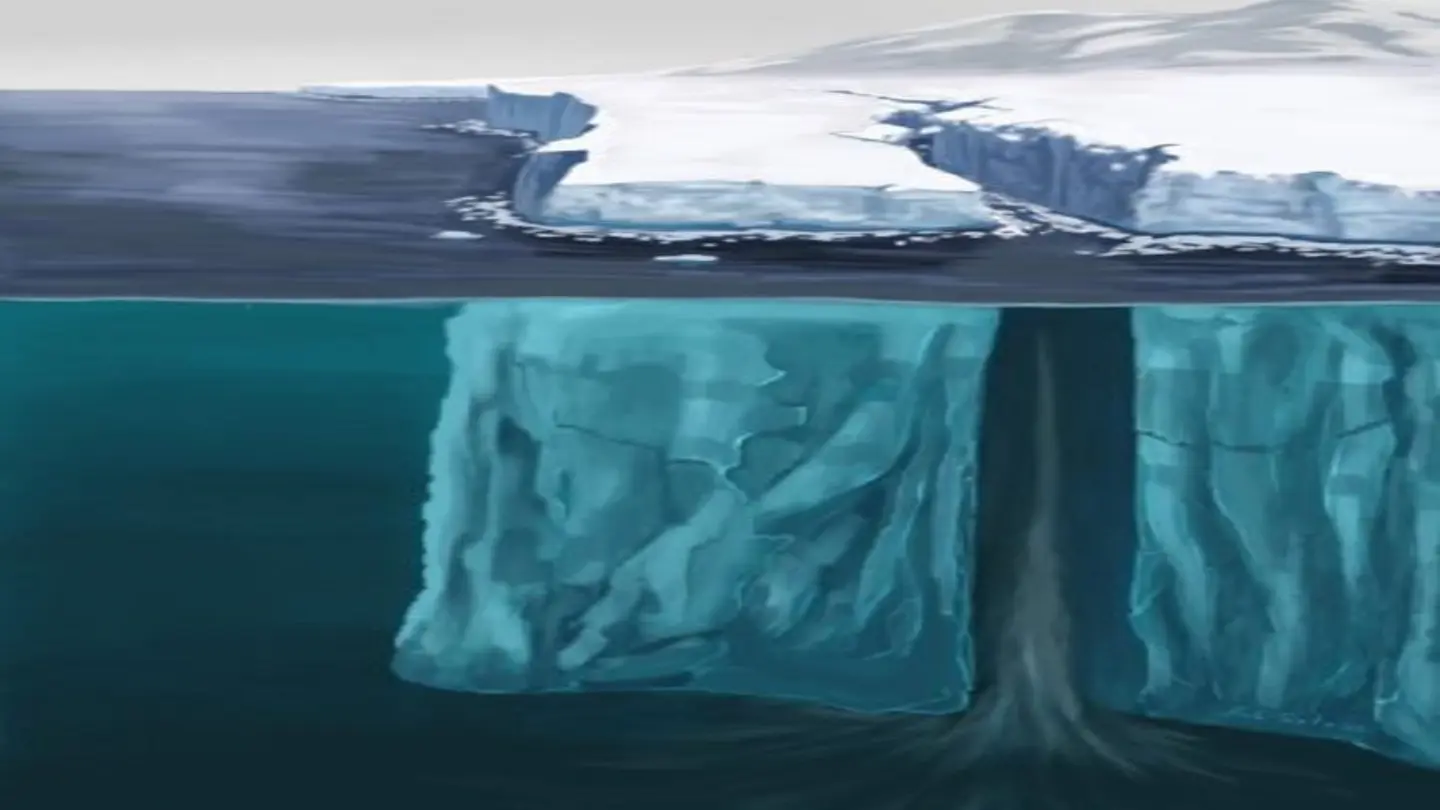
New research published in the ESS Open Archive details a crucial link between the physical properties of ice shelves – specifically their rheology, or how they deform under stress – and their susceptibility to fracturing and collapse. The study focuses on how temperature and stress levels interact to influence the bending behavior of ice shelf fronts, offering insights into the stability of these vital structures in a warming climate.
Ice shelves act as natural barriers, slowing the flow of glaciers into the ocean. Their disintegration contributes significantly to sea-level rise. Understanding the mechanics governing their behavior is therefore paramount for accurate climate modeling and prediction. This research delves into the complexities of ice rheology, moving beyond simplified models that often treat ice as a purely elastic or viscous material.
The study highlights that ice shelf rheology is demonstrably temperature-dependent. Warmer temperatures reduce the ice’s resistance to deformation, making it more pliable and prone to bending. However, the research also emphasizes the critical role of stress. Existing stress within the ice shelf, caused by factors like glacial flow and tidal forces, interacts with temperature changes to determine the overall bending response.
Researchers employed advanced modeling techniques to simulate the bending of ice shelf fronts under varying temperature and stress conditions. Their findings reveal that the interplay between these two factors is non-linear. This means that the effect of temperature on bending isn’t simply additive; it’s modulated by the existing stress state. For example, an ice shelf already under high stress may be far more sensitive to even small temperature increases.
Implications for Future Research
The implications of this research extend beyond fundamental glaciology. More accurate representation of ice shelf rheology in climate models is essential for improving projections of future sea-level rise. Current models often rely on simplified assumptions about ice behavior, which can lead to significant uncertainties in their predictions. This study provides a pathway towards more sophisticated and realistic modeling approaches.
Furthermore, the findings have implications for monitoring and assessing the risk of ice shelf collapse. By incorporating temperature and stress data into predictive models, scientists can better identify areas of ice shelves that are particularly vulnerable to fracturing. This information can be used to prioritize monitoring efforts and inform risk management strategies.
The research team acknowledges that further investigation is needed to fully understand the complexities of ice shelf rheology. Future studies will focus on incorporating additional factors, such as the presence of meltwater and the influence of crevasses, into their models. They also plan to validate their findings with field observations from Antarctic ice shelves.
Ultimately, this work contributes to a growing body of evidence highlighting the sensitivity of ice shelves to climate change. A deeper understanding of the physical processes governing their behavior is crucial for mitigating the impacts of sea-level rise and protecting coastal communities worldwide. The study underscores the urgent need for continued research and monitoring of these critical components of the Earth’s climate system.
Image Source: Google | Image Credit: Respective Owner