Recent research published on the ESS Open Archive delves into the fascinating realm of electromagnetic energy flow, specifically examining how this energy travels along geodesics – the shortest paths between two points in curved spacetime. The study, titled “On the Electromagnetic Energy Flow along Geodesics,” proposes a novel framework for understanding energy transport in complex gravitational fields.
Traditionally, understanding electromagnetic energy flow has relied on approximations suitable for relatively flat spacetime. However, this new work aims to provide a more accurate description applicable to scenarios with significant gravitational effects, such as those near black holes or neutron stars. The researchers utilize advanced mathematical techniques to analyze the behavior of electromagnetic fields in these extreme environments.
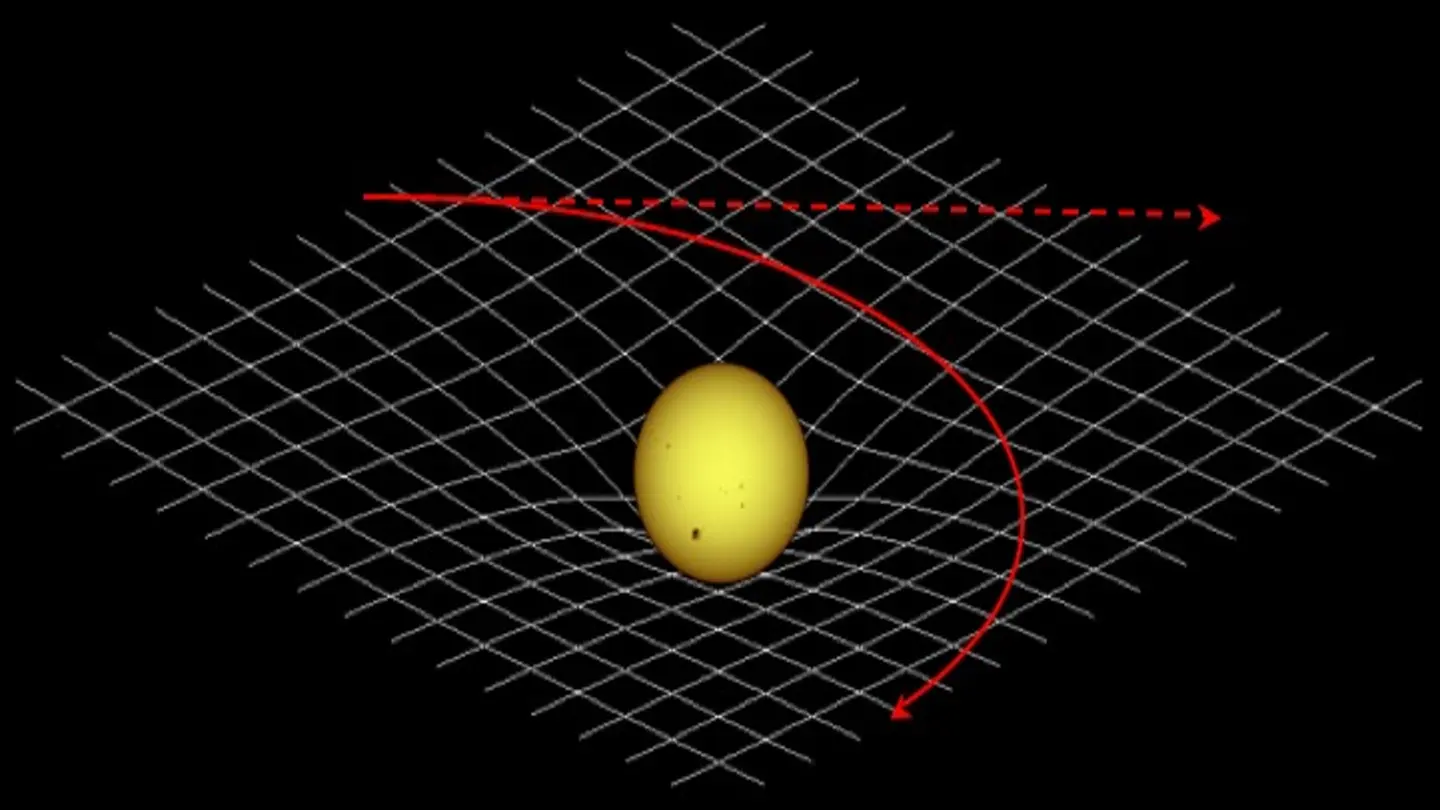
The core of the research lies in a refined analysis of the Poynting vector, a fundamental concept in electromagnetism that describes the directional energy flux of an electromagnetic field. By carefully considering the geometry of spacetime, the authors demonstrate how the Poynting vector is influenced by the curvature of space, leading to deviations from the expected paths in flat spacetime. These deviations are crucial for accurately predicting energy transport in strong gravitational fields.
Implications for Astrophysics
The findings have significant implications for astrophysics, particularly in understanding phenomena involving high-energy processes near compact objects. For instance, the study could shed light on the mechanisms responsible for the emission of radiation from active galactic nuclei, where supermassive black holes accrete matter and release enormous amounts of energy. Accurately modeling energy flow is essential for interpreting observed spectra and understanding the dynamics of these systems.
Furthermore, the research could contribute to a better understanding of gravitational wave astronomy. Electromagnetic signals often accompany gravitational wave events, and a precise understanding of how energy propagates in the surrounding spacetime is vital for correlating these different types of observations. The study’s framework provides a more robust tool for analyzing these multi-messenger signals.
The authors emphasize that their work is primarily theoretical, focusing on developing a rigorous mathematical description of the phenomenon. However, they suggest that future research could involve numerical simulations to test the predictions of their model and compare them with observational data. These simulations would require significant computational resources but could provide valuable insights into the behavior of electromagnetic fields in extreme gravitational environments.
The research also highlights the importance of considering the full complexity of spacetime geometry when analyzing electromagnetic phenomena. Simplified models, while useful in many cases, may fail to capture the subtle but crucial effects of curvature, leading to inaccurate predictions. This study serves as a reminder of the need for a more nuanced approach to understanding energy transport in the universe. The open archive publication encourages further scrutiny and collaboration within the scientific community, potentially accelerating advancements in this field.
Ultimately, this research represents a step towards a more complete and accurate understanding of how electromagnetic energy behaves in the universe, particularly in regions where gravity dominates. It provides a valuable theoretical foundation for future investigations and could lead to new discoveries in astrophysics and cosmology.
Image Source: Google | Image Credit: Respective Owner