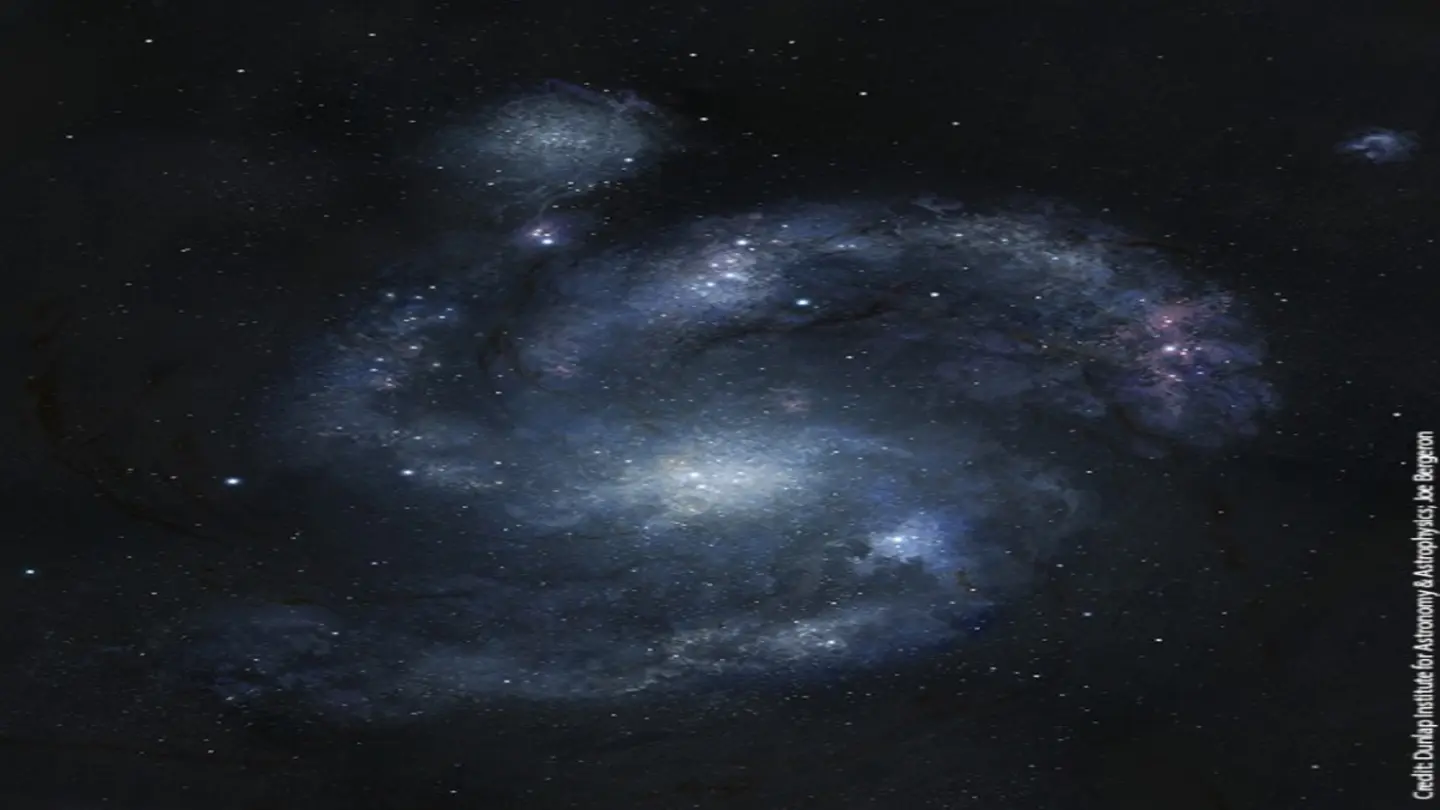
Indian astronomers have identified a remarkably old spiral galaxy, designated as ALK-130809, that challenges current understanding of galaxy formation and evolution. The discovery, made using data from the Subaru Telescope in Hawaii, reveals a galaxy that appears surprisingly mature for its estimated age, prompting a re-evaluation of cosmological models.
The research team, led by astronomers at the Indian Institute of Astrophysics (IIA) and the National Centre for Radio Astrophysics (NCRA), published their findings in the journal Nature. ALK-130809 is located approximately 12.5 billion light-years away, meaning the light observed from it began its journey when the universe was only about 1.8 billion years old – a fraction of its current 13.8 billion years.
Spiral galaxies, characterized by their distinct rotating arms, are generally believed to form over billions of years through gradual processes of star formation and galactic mergers. However, ALK-130809 exhibits a well-defined spiral structure, a feature typically associated with more evolved galaxies. This observation suggests that spiral galaxies may have formed much earlier in the universe than previously thought.
“The existence of a mature spiral galaxy so early in the universe is a puzzle,” explains Dr. Kanak Saha, a co-author of the study from IIA. “Our current models predict that galaxies at that epoch should be irregular and chaotic, not the beautifully structured spirals we observe.” The team employed a technique called integral field spectroscopy to analyze the galaxy’s light, revealing details about its stellar populations and gas dynamics.
The analysis indicates that ALK-130809 has a relatively high star formation rate, but the stars are surprisingly old. This suggests that the galaxy underwent a rapid burst of star formation in its early stages, quickly assembling a significant stellar mass. The researchers also found evidence of a rotating disk of gas, which is essential for maintaining the spiral structure.
Implications for Galaxy Evolution
The discovery has significant implications for our understanding of how galaxies evolve. It suggests that the processes responsible for forming spiral galaxies may be more efficient than previously assumed, or that there may be alternative pathways for their formation. Further research is needed to determine whether ALK-130809 is a rare outlier or a representative example of a previously unknown population of early spiral galaxies.
“This finding forces us to rethink our understanding of the early universe and the conditions that allowed galaxies to form and evolve,” says Dr. Arnab Chakraborty, another researcher involved in the study. “It opens up new avenues for investigation and challenges us to develop more sophisticated models of galaxy formation.” The team plans to continue studying ALK-130809 and search for other similar galaxies to gain a better understanding of their properties and prevalence.
The research highlights the growing role of Indian astronomers in making groundbreaking discoveries about the universe. The use of advanced observational techniques and sophisticated data analysis tools has enabled them to push the boundaries of our knowledge and contribute to the global effort to unravel the mysteries of the cosmos. The findings are expected to stimulate further research in the field and lead to a more complete picture of the universe’s history.
Image Source: Google | Image Credit: Respective Owner