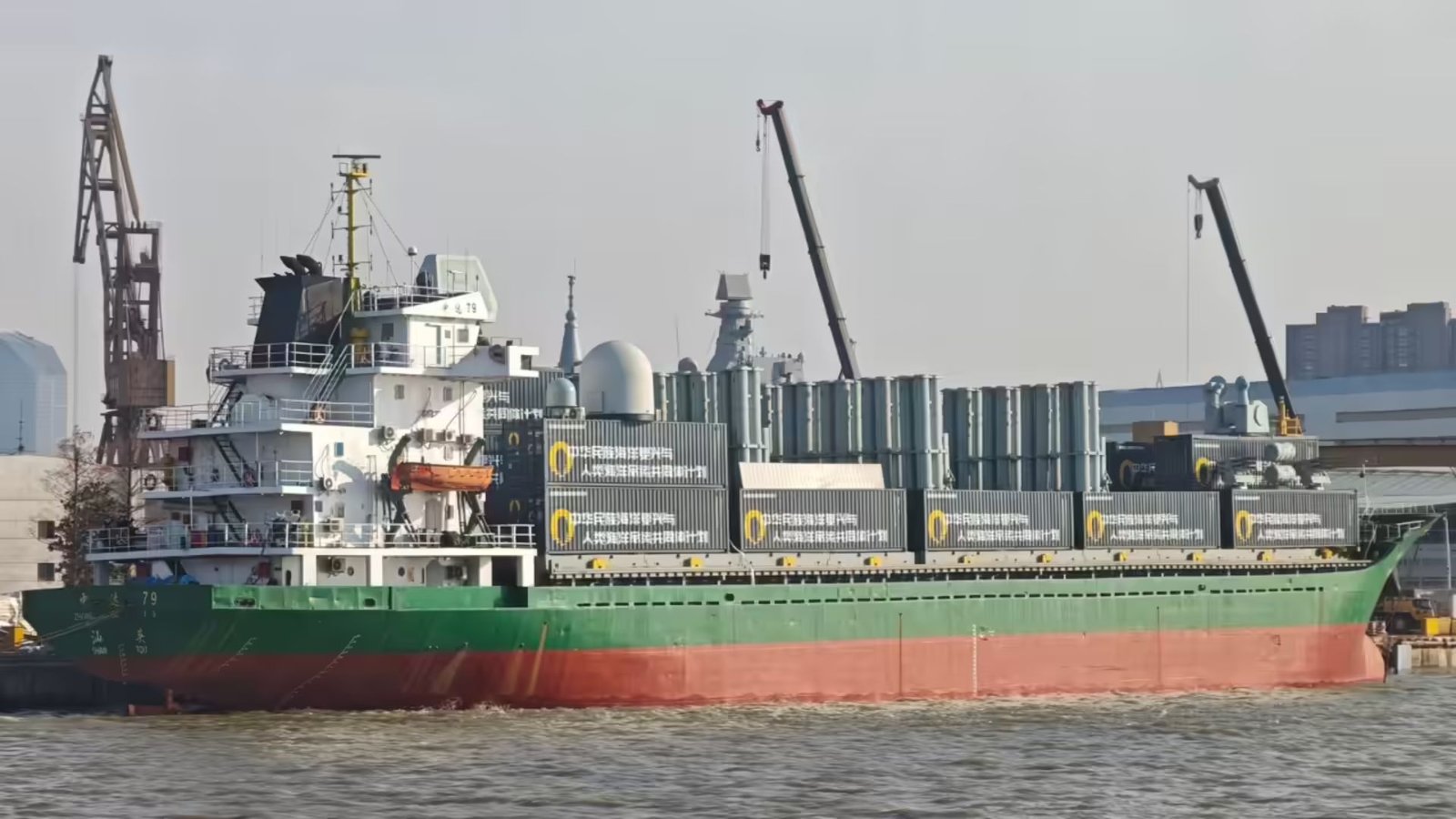
China has sparked concerns over escalating maritime tensions with the open display of a heavily armed cargo ship, the Zhongda 79. Images circulating reveal the vessel equipped with a formidable arsenal of approximately 60 missiles, a move widely interpreted as a demonstration of force in the South China Sea and surrounding waters.
The Zhongda 79, ostensibly a civilian cargo ship, has undergone significant modifications, transforming it into a potential mobile weapons platform. Experts suggest the missiles are likely anti-ship ballistic missiles, capable of targeting naval vessels at considerable distances. This development challenges the conventional understanding of maritime security, blurring the lines between civilian and military assets.
Strategic Implications
The deployment of such weaponry on a cargo vessel raises several strategic questions. Primarily, it complicates efforts to monitor and assess China’s military capabilities. By concealing missiles within a civilian fleet, Beijing gains a degree of deniability and introduces ambiguity regarding its intentions. This tactic could be employed to circumvent potential limitations imposed by international agreements or to create a more unpredictable threat environment for rival nations.
The move is particularly concerning given China’s assertive claims in the South China Sea, where it has ongoing disputes with several neighboring countries, including the Philippines, Vietnam, and Malaysia. The Zhongda 79’s presence in the region could be seen as a direct challenge to these nations and to the United States, which maintains a strong military presence in the area to ensure freedom of navigation.
Analysts believe this is not an isolated incident. There are indications that other Chinese cargo vessels may be undergoing similar weaponization processes. This suggests a broader strategy to enhance China’s maritime power projection capabilities without necessarily relying on traditional warships. The economic benefits of using civilian vessels for military purposes – lower operating costs and reduced scrutiny – are also likely factors.
The international community has reacted with cautious concern. While no official condemnations have been issued, several countries have expressed their unease over the development. The United States Navy has reportedly increased its surveillance of Chinese vessels in the region, seeking to better understand the extent of this new capability. The potential for miscalculation and escalation is high, particularly in a region already fraught with geopolitical tensions.
The Zhongda 79 incident underscores the growing militarization of the maritime domain and the increasing complexity of modern naval warfare. It also highlights the need for greater transparency and adherence to international norms to prevent accidental clashes and maintain regional stability. Further observation of Chinese naval activities will be crucial in determining whether this is a temporary demonstration or a long-term shift in strategy. The implications for global trade routes and maritime security are significant and demand close attention from policymakers and military strategists alike.
The Chinese government has yet to officially comment on the reports, adding to the uncertainty surrounding the vessel’s purpose and capabilities. However, the visual evidence is compelling and has prompted a serious reassessment of China’s maritime ambitions.
Image Source: Google | Image Credit: Respective Owner