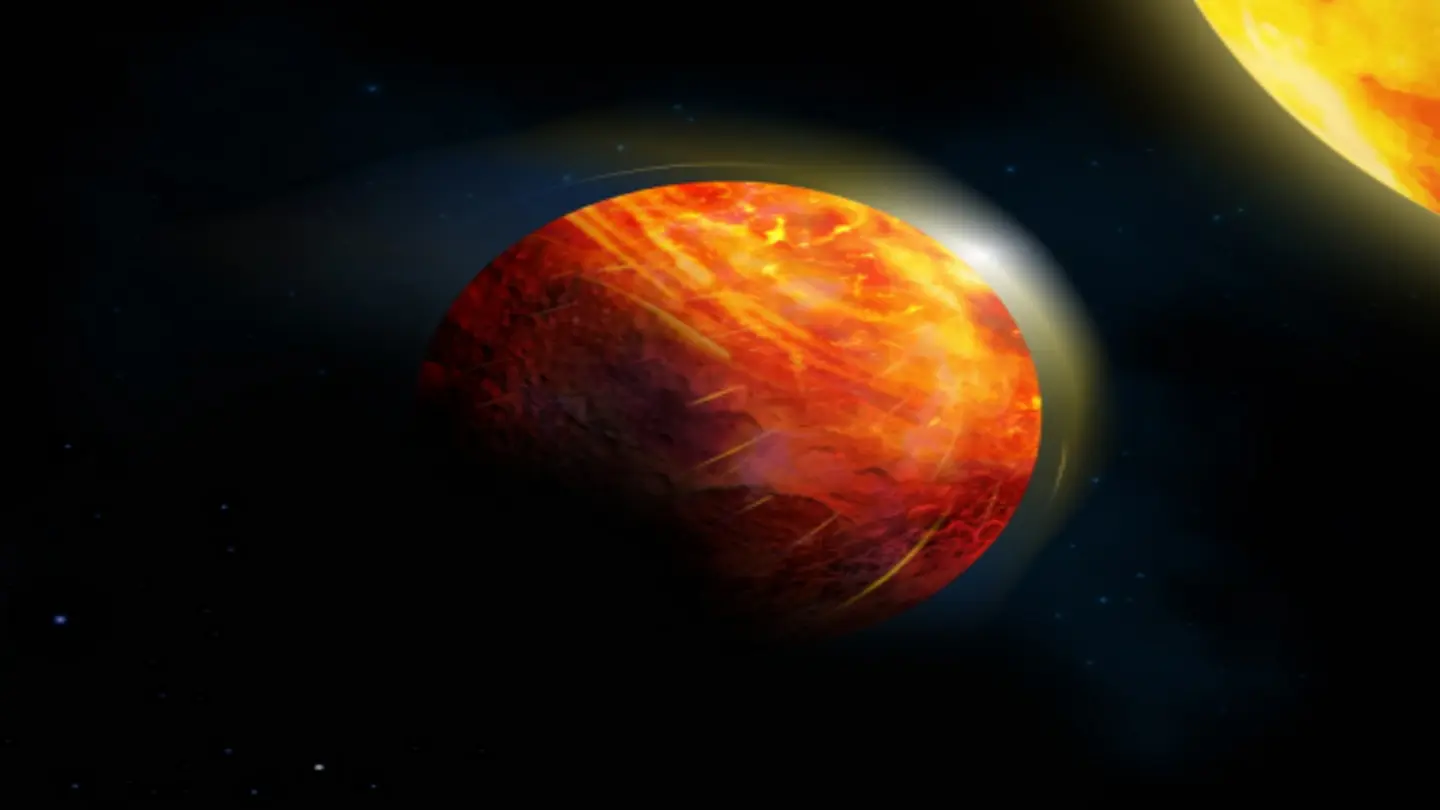
Scientists have uncovered the most compelling evidence to date indicating the presence of an atmosphere around a molten rocky exoplanet, marking a pivotal advancement in the study of planetary formation and habitability beyond our solar system.
The breakthrough centers on observations of a distant world, where researchers detected subtle spectral signatures indicative of gaseous layers surrounding a tortured, lava-coated surface. Using advanced coronagraphy techniques and high-resolution spectroscopy, the team analyzed starlight filtered through the planet’s apparent aura during transits across its host star. This method allowed them to identify molecular traces consistent with a thin but active atmospheric envelope.
Exoplanets resembling this molten rocky type – often termed “lava planets” due to their extreme surface conditions – were previously assumed to lack substantial atmospheres. The findings challenge that assumption, revealing how such worlds might retain gaseous layers despite relentless stellar radiation and tidal forces that should theoretically strip them away. The atmosphere appears to be composed of light elements, possibly vaporized metals or stripped ionic particles, suggesting a dynamic equilibrium between escape and replenishment.
“This discovery rewrites our textbook understanding of atmospheric survival,” said lead researcher Dr. Elena Voss of the Max Planck Institute for Astronomy. “We now see that even planets orbiting perilously close to their stars can maintain atmospheric shells through unexpected mechanisms, perhaps driven by intense volcanic outgassing or magnetic shielding effects.”
The study, published in Nature Astronomy, utilized data from the European Space Agency’s Gaia satellite and NASA’s Transiting Exoplanet Survey Satellite (TESS). Team members emphasized that characterizing such extreme environments provides critical context for assessing the broader population of close-in planets, which comprise a significant fraction of known exoplanets. Understanding their atmospheric fate also informs models of planetary evolution across diverse stellar systems.
Future observations with next-generation telescopes, including the James Webb Space Telescope (JWST) and ground-based Extremely Large Telescopes (ELTs), are expected to refine these findings. Scientists aim to determine whether similar atmospheres exist around other molten rocky worlds and to explore how common such phenomena might be in the galaxy. The discovery underscores the diversity of planetary systems and the resilience of natural processes that shape them, opening new avenues for research into the extreme edges of habitability.
Image Source: Google | Image Credit: Respective Owner