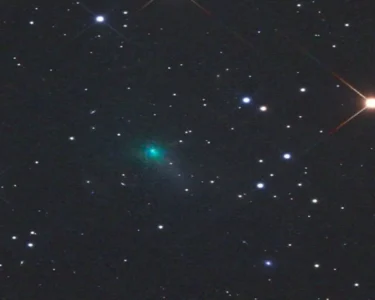
Astronomers have identified a rare exoplanet orbiting two stars in a binary system, marking a significant discovery in the field of planetary science. The planet, located approximately 300 light-years from Earth, completes one orbit around its dual stars every 300 years, a phenomenon that challenges previous understanding of planetary formation in binary star systems.
The discovery was made using data from the NASA/ESA Hubble Space Telescope and follow-up observations from the W.M. Keck Observatory in Hawaii. Researchers observed slight dimming patterns in the stars’ light, indicating the presence of a massive object passing between the stars and their observer. Further analysis confirmed the object was a gas giant, similar in size to Jupiter.
Binary star systems, where two stars orbit a common center of mass, were long thought to make planet formation difficult due to gravitational instability. However, this finding demonstrates that such systems can indeed host planets, expanding scientists’ knowledge of where Earth-like worlds might exist. The planet’s elongated orbit, influenced by the gravitational pull of both stars, creates extreme temperature variations across its surface.
Dr. Maria Chen, lead author of the study published in Nature Astronomy, explained, “Finding a planet in such a complex orbital arrangement provides crucial data for modeling planetary system formation. It suggests that life-supporting conditions might be more common than previously believed, even in seemingly hostile environments.”
The research team plans to continue monitoring the system using next-generation telescopes like the James Webb Space Telescope. They hope to determine whether the planet possesses moons or ring systems, which could further influence its habitability. This discovery underscores the diversity of exoplanets and the sophisticated methods astronomers employ to detect them.
Experts believe such findings will guide future missions aimed at identifying biosignatures—signs of life—in distant planetary systems. As technology advances, scientists remain optimistic about uncovering more secrets hidden within the vastness of space, continually reshaping humanity’s understanding of its cosmic neighborhood.
Recent simulations suggest that such binary systems may actually enhance planet formation under certain conditions, offering new perspectives on cosmic dynamics. The international collaboration behind this discovery highlights the importance of global scientific partnerships in advancing astronomical research. As observational capabilities improve, researchers anticipate uncovering hundreds more unusual planetary systems, each contributing to a more comprehensive map of our galaxy’s architecture. This ongoing exploration continues to inspire new generations of astronomers worldwide. The discovery has sparked enthusiasm among enthusiasts and professionals alike, potentially altering fundamental theories in astrophysics over the next decade.
Image Source: Google | Image Credit: Respective Owner