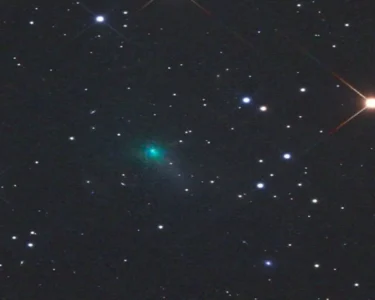
The European Space Agency’s ATLAS survey has identified a remarkable interstellar comet generating intense X-ray emissions, spanning approximately 400,000 kilometers. This discovery marks a pivotal moment in astrophysics, offering unprecedented insights into objects originating beyond our solar system. Unlike typical comets composed primarily of ice and dust, this celestial body exhibits extraordinary energetic behavior, challenging existing models of comet formation and composition.
Researchers were astonished to observe X-ray activity from the comet, a phenomenon rarely detected in such objects. X-rays usually associate with high-temperature environments, such as solar flares or black hole accretion disks. The detection suggests the comet interacts with solar wind or magnetic fields in unique ways, potentially due to its exotic metallic composition or exposure to intense stellar radiation during its interstellar journey.
The comet’s massive size further complicates conventional theories. With a diameter exceeding 400,000 km, it surpasses many dwarf planets in scale. Such dimensions raise questions about its formation environment—whether it coalesced within another star system or underwent significant accretion during its voyage through interstellar space. Preliminary spectral analyses indicate the presence of heavy elements, including iron and nickel, hinting at a possible metallic core.
This detection also underscores the capabilities of modern sky surveys like ATLAS, which continuously monitor the universe for transient events. The comet was first noted during routine observations, and subsequent follow-up studies confirmed its interstellar origin through precise parallax measurements and orbital calculations. Its trajectory indicates a direct interstellar pass, with no gravitational binding to our sun, distinguishing it from previously studied exoplanetary bodies.
Scientists emphasize the importance of studying such visitors for understanding planetary system formation across galaxies. Each interstellar object provides a snapshot of conditions in distant stellar environments. The X-ray emissions, in particular, open new avenues for investigating high-energy processes around cometary nuclei—an area previously considered inconceivable.
Further observations are planned using X-ray telescopes such as Chandra and XMM-Newton to map the emission’s spatial distribution and temporal variability. Understanding whether these X-rays stem from charge exchange reactions, magnetic reconnection, or other mechanisms will refine theoretical models of comet-solar wind interactions. The findings are expected to contribute significantly to both heliophysics and exoastronomy disciplines.
International collaboration will be crucial in unraveling the comet’s mysteries. Institutions from ESA, NASA, and multiple national observatories are coordinating data collection efforts. Public outreach initiatives are also underway to share this exciting development with global audiences, fostering greater appreciation for the dynamic nature of our cosmic neighborhood.
Image Source: Google | Image Credit: Respective Owner