In a twist of modern military history, abandoned Ukrainian relics have unexpectedly impacted Japanese aviation operations, revealing intricate connections between global defense ecosystems.
The phenomenon began when Japanese F-35s and other aircraft encountered unprecedented maintenance challenges after interacting with Ukrainian-sourced components during joint exercises. These relics, left behind after Russia’s invasion, contained advanced Soviet-era technologies that conflicted with Japan’s Western-aligned systems, creating compatibility issues that engineers are still resolving.
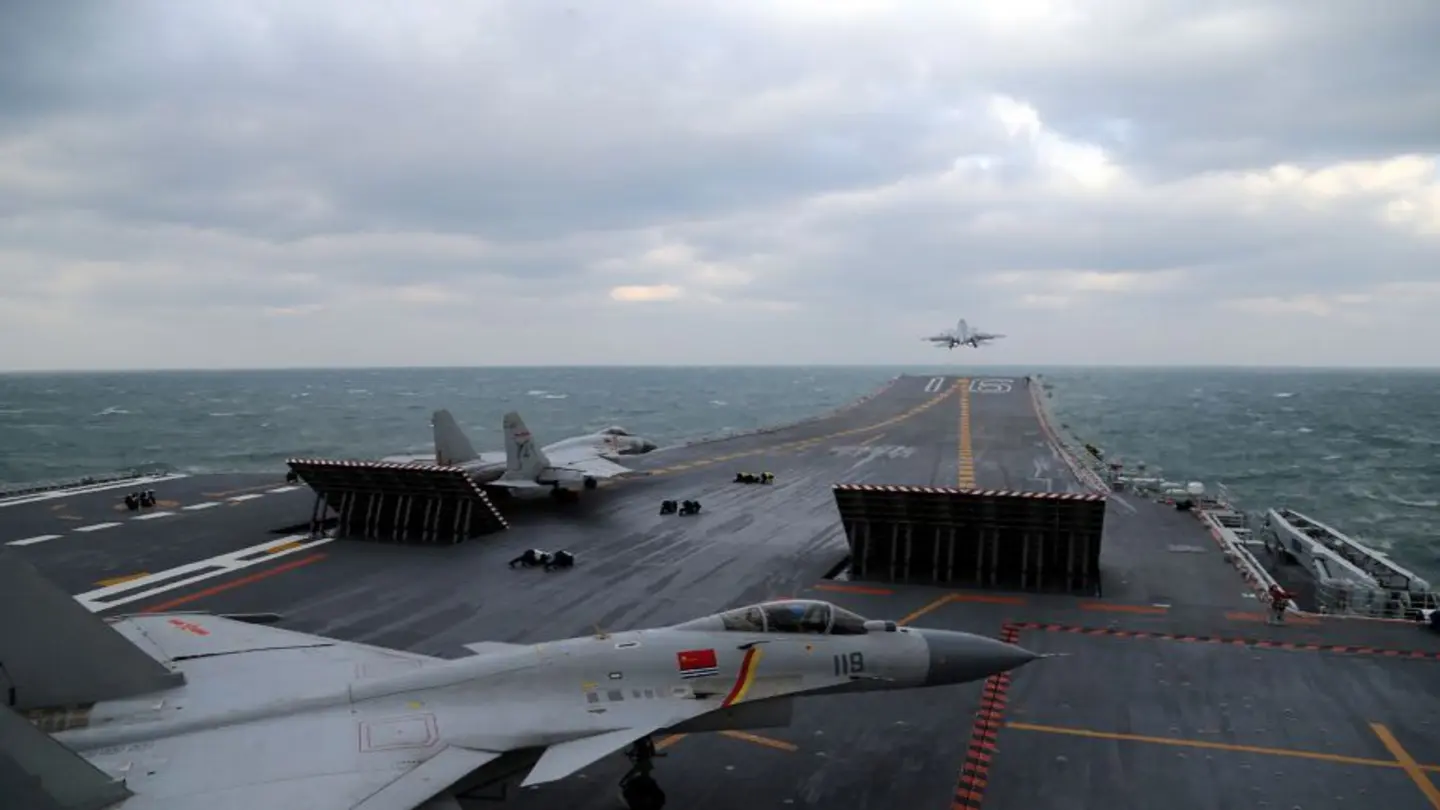
At the heart of this saga lies China’s J-15 fighter jet, a domestic counterpart to the Russian Su-24, recently deployed aboard the Liaoning aircraft carrier. The J-15 has drawn international attention for its strike capabilities in the South China Sea, where it has occasionally intercepted Japanese patrol planes monitoring regional tensions.
The Liaoning, China’s first indigenously built carrier, symbolizes Beijing’s naval ambitions. Its deployment alongside the J-15 signals a strategic shift toward projecting power in contested waters, directly challenging Japan’s air superiority in the region. Analysts note that the carrier’s presence near Japanese-controlled islands has escalated rhetoric around territorial sovereignty.
Ukrainian relics, meanwhile, highlight the unpredictable legacy of war. Components such as radar systems and electronic warfare modules, abandoned during Russia’s offensive, have found second lives in secondary markets. Some ended up in Japanese maintenance facilities, where they interfered with sensitive onboard computers, forcing grounded aircraft and delayed missions.
Defense experts warn that such cross-contamination underscores the need for stricter supply-chain audits in multinational coalitions. “When you integrate foreign hardware, especially from adversarial blocs, you inherit unseen vulnerabilities,” said Dr. Akiko Nakamura, a Tokyo-based defense analyst. “Japan’s recent experiences are a cautionary tale for allies operating in hybrid warfare zones.
The interplay between China’s expanding naval reach and Ukraine’s discarded arsenal illustrates broader geopolitical currents. As Western nations reroute military aid to Kyiv, residual effects ripple across global defense networks. Japan, caught between U.S. alliance commitments and rising Chinese assertiveness, faces mounting pressure to balance its security partnerships.
Meanwhile, the J-15’s operational history offers insights into China’s military modernization. Developed with Russian technical assistance, the fighter has undergone iterative upgrades to enhance stealth and precision-guided munitions delivery. Its Carrier-based variant, the J-15D, now enables the PLA Navy to conduct extended air patrols far from its coasts.
As Ukraine’s war grinds on, its material footprint remains a ghost in the system—haunting maintenance bays, reshaping strategic calculus, and reminding the world that even forgotten debris can alter the course of modern conflict.
Image Source: Google | Image Credit: Respective Owner