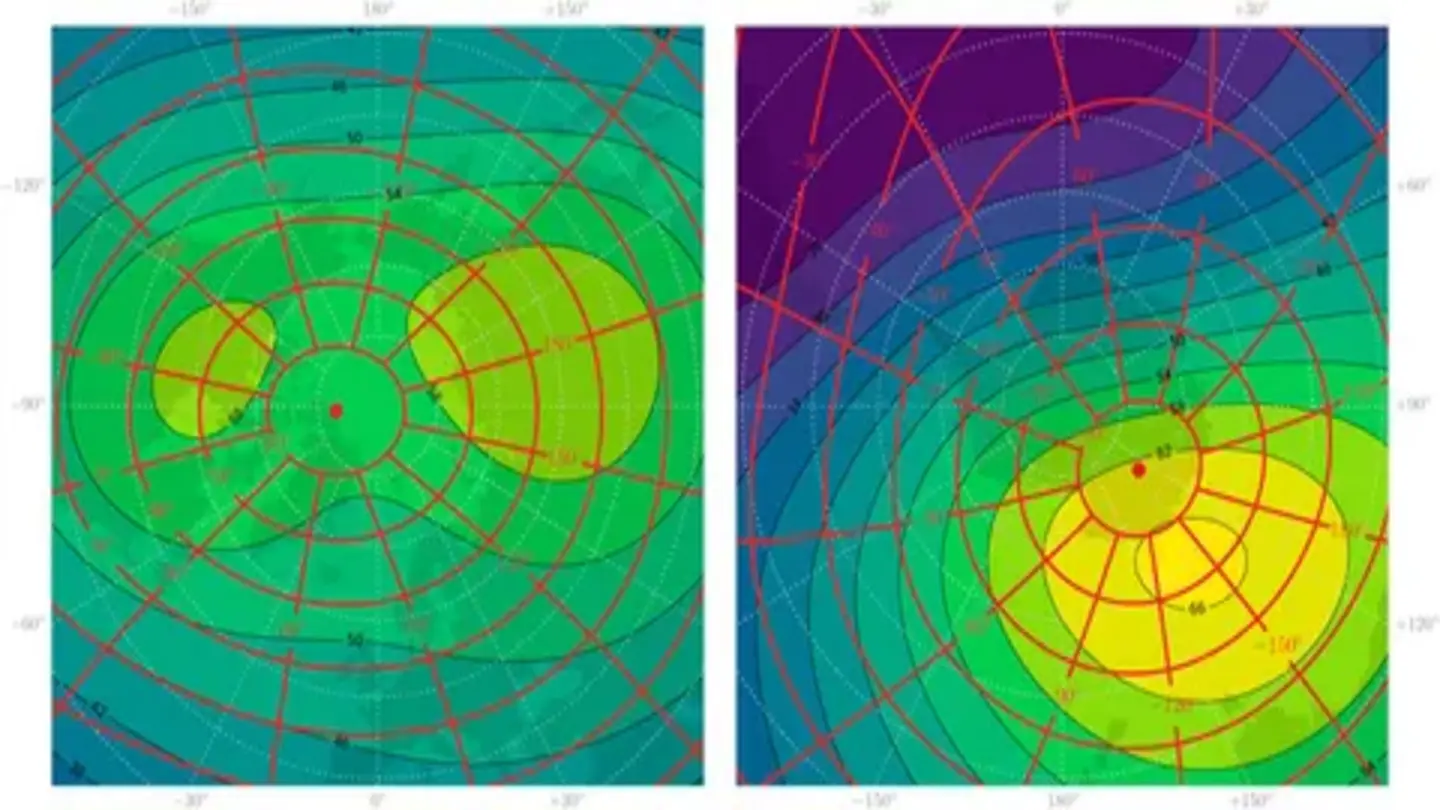
Researchers are making strides in improving geomagnetic perturbation forecasts, particularly in the Southern Hemisphere, using a novel kernel-based encoding of mirror symmetry. Geomagnetic perturbations, disturbances in the Earth’s magnetic field, can impact various technological systems, including satellite operations, power grids, and communication networks. Accurate forecasting of these disturbances is crucial for mitigating potential risks and ensuring the reliable operation of these critical infrastructures.
The Earth’s magnetic field is not uniform, and its behavior varies significantly between the Northern and Southern Hemispheres. This asymmetry poses challenges for developing global forecasting models. The new approach leverages the inherent mirror symmetry properties of geomagnetic phenomena to enhance forecast accuracy specifically in the Southern Hemisphere, which has historically been less well-represented in global models due to a relative scarcity of observational data.
Kernel-Based Encoding Method
The core of this improvement lies in the application of kernel-based encoding. Kernel methods are a class of algorithms used in machine learning for pattern analysis. In this context, they are used to identify and encode the symmetrical relationships between geomagnetic data points. By explicitly incorporating mirror symmetry into the model, the researchers can effectively compensate for the data scarcity in the Southern Hemisphere.
The methodology involves transforming the raw geomagnetic data into a higher-dimensional feature space using a kernel function. This allows the model to capture complex, non-linear relationships that might be missed by traditional linear methods. The encoded symmetry information then guides the model to generate more accurate predictions, even with limited data from the target region. The result is a significant boost in the reliability of geomagnetic perturbation forecasts in the Southern Hemisphere.
The research, published in ESS Open Archive, details the specific kernel functions used and the validation process. The model’s performance was rigorously tested against historical geomagnetic data, demonstrating a clear improvement over existing forecasting methods. The improved forecasts allow for better preparedness and mitigation strategies related to space weather events, reducing the risk of disruption to essential services.
This advancement has broad implications for various sectors that rely on stable geomagnetic conditions. Satellite operators, for instance, can use the more accurate forecasts to adjust satellite orbits and prevent damage from energetic particles associated with geomagnetic storms. Power grid operators can take proactive measures to prevent blackouts caused by geomagnetically induced currents. Furthermore, more reliable communication networks can be maintained by mitigating the effects of ionospheric disturbances triggered by geomagnetic activity. Continued research and refinement of these forecasting techniques are essential to protecting our increasingly technologically dependent society from the hazards of space weather.
Image Source: Google | Image Credit: Respective Owner