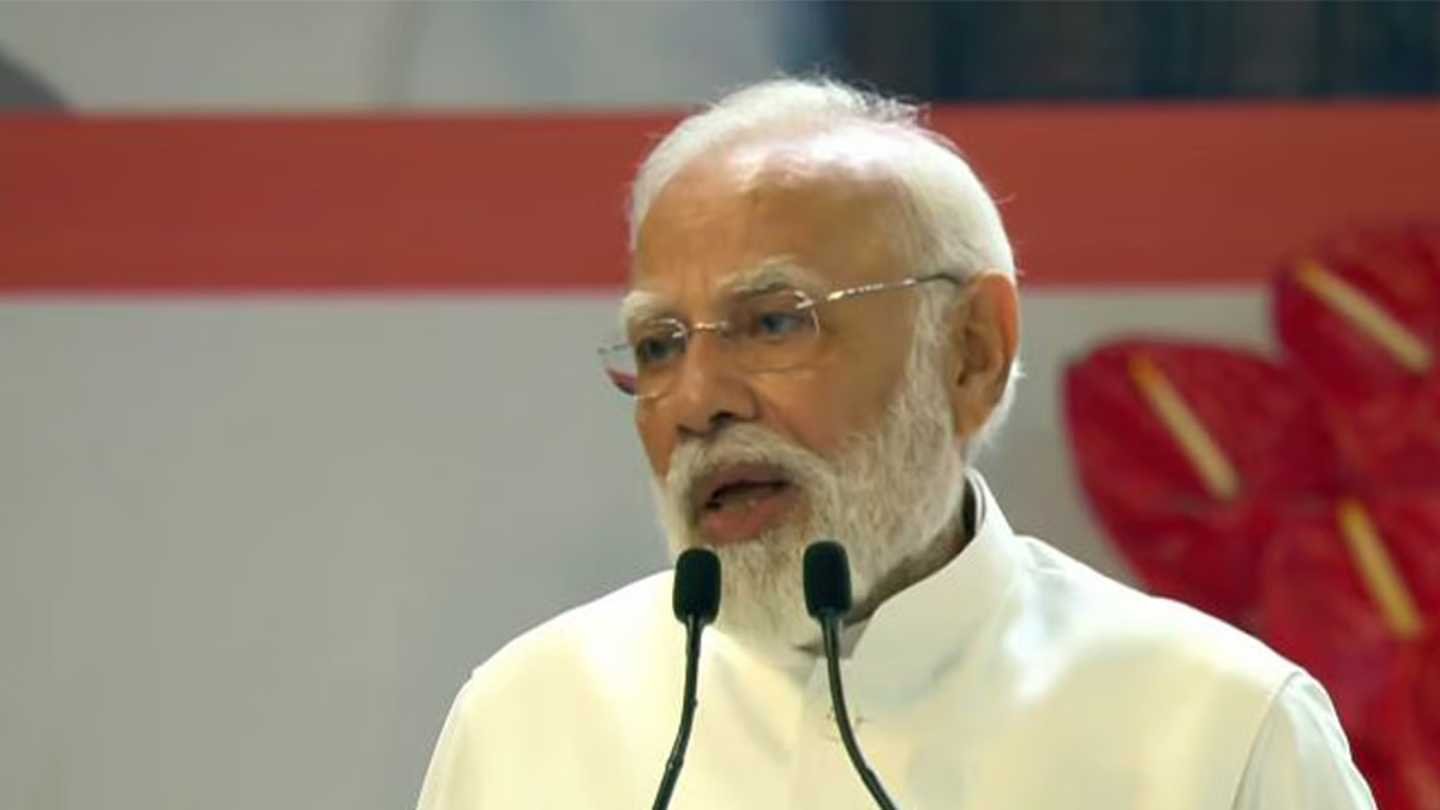
Prime Minister Narendra Modi has launched a strong attack on the Congress party, accusing them of omitting crucial stanzas from the national song ‘Vande Mataram’ and thereby, sowing the seeds of partition. Speaking at a recent public rally, Modi asserted that the Congress had deliberately downplayed the significance of the song’s complete version, which, according to him, embodies the spirit of Indian unity and patriotism. This accusation comes amidst heightened political tensions as the nation gears up for upcoming elections.
Modi’s statements have ignited a fresh debate over the historical context and political interpretations of ‘Vande Mataram.’ He stated that the Congress’s alleged actions were a disservice to the nation’s heritage and a deliberate attempt to appease certain factions, ultimately contributing to the divisive atmosphere that led to the partition of India. The Prime Minister emphasized that the complete version of the song reflects the diverse cultural tapestry of India and its unwavering commitment to national integrity. The ruling party has frequently invoked nationalist sentiments in its political campaigns, positioning itself as the sole protector of India’s cultural and territorial integrity.
Historical Context
‘Vande Mataram,’ composed by Bankim Chandra Chatterjee, played a significant role in the Indian independence movement. Its powerful verses, celebrating the motherland, served as a rallying cry for freedom fighters. However, the song’s association with Hindu nationalism has also made it a subject of controversy, with some minority groups expressing reservations about its compulsory recitation. The Congress party, during its time in power, often navigated a delicate balance between promoting national symbols and addressing concerns about inclusivity.
The Prime Minister’s allegations suggest a renewed effort to highlight historical grievances and underscore what his party perceives as the Congress’s flawed approach to nation-building. He argued that the Congress’s selective adaptation of ‘Vande Mataram’ was not an isolated incident but rather a pattern of compromising on core national values for political expediency. This narrative aims to resonate with voters who prioritize a strong sense of national identity and view any perceived dilution of cultural symbols as a betrayal of India’s heritage.
Political Ramifications
The Prime Minister’s remarks are expected to further polarize the political landscape, particularly during the election season. The Congress party is likely to defend its historical record and accuse the BJP of distorting facts for political gain. Opposition leaders have already begun to criticize Modi’s statements as divisive and misleading, accusing him of exploiting historical sensitivities to consolidate his voter base. The controversy surrounding ‘Vande Mataram’ is likely to intensify in the coming weeks, with both sides presenting their perspectives and interpretations of historical events. The debate serves as a reminder of the complex and often contested nature of national symbols and their role in shaping political discourse.
The BJP is likely to use this issue to reinforce its image as a party committed to preserving India’s cultural heritage and upholding national unity. Meanwhile, the Congress will face the challenge of countering these accusations and presenting a more inclusive vision of Indian nationalism. The unfolding controversy underscores the enduring power of historical narratives in shaping contemporary political debates and influencing voter perceptions.
Image Source: Google | Image Credit: Respective Owner