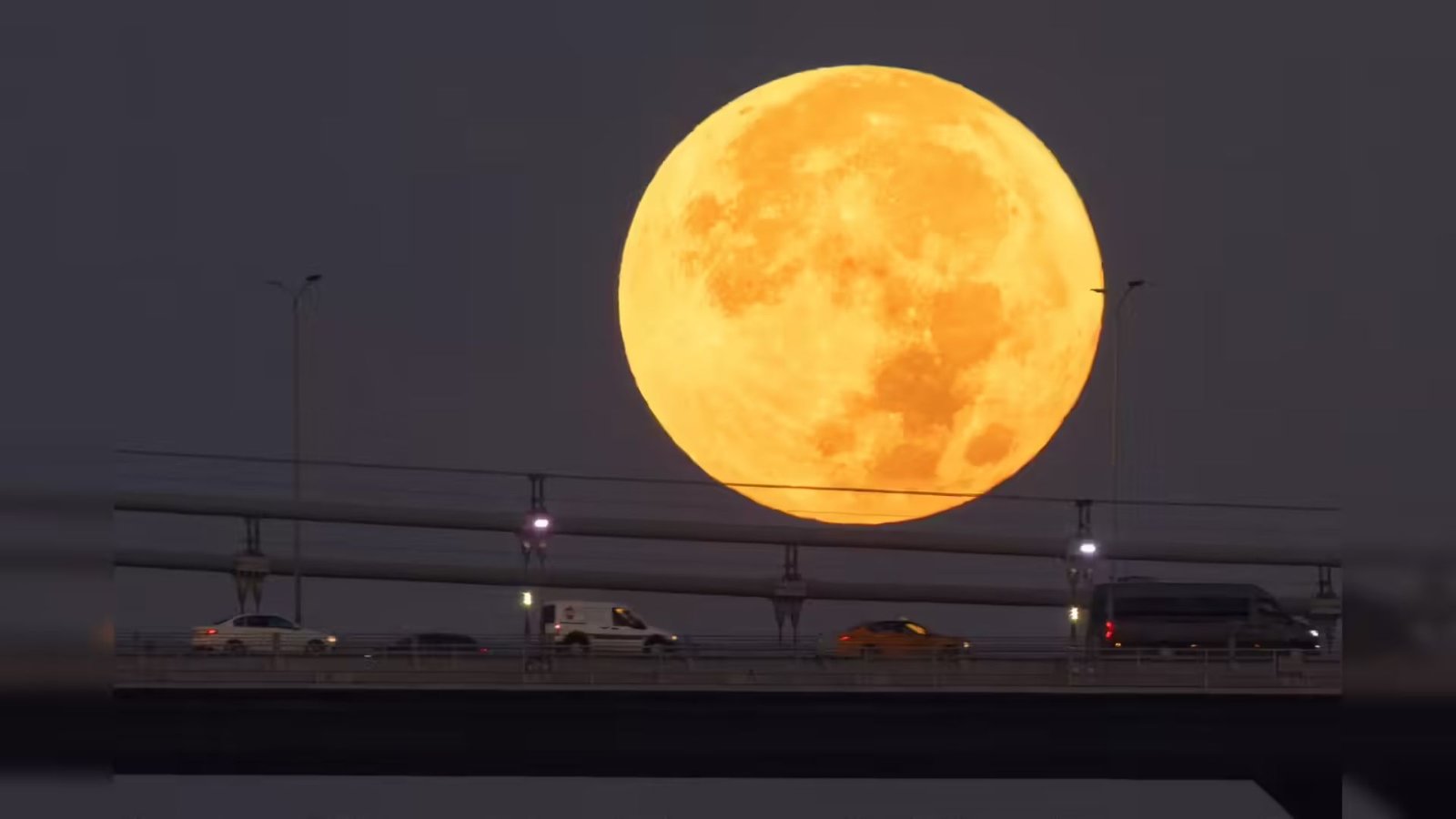
The celestial stage is set for a breathtaking astronomical event as the largest supermoon of 2025 is poised to grace the night sky on November 5. Skywatchers across the globe are eagerly anticipating this spectacular display, which promises to be a truly awe-inspiring sight. A supermoon occurs when a full moon coincides with the moon’s closest approach to Earth in its elliptical orbit, known as perigee. This proximity makes the moon appear significantly larger and brighter than usual.
This particular supermoon in 2025 is expected to be the closest and brightest of the year, offering an unparalleled opportunity for observation and photography. Experts predict that the moon will appear approximately 14% larger and 30% brighter compared to a typical full moon. The increased luminosity will cast an ethereal glow across the landscape, creating a magical ambiance for those who venture out to witness the event.
Optimal Viewing Conditions
To fully appreciate the grandeur of the supermoon, it is recommended to find a location away from city lights and other sources of artificial illumination. Darker skies will enhance the contrast and allow for a more detailed view of the lunar surface. Coastal areas, mountaintops, and open fields are often ideal locations for stargazing and supermoon viewing. Bringing along binoculars or a telescope can further enhance the experience, revealing intricate details of the moon’s craters, mountains, and valleys.
The exact timing of the supermoon will vary depending on your location, so it is advisable to check local astronomical resources or websites for precise information. Typically, the best time to view the supermoon is shortly after moonrise or just before moonset, when the moon is closer to the horizon and appears even larger due to an optical illusion. During these times, the moon’s warm, golden hue can also be particularly captivating.
Scientific Significance
Beyond its aesthetic appeal, the supermoon also holds scientific significance. Its increased gravitational pull can cause slightly higher tides than usual, known as spring tides. While these tidal variations are generally not dramatic, they can be of interest to coastal communities and researchers studying tidal patterns. Furthermore, the supermoon provides an opportunity for scientists to study the moon’s surface composition and reflectivity under enhanced lighting conditions.
As November 5, 2025, approaches, anticipation is building for what promises to be a truly unforgettable celestial spectacle. Whether you are an avid astronomer, a casual skywatcher, or simply someone who appreciates the beauty of nature, the largest supermoon of 2025 is an event not to be missed. Mark your calendars, find a dark location, and prepare to be mesmerized by the luminous glow of our celestial neighbor.
The event serves as a reminder of the vastness and wonder of the universe, inviting us to look up and contemplate our place within the cosmos. It is a chance to connect with the natural world and appreciate the beauty that surrounds us, even in the darkest of nights. Don’t forget your cameras to capture the unforgettable scenes.
Image Source: Google | Image Credit: Respective Owner